The OF Blog

Tuesday, August 31, 2010

August 2010 Reads

Here are the books completed in August.  A lot of these are part of the Gollancz SF or Fantasy Masterworks series, so there are a bunch of reviews here and elsewhere already posted or will be written in the very near future.  Some are re-reads, but most are not.  I believe four languages (English, Spanish, Serbian, Portuguese) were read this month, with at least one book for each language.  And this is the infamous month of reviewing Goodkind, Stanek, and yaoi.  Now for the reads:

259  David Lindsay, A Voyage to Arcturus (re-read; already reviewed on SFF Masterworks blog)

260  Zoran Živković, Skrivena Kamera (Serbian; review in next month, I hope)


261  Zoran Živković, Cámera oculta (Spanish; see above)


262  Zoran Živković, Hidden Camera (re-read; see above)


263  Terry Goodkind, The Law of Nines (already reviewed)


264  Oliverio Girondo, En la Masmédula (Spanish; mindfuck poems)


265  Philip K. Dick, The Simulacra (already reviewed on SFF Masterworks blog)


266  George R. Stewart, Earth Abides (already reviewed on SFF Masterworks blog)


267  Jack Vance, Lyonesse:  Suldrun's Garden (already reviewed on SFF Masterworks blog)


268  Jack Vance, Lyonesse:  The Green Pearl (see above)

269  Jack Vance, Lyonesse:  Madouc (see above)

270  H.G. Wells, The First Men in the Moon (already reviewed)

271  Lucious Shepard, Life During Wartime (already reviewed)

272  Keith Roberts, Pavane (already reviewed)

273  Karel Čapek, R.U.R. (already reviewed)

274  Bisco Hatori, Ouran High School Host Club (already reviewed)

275  Yuiko Takamura, Caged Slave (already reviewed)

276  Brandon Sanderson, The Way of Kings (already reviewed)

277  Tim Powers, The Anubis Gates (already reviewed on SFF Masterworks blog)

278  Lord Dunsany, Time and the Gods (re-read; already reviewed on SFF Masterworks blog)

279  Kurt Vonnegut, Cat's Cradle (already reviewed on SFF Masterworks blog)

280  Tim Powers, The Drawing of the Dark (review forthcoming here)

281  Robert Stanek, Keeper Martin's Tale (already reviewed)

282  Mary Robinette Kowal, Shades of Milk and Honey (review in near future)

283  Fábio Fernandes, Os Dias da Peste (Portuguese; already reviewed)

284  Christopher Priest, Inverted World (already reviewed on SFF Masterworks blog)

285  Gustav Meyrink, The Golem

286  Kazu Kibuishi,  Flight:  Volume 7 (very good graphic novel anthology)

287  Sherri Tepper, Beauty (re-read; already reviewed on SFF Masterworks blog)

288  Ward Moore, Bring the Jubilee (already reviewed)

289  John M. Ford, The Dragon Waiting (already reviewed on SFF Masterworks blog)

290  Geoff Ryman, The Child Garden (review forthcoming here)

291  Walter M. Miller, Jr., Dark Benediction (review forthcoming on SFF Masterworks blog)

292  Olaf Stapledon, Last and First Men (review forthcoming here)

293  Karen Lord, Redemption in Indigo (review forthcoming here)


In Progress: 

Walter Tevis, Mockingbird

Miguel de Unamuno, Niebla (Spanish)

Imagining online reviewers and possible fictions they might write

There are several online reviewers who are either attempting to get their first fictions published or who are writers themselves.  Sometimes I find myself, when in a bit of silly daydreaming, associating these reviewers with certain styles of writing.  I thought it would be fun to list a few bloggers and what types of fiction I'd imagine them writing, then giving you the opportunity to add your own lists.  Here goes:


1.  Adventures in Reading - Short fiction pieces, something in the vein of an Elizabeth Bear or Sarah Monette.

2.  Neth Space - He'd totally update Kim Stanley Robinson's Mars trilogy, while continuing to downgrade Pluto, sadistic scientist that he is at heart!

3.  Pat's Fantasy Hotlist - He'd write Goodkind fanfic.

4.  A Dribble of Ink - He'd write Stanek fanfic.

5.  Temple Library Reviews - He'd write weird fiction concerning vampiric gerbils.

6.  Dark Wolf's Fantasy Reviews - He'd write urban paranormal romance fantasies starring wolves as phallic symbols.

7.  Jacques Barcia - alpaca MMA cage fighting stories

8.  Fábio Fernandes - Brazilian cyberpunk horror stories involving a moose, a chihuahua, and a panda bear.

9.  Paul Smith - Liggoti and Cisco-influenced children's stories.

10.  The Speculative Scotsman - He's speculating...about Mongolian deathworms.

11. Speculative Horizons - My Little Pony slash fiction

12. The Wertzone - Long philosophical tracts on the glories of the great Cookie Monster


There.  Do any of these match up with what you'd envision these blogger/writers actually writing?

Monday, August 30, 2010

Brandon Sanderson, The Way of Kings

Ever since 2005, when his first epic fantasy novel, Elantris, was released, Brandon Sanderson has been one of the more prolific authors, with three YA novels, the (for the moment) standalone Warbreaker, the Mistborn trilogy, and now the beginning of a planned ten-volume The Stormlight Archive series, The Way of Kings, not to mention his work completing the final three volumes of the late Robert Jordan's The Wheel of Time.  In previous commentaries on the Mistborn novels (linked to above), I spent some time praising Sanderson for some of his narrative choices, as well as noting a few perceived deficiencies in his writing, namely that of character interactions and dialogue, although I also noted that each of those novels showed a distinct improvement over what I found to be atrocious dialogue in Elantris.  When I began reading his most ambitious work to date, The Way of Kings, I was curious to see if Sanderson had continued to improve as a writer and as a storyteller.  For the most part, The Way of Kings continues to show Sanderson's development as a writer, although there are a few qualms that I have about the story itself.

The Way of Kings follows three distinct storylines, which until the end of this sprawling novel stay separate.  There is a conflicted old warrior storyline for Dalinar, as he begins to dream of conflicts four millennia in the past that contain elements that run counter to everything that he has believed in and fought for his entire life.  A second subplot is devoted to Kaladin, who is shown in both the "present" and in flashbacks several years before.  He dreams to be a surgeon, but ends up being a slave forced to participate in the most dangerous tasks in a near-perpetual war, that of pushing bridge across narrow chasms so the military forces of his slavers can cross to attack their non-human enemies.  The third plotline deals with Shallan, a daughter of an impoverished noble house who tries to dupe a sorceress and instead learns some secrets that threaten to overturn long-held beliefs.  Unlike his previous solo efforts, where the majority of each novel was devoted to a single character arc, this tripartite division means that the setting and the characters' interactions with the the realm of Roshar are much more complex than anything seen in Sanderson's earlier work.

Speaking of Roshar, it is obvious that Sanderson has devoted a lot of time and energy to creating a fully-realized setting.  There are a plethora of cultures, at least two magic systems on display (that of the Shardblades/Stormlight and Soulcasting), and a look at this burgeoning conflict between the fractured kingdom of Alethkar and the non-human Parshendi.  Unlike his previous novels, where there was a penchant to just dump everything out into the open and subject the reader to a series of infodumps to explain what is occurring, Sanderson displays a restraint here that serves to accentuate the moments of "magic" when they occur.  Sometimes, the better epic fantasies are all about the characters and their interactions with their settings rather than about the settings and those characters placed within them in order to have an excuse for showing off these settings.  As curious as the Roshar setting may be for those "worldbuilding" junkies who want to soak up the setting and its constructed powers, The Way of Kings succeeds as an opening volume because of the better-developed situations that these three main protagonists find themselves in.

Years ago on a now-deleted thread on Westeros, Sanderson and I had a discussion about his writing and what I perceived to be flaws in his approach toward developing the characters in Elantris.  I recall Sanderson mentioning that he is more of a prose minimalist, desiring to have the plot and action fill in the "gaps" left by the paucity of description and the brevity of character dialogue.  It was a very productive discussion, one that helped me understand some of what he was attempting to do with his fiction, but it does bear noting that Sanderson has improved on utilizing vignettes to develop his characters.  One particular scene struck me as being representative of Sanderson's progress.  Here Dalinar is talking with his dead brother's widow, a woman he had loved before his brother had discovered her:

Her hand was still on his arm.  She reached out with her safehand and closed the door to the hallway.  He almost stopped her, but he hesitated.  Why?

The door clicked closed.  They were alone.  And she was so beautiful.  Those clever, excitable eyes, alight with passion.

"Navani," Dalinar said, forcing down his desire.  "You're doing it again."  Why did he let her?

"Yes, I am," she said.  "I'm a stubborn woman, Dalinar."  There didn't seem to be any playfulness in her tone.

"This is not proper.  My brother..." He reached for the door to open it again.

"Your brother," Navani spat, expression flashing with anger.  "Why must everyone always focus on him?  Everyone always worries so much about the man who died!  He's not here, Dalinar.  He's gone.  I miss him.  But not half as much as you do, it appears."

"I honor his memory," Dalinar said stiffly, hesitating, hand on the door's latch.

"That's fine!  I'm happy you do.  But it's been six years, and all anyone can see me as is the wife of a dead man.  The other women, they humor me with idle gossip, but they won't let me into their political circles.  They think I'm a relic.  You wanted to know why I came back so quickly?"

"I - "

"I returned,"  she said, "because I have no home.  I'm expected to sit out of important events because my husband is dead!  Lounge around, pampered but ignored.  I make them uncomfortable.  The queen, the other women at court."

"I'm sorry," Dalinar said.  "But I don't - "

She raised her freehand, tapping him on the chest.  "I won't take it from you, Dalinar.  We were friends before I even met Gavilar!  You still know me as me, not some shadow of a dynasty that crumbled years ago.  Don't you?"  She looked at him, pleading.

Blood of my fathers, Dalinar thought with shock.  She's crying.  Two small tears.

He had rarely seen her so sincere.

And so he kissed her. (pp. 861-862)

This scene illustrates Sanderson's development nicely.  Whereas in earlier novels he might have had this just in dialogue and not inserted those small, subtle paralingual clues as to the characters' conflicted emotions, here in The Way of Kings he utilizes them to add depth to the characters.  No longer do the characters feel as though they are sketchy figures blurting out lines that ring hollow because of the lack of character development and scene "color."  The characters on the whole here display a "maturity" of development that was largely lacking in Sanderson's earlier stories and the three main plot arcs benefit tremendously here from this improvement in character sketching and development.

This is not to say that there are not weaknesses in The Way of Kings.  Due to the tripartite plot arcs, these arcs sometimes take hundreds of pages to develop toward anything approaching action.  Each requires its own setting and character development and as a result of the scene switching that takes place every few chapters, the narrative flow at times can feel a bit sluggish, particularly for the first half of this 1000 page novel.  This, however, is largely unavoidable due to the nature of the story and by the 3/4 mark, there is a lot more plot and character movement that makes for a comparatively faster-paced conclusion.  Although considering that this is an opening to a planned ten volume series, perhaps "conclusion" is not the best of words, as there are several intriguing developments that await further exposition and development in future volumes.  In addition, as improved as the characterizations are as a whole, there were still a few places where the character depictions felt a bit false.  I particularly noticed this with Kaladin's arc, as a few of his comments and reactions to events felt a bit too shallow and unsuitable for his character.  Perhaps Sanderson was aiming for more of a Spartacus or Ben-Hur vibe with his "well-to-do youth falls captive, is enslaved, and manages to rise up to fight for dignity" approach to Kaladin's character, but I was unconvinced a few of the times that Kaladin had interactions with others outside of his troop.  There was nothing spectacularly "wrong" with those few scenes, but rather this vague sense that something was "off" in the character and his interactions with his former "superiors."

The Way of Kings is a good, solid epic fantasy opener.  It will not wow its readers with spectacular battle scenes nor with its roguish characters, for that is not the intent of the tale.  It is a fine example of a conventional epic fantasy tale of discovery,  with characters becoming more aware of themselves and their environs.  It does not aim to be anything more than a well-told narrative and for the most part, it succeeds at reminding its readers of the better epic fantasies of the past thirty years or so.  Sometimes, all one wants to read is just a non-experimental tale that presents its conventional elements in an attractive format.  The Way of Kings succeeds at that and it will be an enjoyable read for those readers who desire a well-written "more of the same" rather than something completely novel to them.

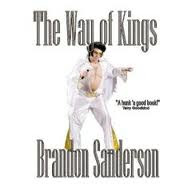
P.S.  That is not a limited-edition cover for the novel.  It is a tribute to the sadly-deleted former Amazon page for the book, created years ago due to a miscommunication.  The fake reviews were a riot, and I preserved two here.

It's odd seeing late comers to a party trying to refine that party, no?

I pose that question in my title because that perhaps best explains my puzzlement at seeing several blog articles over the past week or so trying to define what is/was the "New Weird" and trying to identify who writes that.  I suppose I should just supply links to the offending blogs before commencing with a dressdown, so here are the offenders:

Sensawunda (parts one and two)

The World in the Satin Bag


Literary Musings

Now onto the eviscerations.

After reading these four posts, I was left wondering "are these three blind men grabbing elephant parts and trying to make sense of it?" and "why the hell are they talking about an informal "movement" that mostly died off a half-decade or so ago?"  I remember when the actual term "New Weird" began to be discussed wildly, way back in 2002/2003.  It never was a formal movement; just try to name any of the particulars associated with it who ever had a full definition for the work.  If anything, such a term deals as much with conflicts and arguments rather than anything that could be ascertained with any sort of definitive stance.  Some people formerly associated with it pretty much despise the term today, while others have gone from outright objection to being placed under that shredded umbrella to being resigned to being associated with the term.  It seems to me that it is ridiculous for those who didn't witness those arguments or at least researched what was going down during the turn of the century to proclaim with any degree of certainty that authors X and/or Y are parts of the New Weird without at least acknowledging the controversies surrounding their association.

Added to that is the inclusion of some rather odd choices, such as writers (Mervyn Peake in particular) who had been dead for three decades before ever the term "New Weird" was bandied about.  The historical inaccuracies are a bit odd, to say the least.  Just wish more time, care, and research had been taken before some of the assertions made in those linked articles had been made.

That's not to say there aren't some interesting postulations there.  Discussing elements that may be common in the associated New Weird acts is something that is worthwhile.  I just don't know if this is anything more than placing a cart before a horse, considering that the very term "New Weird" perhaps needs to be defined better than what I have seen in those articles.  As someone who is ambivalent to the very term (I often put it in scare quotes) due to the lack of anything common about them in a way that perhaps the chronologically-oriented American Golden Age SF or the Anglo-American New Wave scenes are, I just don't know if there is anything that really can be said other than "the New Weird was a term loosely tied to several American and British writers around the turn of the 21st centuries whose multivariate influences shared a few commonalities in terms of interaction with previous literary and cultural movements."  I am hesitant to call it a "movement," much less a coherent one.  I certainly do not think it is a valid term for the new writers of the past five years or so; too many variations in story, theme, and literary style and influence.

Perhaps others will disagree.  Maybe some will come up with something more than hastily tossed-together authors whose associations lack much in the way of either rhyme or reason.  But until more cogent arguments can be made for the "New Weird" being anything more than an informal series of connections that never coalesced into anything resembling a real literary "movement," I just can't help but to reject the arguments presented in the linked posts above.

Edit:  It was kindly pointed to me that in discussing this, that I failed to mention the anthology The New Weird, edited by Ann and Jeff VanderMeer.  Although I had mentioned it in the Twitter discussion that preceded this post, it is a major, major brain fart on my part that I did not note that this anthology does contain not just samples of what usually is accepted as being NW, but it contains an introduction, found online, that discusses the term itself.  So perhaps I should be ready to accept what I might dish out as well?

As for my thoughts on the anthology, I did review it a couple of years ago.  Enjoyed it, agreed with most of the points made, just hesitant on a few others.  But yeah, leaving that out is rather bad and I'd rather just tack on an addendum/mea culpa than edit it in and pretend nothing had been left out unintentionally.

Sunday, August 29, 2010

Ward Moore, Bring the Jubilee

I was born, as I say, in 1921, but it was not until the early 1930s, when I was about ten, that I bean to understand what a peculiarly frustrated and disinherited world was about me.  Perhaps my approach to realization was through the crayon portrait of Granpa Hodgins which hung, very solemnly, over the mantel.

Granpa Hodgins, after whom I was named, perhaps a little grandiloquently, Hodgins McCormick Backmaker, had been a veteran of the War of Southron Independence.  Like so many young men he had put on a shapeless blue uniform in response to the call of the ill-advised and headstrong - or martyred - Mr. Lincoln.  Depending on which of my lives' viewpoints you take.

Granpa lost an arm on the Great Retreat to Philadelphia after the fall of Washington to General Lee's victorious Army of Northern Virginia, so his war ended some six months before the capitulation at Reading and the acknowledgment of the independence of the Confederate States on July 4, 1864.  One-armed and embittered, Granpa came home to Wappinger Falls and, like his fellow veterans, tried to remake his life in a different and increasingly hopeless world. (p. 1)

With the possible exception of World War II, the largest number of alt-histories centered around the events and personages of the American Civil War.  What if Lincoln had not been as "headstrong," as many of his detractors had noted?  What if Maryland and Missouri had voted to secede in 1861, cutting off Washington, D.C. and most of the Mississippi River from Union control at the war's outset?  What if Buell had not arrived in time at Pittsburg Landing?  What if "Stonewall" Jackson had not been shot?  What if Lee's general orders had not been rolled up in tobacco and dropped, only to be discovered by Union forces before Antietam?  What if the Confederate forces had occupied the Round Tops at the onset of the crucial Battle of Gettysburg? 

These are the sorts of questions that have haunted historians as well as citizens on both sides of the conflict.  Although, as I said in my earlier review of Keith Roberts' Pavane, I have a professional wariness of alt-histories, sometimes these works, if they revolve around more than just a single person or event, can add something to our understanding of the historical event or era in question.  Ward Moore's 1953 novel, Bring the Jubilee, deserves to be placed in this categorization of rewarding alt-histories.  Its combination of events, trends, and awareness of social dynamics raises it above the level of a mere "what if?" hypothesis, as there are some disturbing elements explored in this work that certainly apply to American society of Ward's time and perhaps for our own as well.

Bring the Jubilee is written in a first-person, pseudo-autobiographical format.  The narrator, the young Hodgins M. Backmaker, born in 1921, narrates life in the defeated Union almost a century after its defeat at the hands of the Confederacy.  As a native Southerner who grew up hearing tales of the "Lost Cause," Moore's transference of the mixture of guilt, anger, and emotional depression from the gutted South to an imagined defeated North rings true.  From the KKK analogue, the Grand Army, to the widespread, deep economic recession that wipes out all of the early proto-industrial developments in the North during the antebellum period, the Civil War, now known as the War of Southron Independence rather than the War of Failed Southern Independence, has come to hold the same level of bitter significance for the Yankees as the Civil War has had in the South in reality. 

Moore also does a very good job extrapolating from the conditions he alters.  From the horrid treatment of African Americans in the Union (comparisons are made in a few places in the text to the Jewish Pogroms of the early 20th century) to the anti-immigration initiatives to the Confederate conquest of Mexico in the late 1860s, these events feel all the more "real" because of how well Moore hints at the root social causes:  scapegoats for the defeat, the need to appease the stronger powers around the shrunken Union, to the desire of the Confederacy to expand in order to preserve its polity and power. 

As strong as Moore's social historical extrapolations might be, some readers may find his narrator to be almost too invisible in the background.  Backmaker, as a historian, serves the narrative point of detailing the alt-history that has unfolded.  He is a witness, not an active participant, for most of the novel.  This narrative "invisibility," while it serves to accentuate Moore's imagining of how events could have unfolded differently, does make it more difficult later on in the novel when Backmaker becomes involved in a physics experiment in the 1950s that ends up with him playing a much more decisive role in the "Jubilee" than what had transpired for the first 80% or so of the novel.  This shift in the narrator's importance to the overall story was a bit abrupt, but yet it does circle back to a part of the introductory chapter that I chose not to quote.

Bring the Jubilee's strengths far outweigh its negatives.  Far from being a simple "what if?" alt-history, it is a well-considered, well-constructed argument for how social attitudes could change in the light of military defeat.  His defeated United States feels very plausible and the related world events around this time fit comfortably with Moore's takes on people, their fears, their desires not to rock the socio-political boat, and so forth.  Although the final two chapters may feel awkward in comparison to the first, Bring the Jubilee certainly is one of the finest alt-histories that I have read, one that is well suited to the "masterworks" label attached to its Gollancz edition.

Saturday, August 28, 2010

Keith Roberts, Pavane

On a warm July evening of the year 1588, in the royal palace of Greenwich, London, a woman lay dying, an assassin's bullets lodged in abdomen and chest.  Her face was lined, her teeth blackened, and death lent her no dignity; but her last breath started echoes that ran out to shake a hemisphere.  For the Faery Queen, Elizabeth the First, paramount ruler of England, was no more...

The rage of the English knew no bounds.  A word, a whisper was enough; a half-wit youth, torn by the mob, calling on the blessing of the Pope...The English Catholics, bled white by fines, still mourning the Queen of the Scots, still remembering the gory Rising of the North, were faced with fresh pogroms.  Unwillingly, in self-defence, they took up arms against their countrymen as the flame lit by the Walsingham massacres ran across the land, mingling with the light of warning beacons the sullen glare of the auto-da-fé. (p. vii)

As a historian, particularly one who concentrated on cultural and religious history, I am very wary of any work of alt-history that introduces radical changes from a simple "what if?" scenario.  It is not because I think such speculations are fruitless.  After all, not much would be accomplished in historical studies if such questions were not asked daily of almost everything.  Rather, it is the sense that for many, perhaps for the authors as much as the readers of such alt-histories, there is a distortion that occurs whenever a focus is shifted to a singular person or event.  Unfortunately for me, Larry as Reader, whenever I have to confront these questions of possible historical distortion in a story, Larry as Historian intrudes upon the Reader/Text/Author interpretation triangle, muddying the waters of story analysis.

This certainly was the case with my recent reading of Keith Roberts' 1968 novel, Pavane.  Roberts certainly crafted a stirring beginning, as indicated by the first two paragraphs of his two-page prologue that introduces the vastly-altered 20th century setting.  The year 1588 certainly was a momentous occasion, as some date from it England's rise to international prominence, a position it maintained until the end of World War II.  There certainly were precarious conditions within the country, as Roberts does note, as well as conflicts with Spain and to a lesser extent, France.  But there are a host of other issues, ranging from social divisions that ran deeper than the newly-formed religious factions to the already well-developed sense of English nationalism, that make it difficult for this reader at least to accept that there was a blithe acceptance of the posited Armada conquest and the full and total restoration of the Catholic Church in England.

Sometimes reviewing a work means that the reviewer has to review his or her own biases and attempt to quell them, if they cannot be suspended for the duration of this piece.  For the most part, once I accepted that there was going to be a dissonance between my understanding of history and what Roberts uses as a catalyst for his story, I was resigned to the fact that I would be battling myself in an attempt to enjoy this story and to appreciate what Roberts does accomplish with his six interconnected stories and a brief coda.  Despite my misgivings about the rationale behind such an alt-history and despite my puzzlement over some of the implications of the imagined alt-choices that Roberts highlights, there are things of value within this story.

Most of the action of these stories takes place in the early to mid-20th century.  The Catholic restoration has been in place for nearly four hundred years, not just in England, but also in the formerly Protestant German states.  Technological advancements have mostly been halted, although there are some curious analogues to the Industrial Revolution.  The guild system is still largely intact and the populace has been redivided into ethno-linguistic lines (a restored Norman French, Middle English (!), Modern English, Welsh, Scots, Scottish Gaelic, and Latin are now the languages of Court and People).  There is steam transport, but the use and power of it is heavily regulated.  Learning is concentrated in the hands of the few, and the Papacy has as much influence as in the days of Innocent III.  It is an alien world to us, one that frankly seems unrealistic considering the developments in Catholic countries during the 15th-18th centuries (not to mention that of the Protestant-controlled regions during the same time), but the key to these stories is not to focus so much on the backdrop, but instead on the characters' interactions with this alt-environment. 

Roberts' characters shine in the stories contained within this narrative collection.  With very few characters appearing in more than one story, each of the characters that do appear in these stories typically find themselves confronting the world around them, questioning the order of things and in some cases, wondering about these apparently mystical "old ones" that appear on occasion, hinting at a different reality.  Roberts doesn't rush the telling of these stories; he allows the characters to "breathe" and to express their hopes and fears in such a fashion that the reader becomes more drawn to unraveling those little connections between the stories.  The prose is very well-constructed, as few words are wasted and everything builds up to a strong conclusion in the Coda.   If the reader can accept the plausibility of the narrative overarching the individual tales presented within it, Pavane can feel just like the slow, intricately-constructed dance after which the book is named.

But that is the key issue here.  Can the reader suspend his or her disbelief enough to enjoy the rich tapestry of stories?  For myself, I struggled throughout.  I did appreciate how well Roberts constructed his stories; I just could not accept the premise.  Even with the revelations at the end that overturned some of the conceits found within the linked stories, I found myself thinking far too often "this just is not plausible enough!" for me to gain full enjoyment out of it.  However, this is a highly individualized reaction and I could see for those readers who want well-constructed stories with interesting characters and prose that makes their concerns feel vivid and "alive" where Pavane would be just the sort of story for them.  Recognizing that a work may be a "masterwork" does not mean that one has to "like" it, of course.  For me, Pavane was a book whose merits were partially obscured by my own biases and skepticism about the premise behind the stories contained within it.  Those biases and skepticism were never fully overcome, thus lessening my enjoyment, if not my appreciation, for this work.

Friday, August 27, 2010

Biblical Terror and Other Weird/Punkish Book Porn


Eight books have arrived this week that I think might be of some interest to readers here.  Notice the groovy 1969 cover art for the Ballantine Adult Fantasy edition of Fletcher Pratt's The Blue Star.  I'm looking forward to reading Gail Carriger's third novel in her The Parasol Protectorate series.  Very witty writing.  This sounds intriguing, to say the least.  And a book on fairy tales that arrived today.


Heard some very good things about Robert Irwin, so I thought I'd try his The Arabian Nightmare.  In the middle is a review copy of an October 2010 release, She Naied a Stake Through His Head:  Tales of Biblical Terror.  Intriguing.  And then there's Raymond Queneau's 1940s novel, Saint Glinglin, that seems to be quite promising already a chapter into it.


My tenth translation/edition of one of my favorite stories arrived today.  Now I have French, English, Spanish, Latin, German, Catalan, Italian, Serbian, Hungarian, and Portuguese editions of The Little Prince, second only to my collection of Bibles in various languages.  Oh, and there's this steampunkish anthology that arrived a couple of days ago.  Anyone think it is worth reading?

So...which one of these books seems to be the "weirdest" to you?  Which one(s) would you most like to read?
 
Add to Technorati Favorites