The OF Blog: Brandon Sanderson
Showing posts with label Brandon Sanderson. Show all posts

Friday, May 16, 2014

Brandon Sanderson, Words of Radiance

I don't know if it's true for every reader, but for myself, every so often there is an author and/or work that comes along that despite a host of flaws and shortcomings, somehow manages to capture my attention just enough for me to read the next volume.  No, this isn't like the few times that I've reviewed a book by the likes of Terry Goodkind or Robert Stanek, where the whole point of the "reviews" was to unload both barrels into something that I found to be unadulteratedly putrid on both prose and thematic levels.  Instead, there is a sense that underneath the tedium of overextended metaphors and labored scene descriptions that there might lurk something that might be developed to better effect in a future novel.

This certainly has been the case with my previous encounters with Brandon Sanderson's non-WoT work.  Despite finding his debut novel, Elantris, to be a chore to read, I was persuaded to read his Mistborn trilogy and largely found those three novels to be light, quick entertainment.  His latter novels in his larger Cosmere setting, Warbreaker and the first volume in the planned 10 book The Stormlight Archive series, The Way of Kings, were not as enjoyable, although there were moments that intrigued me.  Sanderson's prose, which I have commented at length in prior reviews, had at least incrementally improved to the point where his characterizations and dialogues were at least inoffensive and not as groan-inducing as was the case when I read Elantris nearly ten years ago.  It has been four years since I last read one of his non-WoT novels, with only the novella The Emperor's Soul (which might be his best-written work, despite the problems I had with it; I seem to have a more favorable impression 17 months later than when I wrote my review) read in the interim.  Therefore, it was with a mixture of trepidation and curiosity that I recently read the second The Stormlight Archive novel, Words of Radiance.  Naturally, that mixture of boredom and anticipation that I mentioned above applies just as well for this book as for most of his earlier works.

The story picks up very soon after the events of The Way of Kings, as the three main protagonists of that novel, Kaladin, Dalinar, and Shallan, as they continue along plot arcs developed in the first novel.  Sanderson depicts their stories, along with a host of others (mostly through interlude chapters), in a series of alternating chapters.  Although Sanderson for the most part manages to keep the focus grounded with these three, there are already signs of expansion toward a much larger narrative.  This is to be somewhat expected, considering that apparently this ten-part series is one of the key linchpins to the larger Cosmere mega-narrative and that certain characters/settings from his earlier (and future) novels/series will make at least cameo appearances.  Yet there is a trade-off for having this expansion of both setting and PoV character list, as all-too-frequently the narrative energy grinds to a crawl for huge stretches of this nearly 1100 page novel.  There are a lot of complicated parts already and like its predecessor, Words of Radiance, feels like a half of a huge (2,000 page) introduction that barely manages to establish the narrative stakes before it concludes.  Perhaps in the next three volumes (I believe this ten-part series is further sub-divided into two sub-series of five novels) the painstaking devotion to seemingly minute details will pay dividends.  For now, however, it just feels like a bloated introduction that could have been quartered without any loss in set-up or detail.

This sense of bloat carries over into the descriptions.  While there are at least some attempts to develop major and minor characters alike, there are times where Sanderson seems to get in way of himself.  Here is a scene from early in the novel that illustrates well many of the problems with his writing:

Oathbringer.  It was Dalinar's Shardblade – curved, like a back arching, with a hooklike tip on the end matched by a sequence of jutting serrations by the crossguard.  Like waves in motion, peeking up from the ocean below. 
How often had he lusted for this weapon?  Now it was his, but he found the possession hollow.  Dalinar Kholin – driven mad by grief, broken to the point that battle frightened him – still clung to life.  Sadeas's old friend was like a favored axehound he'd been forced to put down, only to find it whimpering at the window, the poison having not quite done its work. (pp. 88-89)
I love similes and metaphors within descriptive passages.  If used correctly, they can strengthen readers' visualizations of what is transpiring or make even bizarre scenes more easily relatable.  Yet here the similes feel forced.  "Curved, like a back arching"?  It just doesn't work for me.  The "waves in motion" simile was better, although it too feels too garrulous for the scene's needs.  As for the simile of the favored axehound, I'll just leave that with a simple shaking of my head.  If it weren't for the fact that similar issues arise frequently over the course of the novel, I might dismiss this as a singular false note.  Unfortunately, it is a false note that blares repeatedly throughout the narrative.

A good plot can lead the reader to forgive much.  In fact, there is just enough plot advancement here that by the final 157 page part, the action captured my wandering attention.  Sanderson depends upon the "clicking together" of certain plot mysteries for his plots to work and here in Words of Radiance, after several hundred pages of slow-developing, oft-tedious character interactions and plot development, the final section manages to tie these elements together at last and create at least the semblance of rousing action.  While nothing in this section is truly original (there are echoes of older works here), Sanderson does manage to make the action interesting enough that by the time the final page was read, I found myself vaguely curious about what is about to transpire.  This final scene is perhaps one of the better volume conclusions that Sanderson has written and despite my near-antipathy for many of the novel's component elements, I am curious enough that I will read the third volume whenever it is released.  Words of Radiance might belie its lofty title (one based on a fictional book mentioned occasionally in the narrative), but for those readers who enjoy recent epic fantasies more than I do, it may prove to be the belated start to the real overarching Cosmere narrative.

Tuesday, December 24, 2013

Best (Worst?) of 2013: Five Disappointing Releases

In writing a series of posts regarding the "best" of this passing year in a variety of categories, I debated for some days whether or not to write a post dedicated to those new releases that I read which were either execrable reads or were so flawed in some form or fashion that they did not live up to my modest expectation of entertaining me.  Some of these works others will find to be good or even excellent reads.  Others likely will gender a response of "why the hell did you read that dreck in the first place?"  But a "failure rate" of roughly 5% (5 out of slightly over 100 2013 US releases read, with another 25-50 being a mass of decent to solidly good tales that left only fleeting impressions and nothing truly indelible on my memory) is not too bad, I suppose.  Anyway, here are the five whose stories not only failed to capture my attention, but which left me feeling at least wistful about the time lost to reading/reflecting upon them:

5.  Wendy Lower, Hitler's Furies:  German Women in the Nazi Killing Fields 

See the link above for the original review, but this excerpt summarizes many of my disappointments with the study:

The sources included in the endnotes is impressive.  Although I haven't kept up with the literature since late 1997, there are a wealth of studies on the issues of women in the Third Reich and roles of women in the Holocaust that appear to be promising reads.  Yet within the body of her study, Lower rarely mentions any of these other historians and their contributions to the field.  Perhaps this is due to Hitler's Furies being marketed more to a general audience than toward an academic one, but ultimately this leads to the sense that Lower's narrative is detached too much from the debates that historians have had on this subject over the past six decades.  While it may be understandable that Lower wants to avoid the old Intentionalist/Functionalist debate regarding the level of intent that the decision-makers had in beginning the Final Solution, the book suffers because there is insufficient grounding of her arguments within the context of larger discussions of the Holocaust's beginning, mechanics, and how its perpetrators justified their actions.  Even the women involved seem at times acting within a narrative vacuum; there is not enough explanation to cover their myriad actions.
Yet despite these serious issues that I have with Hitler's Furies, it is a book that at the very least presents vividly-described actresses and whose discussions at least point the way to possible future paths of exploration within the field.  It is a flawed work, but for non-historian readers curious about the time period, it certainly is a work that will appeal to them.  For many historians of the period, however, Lower's work may be frustrating in the sense that it seems that with just more focus on placing her work within the context of current historiography, her work could have been as important as those of Ian Kershaw and Browning in discussing the mindsets of those involved in the Shoah.  The arguments on complicity and the forms in which it took here will continue to rage on.
 4.  Karen Lord, The Best of All Possible Worlds

I bought Lord's second novel on the basis of her strong debut novel, Redemption in Indigo.  Yet when I read it soon after its February 2013 release, I found myself being distracted too frequently while reading the narrative.  There just was no "spark," nothing that interested me, as the setting had too many parallels with prior SF landscapes, the characters were earnest yet lacking in vitality, and while the prose wasn't horrendous, neither did it sparkle with wit, verve, or anything that might have given me a reason to pay closer attention.  The result was a narrative that didn't appeal to me, leaving me then (and now,  months after I traded the book in at the local used bookstore for others) so disinclined to think about its themes that I chose not to write a formal review about how disappointed I was with Lord's sophomore effort.

3.  Ann Leckie, Ancillary Justice 

I reviewed this earlier this month and there is little that I would add to that review other than to note that my disappointment stems from the rare case where I tried a book despite my misgivings about the book's premise due to the enthusiastic praise of others.  I suppose in her presumed desire to write a "gender-positive" account that Leckie just failed to make her debut novel a "prose-positive" or "dynamic character-positive" one as well, as the blandness of virtually everything but her underdeveloped theme of the artificiality of gender divisions just left me cold to the pedestrian narrative.

2.  Robert Jordan and Brandon Sanderson, A Memory of Light 

I wrote a detailed review as to why this bloated concluding volume was a major disappointment to me, considering that at one point (well, back in the late 1990s) I enjoyed reading the WoT novels, that any more commentary would just rehash what was stated earlier.  Although I will admit that livetweeting this book back in January (using the hashtag "#WoTTF") did give birth to one of my better literary putdowns:  "non-erotic pornography."

1.  Terry Goodkind, The Third Kingdom 

This is the most disappointing 2013 release read, not because I had any hopes that it would be good, but because I lost a trusted Serbian reading squirrel due to this crap.  Damn good one, Stefan was.  He still is missed, as I have yet to attempt reading another epic fantasy until I can find a suitable replacement.

So there we have it, five disappointing releases, each for different reasons (5:  professional wish for more analysis of sources; 4:  weaker sophomore effort; 3:  too high of expectations based on others' proclamations; 2:  disappointed nostalgia of a former perhaps-fan; 1:  the toil caused by reading the book).  Any thoughts on these five books or any disappointing 2013 releases that you have read this year?

Friday, January 11, 2013

Robert Jordan and Brandon Sanderson, A Memory of Light

After nearly 23 years and countless millions of words vomited out upon thousands of pages, Robert Jordan's The Wheel of Time series finally concludes with its 14th volume, A Memory of Light.  It has been a memorable series for those who've read, it albeit for some such as myself, it has become more an exercise in patience and restraint, waiting to see if the payoff justifies to any extent the laborious parsing of repetitive descriptions, redundant sentences, clothing and furniture porn, hackneyed villain motivations, etc.  My own opinion of the series has fluctuated between a diversion during my last semester of grad school in the Fall of 1997 (it was a change of pace from reading Hitler's memoirs and speeches for my grad seminar/research) toward it being a repetitive, poorly structured (and written) clunker of a novel/series.  Three years ago, I wrote a series of posts on re-reading the Jordan-penned books, most of them for the first time since the release of the ninth book back in November 2000, and the re-reads did little to improve my deepening dislike for the series.  Yet the first semi-posthumous release, co-written by Brandon Sanderson, I thought at first was a marked improvement.  That was before I began to understand while reading the second co-written volume, Towers of Midnight, that the planned three-volume conclusion to the WoT series was terribly flawed in terms of narrative structure, characterization development, and prose.  Therefore, it was with some trepidation that I ordered A Memory of Light and read it over the past three days.  Unfortunately, it is one of the worst-written books in a series renowned for its mediocre, bloated prose.

In reviewing A Memory of Light, many references will be made to the series as a whole and to specific plot/prose points, as the WoT series is designed as much to be a single "novel" (one that consists of over 3 million words) as anything else, as there is not as many episodic "closing points" vis-à-vis other massive epic fantasy novels of recent years.  As a conclusion to WoT, A Memory of Light at first glance would seem to meet fan/reader expectations:  there is a lot of action and movement, plus several characters have their arcs come to a close.  Those who enjoy hundreds of pages of "battle scenes," with good and evil characters pitted at each other in a series of personal and group duels, doubtless will be thrilled to know that there's a single chapter of nearly 200 pages that covers much of the fighting.  Those who wrote "theories" about possible plot foreshadowings almost certainly will be excited at which of their predictive guesses came true and which ones had surprising conclusions.  In other words, those who read the series in order to place themselves as a sort of textual sleuth will find much more to like from this book than those who read books in order to enjoy the writing and the development of narrative, scene, and characters.

If The Gathering Storm and Towers of Midnight suffered because of an unwieldy narrative that saw massive time jumps (including scenes in consecutive chapters that were separated by nearly a month's worth of narrative time; some characters would have done something in one scene while in the next they would have no knowledge of it, since that was in their "future"), A Memory of Light suffers from an odd compression/expansion of character action and dialogue that makes it difficult at times to focus on what is transpiring.  For example, the first 250 pages or so of this massive 909 page novel are devoted to pre-planning for the prophesied "Last Battle," with prior ally fault lines discussed in detail yet once again, only for there to be sudden mini-conclusions that make the events feel extraneous.  There is a nasty habit throughout the series for the author(s) to re-explain what had already been covered previously.  Scenes such as the one below, when the main leader, Rand al'Thor confronts in a dream his ancient foe (and apparently suddenly his old friend; this development is one of many that is not satisfactorily explained), have their narrative power weakened considerably with reiterations of previously-discussed things:

Moridin, like many of the Forsaken, had usually entered Tel'aran'rhiod in the flesh, which was dangerous.  Some said that entering in the flesh was an evil thing, that it lost you a part of your humanity.  It also made you more powerful. (pp. 135-136)

Jordan/Sanderson (from what I can tell, the majority of the first 2/3 of the novel is Sanderson's writing) devotes too much time to reiterating past statements.  If WoT is to be viewed, as Jordan apparently wished, as a multi-volume novel, then its overuse of description weakens the effect of scenes considerably.  Instead of having this antagonist represent his threat through simple action, the author(s) instead have decided that it is best to have the PoV character think yet once again about the situation.  While some might believe that this reinforces certain narrative events/character traits, what happens in most cases is that the character is stripped of his/her ability to convey a true sense of urgency because s/he has now slipped into a mini-soliloquy that detracts from the scene itself.  If this were even only an occasional matter, it would not be too great of a hindrance, but it happens so frequently that it greatly wounds the narrative flow, reducing the internal action of the first half of the novel to a herky-jerky, sputtering mess.

Yet by roughly the halfway point, the narrative changes as the series of conflicts finally bubbles over.  The bloated expansion of character monologues within their interactions with others is reduced, yet a curious reversal takes place.  Due to the authors' development of dozens of subplots and characters, the narrative tries to focus on a whole slew of angles on four different battlefields stretching over a few weeks' time.  The problem with that is that a great many of these get quick, cursory resolutions (usually death or maiming) that do not justify the great amount of time spent on them throughout the series.  While it could be argued that these numerous subplots are necessary in order to underscore the main thrust of the Dark One/Dragon Reborn duel, that of the will to fight, the narrative would have benefited if it had been pared down to a handful or less other PoVs during the final 1/3 of the novel.  There is an attempt at pathos, yet it falls well short of its potential because despite all of the verbiage spewed throughout the series, so many of these characters lack any true sense of character.  Doubtless some will disagree and say that Characters X, Y, and Z moved them to laughter and/or tears, but can the same be said for the whole cast of hundreds?  It is understandable that the authors compress these character thoughts/actions into shorter (often a paragraph or two moments) segments during the battles themselves, yet the end result is this unevenness of characterization that weakens the intended effect when several of them die.

It certainly does not help that the prose is perfunctory at best.  Sanderson is not a gifted stylist, but having to work within the constraints of Jordan's clunky prose does him no favors here.  Too often, he tries to capture the essence of Jordan's prose by emulating his detailed descriptions, but scenes such as the death of Gawyn suffer because the attention to scene detail detracts from the emotional aspect:

Somehow Gawyn managed to push himself up to his knees.  His heart cried out; he needed to return to Egwene.  He began to crawl, blood mixing with the earth beneath him as it seeped from his wound.  Through eyes clouded with cold perspiration, he spotted several cavalry mounts twenty paces ahead, poking at blackened tufts of grass at their feet and tethered to a picket-line.  After minutes of struggle, an impossible interval of time that left him drained, he pulled himself up on to the back of the first horse he could reach and untether.  Gawyn hunched over, dazed, grasping its mane in one hand.  Summoning his remaining strength, he kicked his heel into the animal's rib cage. (p. 664)

To some, this might be acceptable, because it sets up the area around him and his struggle to live, but what happens in this scene and others is a reduction of the human struggle to a background element.  There is no exploration of his thoughts, no insight into his character, no sense of regret over the foolish actions that led to a foolhardy duel.  Instead, this paragraph is to serve as a commentary on Gawyn's after-fight state, as the scene immediately shifts to another part of the battle.  The chance of revealing more of his character through his futile fight to live is lost by the division of the main fight scenes into a lengthy, nearly 200 page chapter that does little besides emphasize the chaotic nature of fighting.

Many more examples could be cited here of the authors' questionable choice of using overly detailed scene descriptions to serve in place of real, actual character development.  However, there is the risk of losing sight of the novel's other structural issues, that of how A Memory of Light is developed as a singular novel.  As a last volume in a series, its true beginning lies within the previous 13 novels, yet its form is that of a stilted 250 pages of pre-battle scenes followed by quick action scene after quick action scene.  There are few good transitions; all are swallowed by the quickly-shifting PoV perspective moves, causing the narrative to lurch and stop-and-start its way forward, as certain strands are lost for 50 pages or more before resurfacing briefly.  There is no elegance to it, nothing that feels smooth.  Of course, some might argue that this is precisely the point when it comes to depicting a violent conflict, yet here in A Memory of Light, there is little actual movement beyond the fight.  It means so little, outside of the scenes involving the Dragon Reborn's duel.  Compared to the final Malazan Book of the Fallen novel, The Crippled God, the fighting scenes here are weaker because it has taken so long to get to the point of fighting that it is so abrupt of a transition to the deluge of deaths.  There is little of the Malazan book's emphasis on the whys of the fight (outside of saving the world from evil forces); it feels paint-by-numbers in its initial sketchiness and in the quality of the narrative and thematic "paint" used to fill in the spaces.

When I reviewed Towers of Midnight, I commented somewhere that the sum of that novel was lesser than its parts.  This certainly is also the case with A Memory of Light.  It is understandable that fans who have awaited a decade or more for the series to be complete to be content or satisfied with knowing what finally happens.  But novels aren't judged solely by plot information.  It is difficult to imagine re-reading this book for its prose or for its development of theme or characterization.  It is a bloated work in a series infamous for its "fatness."  The writing does not serve the authors' aims in developing the scenes and the dialogues largely feel stilted and devoid of any real depth of human emotion.  Even the long-awaited conclusion suffers from its abruptness intermingled with unexplained actions that are designed more to keep the hardcore fans "theorizing" about their import than to provide any semblance of a tale that concludes at a proper resting point.  WoT as a whole is a series that is not read for much beyond its ability to facilitate reader predictions and now that it is "complete," there is very little to recommend it to readers.  The writing is at best mediocre and often is very poor; the characterizations are tinny, leaving many readers with a bad taste in their mouths; the overarching themes regarding balance, the struggle of good and evil, and free will are presented in a hackneyed fashion that may only appeal to those who have not seen these issues treated by more talented and perceptive writers.  The only good reason that I could give for reading this book is for readers to find out what happened next.  It is not the sort that I would think would make for a rewarding re-reading experience, as there is virtually nothing to offer beyond readers trying to figure out the authors' narrative game.  But if you've read anything in this series, you already knew that, right?  Recommendation to burn after reading it, if you must read it.

Sunday, November 18, 2012

Brandon Sanderson, The Emperor's Soul

Shai pressed her stamp down on the tabletop.

As always, the stamp sank slightly into the material.  A soulstamp left a seal you could feel, regardless of the material.  She twisted the stamp a half turn – this did not blur the ink, though she did not know why.  One of her mentors had taught that it was because by this point the seal was touching the object's soul and not its physical presence.

When she pulled the stamp back, it left a bright red seal in the wood as if carved there.  Transformation spread from the seal in a wave.  The table's dull grey splintery cedar became beautiful and well maintained, with a warm patina that reflected the light of the candles sitting across from her.

Shai rested her fingers on the new table; it was now smooth to the touch.  The sides and legs were finely carved, inlaid here and there with silver. (p. 49, ARC edition)

Brandon Sanderson's latest short novel, The Emperor's Soul, set in the same "world" as his first published novel, Elantris, is one of those "almost" novels.  It almost is a good novel, with almost a fascinating premise, and almost with excellent prose.  Yet almost is not the same as actually accomplishing something and in the case of The Emperor's Soul "almost" might as well be something that actually is not all that good.

Sanderson's stories depend heavily upon the use of magical systems, many of which differ in structure, if not always in function, from what passes for the norm in secondary-world/epic fantasies.  For The Emperor's Soul, he uses the idea of carved stamps as a means of transferring meaning (and physical/semantic form) to another object.  Skilled artisans, working with the proper materials, can imbue an object (such as the table in the passage above) with new characteristics, transfiguring its original form into something quite different in appearance and substance.  While not a new fictional concept (I almost immediately thought of Gustav Meyrinck's The Golem and the symbol inscribed on the golem's head), it certainly is not something used much in secondary-world fantasies.  Yet the potential in having this form of "magic" used is largely wasted, as Sanderson destroys the mysterious, possibly mystical elements of such a "magic system" by overexplaining the concepts and effects of soul stamping.

Likewise, the plot had the potential to be page turning, with the main character, the Forger Shai (who had been arrested earlier after her masterful reproduction of a painting was detected after laborious study by the Emperor's men) given only a scant one hundred days to "forge" a new "soul" for the Emperor after he is the target of an assassination attempt and his mind is erased when healing is attempted.  Yet too often Sanderson engages in exposition when perhaps it would have been better to have Shai work on the concepts of the soul that she is "forging" without explaining, via forced, often wooden dialogues with other characters, what to her would have been the most basic of concepts.  Having encountered other writers who have taken an elliptical approach toward describing a person's character (Jeffrey Ford's excellent The Portrait of Mrs. Charbuque comes to mind), Sanderson's laborious explanations of the semantics of soul forging becomes redundant by the novel's midpoint with most of its potential power to surprise and intrigue the reader leached by the repetitive explanations.

This problem is compounded by the characterizations being spotty.  While I have noted in the past that characterization is often one of Sanderson's weaker points as a novelist, there are times where the characters, even the main ones such as Shai, feel as though they are pushed too far into the background, with there often being the sense that the reader is hearing the trite comments from cyphers rather than fully fleshed-out characters.  While some might argue that in a short novel of less than 200 pages that it is very difficult for there to be well-developed, dynamic characters, in other stories that I have read which have treated similar topics before (some of Borges' short fiction, for example), the characters, even when they have little to say, usually do not feel as extraneous to the story as they do here in The Emperor's Soul.

But the biggest fault lies in the thematic treatment.  The concept of "forging" a new soul and impressing new memories (or the simulacra of old ones) possesses great potential, Sanderson does a poor job in actually exploring the ramifications of this.  This is what frustrated me most while reading it.  As Shai works for one hundred days on her forging of replacement memories/character for the hollowed-out emperor, there could have been much, much more said about the meaning of such an undertaking.  However, Sanderson just seemed to be unwilling to explore just what was involved here.  He provides a hint of something deeper that is transpiring, but in the inverse of his tendency to overexplain the mechanics of an action, he fails to develop adequately the semantics involved.  By novel's end, the reader has a very good idea of what Shai has been doing in terms of the mechanics of her "magic," but there is no real "magical" element of transformation that's taking place because Sanderson does not explore well the transformative aspects of Shai's soul stamping.

There lurks within The Emperor's Soul the germ of an outstanding fiction, one that a master like Umberto Eco, Jorge Luis Borges, or José Saramago could have taken and nurtured until it blossomed.  But this is not what Sanderson apparently was interested in doing and the story suffers for it.  It is not pure dreck, as there are times where the descriptive prose and plot create some narrative tension that might make this interesting to readers who are not as curious about the semantics of the stamping as I am, but it is a failed novel whose potential is largely unreached because Sanderson "almost" develops the story and its elements, yet ultimately shying away from it for some unknown reason.  Yet as I said above, "almost" does not equate with any accomplishments and The Emperor's Soul is a much poorer novel than it otherwise could have been due to Sanderson's lack of thematic, prose, and character development.

Tuesday, November 08, 2011

Brandon Sanderson, The Alloy of Law

One of my biggest complaints whenever I try to read multi-volume epic fantasies is the amount of extraneous detail that often goes into trying to depict a setting that ultimately is intended to be static, immutable.  There are only so many iterations of a cod-medieval setting replete with swords, pageantry, and nefarious forces that I can stomach.  Sometimes, I just want to see development, change that spans more than just a move from a quasi-Venice to a quasi-Alexandria on a fictitious map.

Despite my well-known reservations regarding his prose, in particular his often-wooden dialogue, I will admit that I was intrigued by the vision Brandon Sanderson laid out for his fantasy writings, especially for his Mistborn milieu, which I consider to be his most entertaining in regards to setting, characters, and "magic system."  When I reviewed those three novels back in 2007 and 2008, I had more positive things to praise than negative elements to critique.  Yet changing the setting drastically, having virtually no characters in common with the first Mistborn trilogy, with technological levels approximating those of the late 19th century American West, is risky for those who may perhaps have wanted more of the same:  more Mistborn/Misting duels, more magical pyrotechnics, more quasi-Manichaean struggles akin to the Preservation/Ruin conflict that spans the original three volumes.  For the most part, Sanderson manages to strike a balance between preserving those elements that made the original trilogy an adventure-filled read while also introducing new characters and setting the stage for his planned second trilogy set on the world of Scadrial.

Set roughly 300 years after the events of  The Hero of Ages, The Alloy of Law follows the duo of Waxillium Ladrian, a Twinborn (able to use one Allomanic power – Push – and one Feruchemic power – the ability to store or release weight through his "metalminds"), and his close friend Wayne, who also posesses Feruchemic healing powers.  The story begins in the sparsely-settled west, known as the Roughs, with Wax and Wayne confronting a rogue who is holding a female companion of Wax's hostage.  Things go awry and the lady is not saved, setting up the rationale for Wax's actions in the latter half of this roughly 320 page novel.

Sanderson attempts to show Wax's trauma over the shooting months after the event, yet there's a lack of depth to it, as though the hero must suffer for the villain's outmaneuvering of him.  Take for instance this passage from the first chapter following the Prologue:

Though it had been five months since Lessie's death, he could still hear the gunshot, see the blood sprayed on the bricks.  He had left the Roughs, moved back to the city, answering the desperate summons to do his duty to his house at his uncle's passing. 
Five months and a world away, and he could still hear that gunshot.  Crisp, clean, like the sky cracking. (p. 28)

There is nothing "wrong" with that passage nor with the ones sprinkled throughout the first half of the narrative that alludes to Wax giving up his gun and trying to settle in as head of his noble house, but there is a sense that this emotion is but a surface detail, soon to be subsumed by the mysterious outbreak of violence and kidnappings directed toward those who are descendants of Mistborns.  It is as though Sanderson needed a conflicted, reluctant hero, yet the rationale behind his reluctance is only sporadically explored, leaving the sense that Wax's motivations are not as strongly developed as they otherwise could be.

The second half of The Alloy of Law contains the fast-paced, adventure-filled elements that fans of the original series, particularly Mistborn itself, enjoyed most.  The antagonist is perhaps the best-realized of Sanderson's villains in that his motives are clear, understandable, and easy to sympathize with, yet without ever truly blurring the line between what is "right" and what is "wrong."  The almost-obligatory fight between the underdogs Wax and Wayne and this adversary is perhaps the best that Sanderson has written, as the action scenes flow seamlessly from locale to locale until the finale.

One does not read light, fast-paced duel novels for their depth of character or their sparkling prose (although such elements are always a plus when encountered).  Those who have derided Sanderson for the seemingly simplicity of his characterizations and how he constructs their scenes and dialogues will doubtless find The Alloy of Law to be more of the same.  Those who favor directness in action and narrative will find The Alloy of Law to be at least the equal of his other novels and perhaps his most enjoyable to read.  Due to this novel being roughly 200 pages shorter than any of his previous non-YA fiction, The Alloy of Law is tighter, more compact, and yet it contains a surprisingly amount of revelations about the previous trilogy and a surprising hint at what is to come in his planned future trilogy.  It is not by any means a "perfect" novel, but The Alloy of Law certainly is one of Sanderson's two best novels in terms of its action and that will be more than enough to sate the appetites of those who enjoyed his earlier Mistborn offerings.

Friday, November 05, 2010

Robert Jordan and Brandon Sanderson, Towers of Midnight

"The Wheel of Time turns, and Ages come and pass, leaving memories that become legend.  Legends fade to myth, and even myth is long forgotten when the Age that gave it birth comes again."
This quote, which opens the main sequence of every single The Wheel of Time book, can, with some alterations be applied to reading, memory, and the impressions formed (and altered) from the commingling of the above.  I am not by nature someone who trusts wholeheartedly my first impressions; too often they change with time and further reflection.  I have found this to be the case with this now-thirteen-volume epic fantasy series.  When I reviewed the twelfth volume (and the first where Brandon Sanderson wrote most of the material in place of the deceased Robert Jordan), The Gathering Storm, in October 2009, I perhaps was a bit too forgiving of that book's shortcomings because I reviewed the book after not having read most of the other volumes since 2000.  Certainly my memory did not jibe too well with my experiences re-reading the first eleven volumes this past spring and writing commentaries on my impressions.   In short, it was a slog re-reading this series.  Not merely because of the myriad subplots nor because there were repetitive and yet shallow social commentaries, but also due to the creaky, non-graceful prose and uneven characterizations that often left me feeling cold.  Despite the change in authors and the plot developments that one might expect in the penultimate volume of such a ponderous multi-volume series, Towers of Midnight, after some reflection, is a flawed volume in a very flawed series.

Most reviews of a thirteenth volume naturally will be the thoughts of fans (or former fans), intended more for those who are going to read the volume regardless of the reviewer's reactions than any such essay being targeted toward those who are unfamiliar with the series.  When I agreed to receive a review copy and to consider writing a review of this book, I did so largely to see just what my reaction would be to the latest installment in a series that has diminished in my esteem over the past decade.  Interestingly, my initial reaction was mostly a sort of backhanded compliment, something along the lines of "Oh!  Sanderson has eschewed having faux bondage scenes in here!  And hey!  I don't have to endure the repetitive thoughts on how this male or female PoV character states their bafflement at the opposite sex!  Sweet!" rather than being wowed by the mechanics of the story.  However, in the interim of nearly three weeks between me receiving a review copy and the writing of this review those initial positive reactions have faded while my unease at the structure of this novel increased.

Doubtless, most fans of the WoT series are just excited to discover that "stuff happens!"  It is true that on a plot level, there are several important reveals that either further or conclude several plot threads, some of which had been left hanging since the earliest volumes of this series.  For those that treat this series as merely an extended Wikipedia summary, doubtless the developments here (from the starting of major combat operations up north to battles in the world of dreams and one male character growing a pair and admitting his own nature to a long-expected rescue of a character left for dead eight volumes ago) make Towers of Midnight an exciting must-read for them.  But for those readers such as myself who wish there would an elegance to the writing or at least a sound structure that limits herky-jerkiness to a minimum, this book perhaps might be one of the most poorly-written volumes in a series that is infamous for its sometimes-execrable prose.

In previous reviews of his solo efforts, I have noted, if usually in passing, that Sanderson's prose rarely is more than "serviceable."  There is nothing inherently wrong with aiming for "invisible prose"; I just have different preferences.  However, in this volume and much more so than in the previous, Sanderson's prose inclinations clash noticeably with those scenes originally written by the deceased Jordan.  Time after time, there would be several pages or chapters full of prose that is short, staccato, and focused more on getting from Point A to Point B as quickly as possible when suddenly the tone would shift (often, this would be when a character moves to a different locale) and then there would be more ornate descriptive prose.  After a while, it became irritating, often because I would be jarred out of my accustomed reading rhythm just so I could process these narrative shifts before the flow would turn back to the staccato rhythms of before.

Although I am far from a superfan (or WoThead, as some call those fans who obsess over the minute details of the series), it was irritating to see continuity errors.  From how some of the main characters were portrayed (particularly in their interactions with other main characters) to a few of the small details I recalled from re-reading the series a half-year ago, those mistakes in terminology, in characterization, and even in long-established plot lines, these errors contributed to the sense that the writing was uneven at best and poorly-constructed at worst.  These faults are not necessarily all Sanderson's; Jordan's narrative structure had become unwieldy several volumes before, making it near-impossible for anyone to keep things 100% true to each and every one of those minute developments in plot and character.  However, it is telling when they are numerous enough that they grate on someone who doesn't devote much time at all to thinking about this bloated series.

Furthermore, the character developments were often too abrupt.  At the end of the last volume, the reader sees the Dragon Reborn's epiphany on Dragonmount.  But when Rand appears first, he has morphed into a sort of messianic figure; there is a sense of falseness that rings in that scene and subsequent ones because it is so jarring and it goes against the grain of the previous few volumes.  To a lesser degree, this is seen in Egwene and Perrin's scenes.  Despite writing a nearly 900 page book, Sanderson has written a volume that lacks adequate character transitions.  This failure lessens the power of the transformations that do occur in this volume, as they feel flat and less emotional than they perhaps should have been, due to the lack of development that sets up these drastic changes.

This sloppiness and sketchiness even appears in the internal chronology of scenes.  Without much in the way of explanation, several subplots in Towers of Midnight are a month or more behind others that were treated in The Gathering Storm.  In one memorable moment, the character Tam al'Thor, the adoptive father of Rand, appears in two distinct places (and times) within a span of a handful of chapters, with virtually nothing in the way of referring back to events in the previous volume that set up those situations.  It's the little things like this that dampened my initial enjoyment of this book.  Almost every subplot contains these little problems.  Individually, they would not effect my reaction to the story, but cumulatively they downgrade Towers of Midnight from an enjoyable addition to the WoT story to being one of the most problematic books in the entire series.  Recommended only for those who are committed to finishing this series to the (perhaps) bitter end.

Tuesday, November 02, 2010

Before I review the new WoT, a recap of the previous twelve volumes

As I stated last week, I am not going to be posting my review of the thirteenth The Wheel of Time book, Towers of Midnight, until this weekend (possibly Friday, but maybe not until Saturday or even Sunday).  For those rare few (and new) souls that visit here who have not read my thoughts on the volumes in this series (plus a prequel), I have decided to link to all thirteen previous reviews of this oft-bloated series.

The first review I did, back in October 2009, was for the twelfth volume, The Gathering Storm.  That review followed a hasty reading of the eleventh volume, Knife of Dreams, when I was offered a review copy and the difference in tone between that and my reflective reviews of the first nine volumes (read earlier this year for the first time since 2000), the tenth (read for the first time in 2006) and eleventh (read very rapidly in October 2009 and at a more leisurely pace this spring) is palpable.  Needless to say, these aren't going to be the sort of commentaries that devout fans of the WoT series (the so-called WoTHeads) are going to enjoy.  But enough of the babbling.  Here are the links:

The Eye of the World

The Great Hunt

The Dragon Reborn

The Shadow Rising

The Fires of Heaven

Lord of Chaos

A Crown of Swords

The Path of Daggers

Winter's Heart

Crossroads of Twilight

Knife of Dreams

The Gathering Storm

New Spring (prequel)


Based on these, how do you think I reacted to the just-released Towers of Twilight when I read it a couple of weeks ago?

Friday, October 15, 2010

My copy of Towers of Midnight just arrived


 I received my review copy of Robert Jordan and Brandon Sanderson's Towers of Midnight a few minutes ago.  Here are two photos to prove that I received them, although I will not be revealing anything of a spoilerish nature until November 2, the book's scheduled US release date.  I will note that there are 861 pages in this book and that glancing at the very end of the book, it's surprising.  Might read it this weekend rather than next weekend, as I had originally planned, just on the basis of those final scenes, so I can see how it reached to that point.  But outside of that, mum shall be the word, as I have already promised elsewhere.


Monday, August 30, 2010

Brandon Sanderson, The Way of Kings

Ever since 2005, when his first epic fantasy novel, Elantris, was released, Brandon Sanderson has been one of the more prolific authors, with three YA novels, the (for the moment) standalone Warbreaker, the Mistborn trilogy, and now the beginning of a planned ten-volume The Stormlight Archive series, The Way of Kings, not to mention his work completing the final three volumes of the late Robert Jordan's The Wheel of Time.  In previous commentaries on the Mistborn novels (linked to above), I spent some time praising Sanderson for some of his narrative choices, as well as noting a few perceived deficiencies in his writing, namely that of character interactions and dialogue, although I also noted that each of those novels showed a distinct improvement over what I found to be atrocious dialogue in Elantris.  When I began reading his most ambitious work to date, The Way of Kings, I was curious to see if Sanderson had continued to improve as a writer and as a storyteller.  For the most part, The Way of Kings continues to show Sanderson's development as a writer, although there are a few qualms that I have about the story itself.

The Way of Kings follows three distinct storylines, which until the end of this sprawling novel stay separate.  There is a conflicted old warrior storyline for Dalinar, as he begins to dream of conflicts four millennia in the past that contain elements that run counter to everything that he has believed in and fought for his entire life.  A second subplot is devoted to Kaladin, who is shown in both the "present" and in flashbacks several years before.  He dreams to be a surgeon, but ends up being a slave forced to participate in the most dangerous tasks in a near-perpetual war, that of pushing bridge across narrow chasms so the military forces of his slavers can cross to attack their non-human enemies.  The third plotline deals with Shallan, a daughter of an impoverished noble house who tries to dupe a sorceress and instead learns some secrets that threaten to overturn long-held beliefs.  Unlike his previous solo efforts, where the majority of each novel was devoted to a single character arc, this tripartite division means that the setting and the characters' interactions with the the realm of Roshar are much more complex than anything seen in Sanderson's earlier work.

Speaking of Roshar, it is obvious that Sanderson has devoted a lot of time and energy to creating a fully-realized setting.  There are a plethora of cultures, at least two magic systems on display (that of the Shardblades/Stormlight and Soulcasting), and a look at this burgeoning conflict between the fractured kingdom of Alethkar and the non-human Parshendi.  Unlike his previous novels, where there was a penchant to just dump everything out into the open and subject the reader to a series of infodumps to explain what is occurring, Sanderson displays a restraint here that serves to accentuate the moments of "magic" when they occur.  Sometimes, the better epic fantasies are all about the characters and their interactions with their settings rather than about the settings and those characters placed within them in order to have an excuse for showing off these settings.  As curious as the Roshar setting may be for those "worldbuilding" junkies who want to soak up the setting and its constructed powers, The Way of Kings succeeds as an opening volume because of the better-developed situations that these three main protagonists find themselves in.

Years ago on a now-deleted thread on Westeros, Sanderson and I had a discussion about his writing and what I perceived to be flaws in his approach toward developing the characters in Elantris.  I recall Sanderson mentioning that he is more of a prose minimalist, desiring to have the plot and action fill in the "gaps" left by the paucity of description and the brevity of character dialogue.  It was a very productive discussion, one that helped me understand some of what he was attempting to do with his fiction, but it does bear noting that Sanderson has improved on utilizing vignettes to develop his characters.  One particular scene struck me as being representative of Sanderson's progress.  Here Dalinar is talking with his dead brother's widow, a woman he had loved before his brother had discovered her:

Her hand was still on his arm.  She reached out with her safehand and closed the door to the hallway.  He almost stopped her, but he hesitated.  Why?

The door clicked closed.  They were alone.  And she was so beautiful.  Those clever, excitable eyes, alight with passion.

"Navani," Dalinar said, forcing down his desire.  "You're doing it again."  Why did he let her?

"Yes, I am," she said.  "I'm a stubborn woman, Dalinar."  There didn't seem to be any playfulness in her tone.

"This is not proper.  My brother..." He reached for the door to open it again.

"Your brother," Navani spat, expression flashing with anger.  "Why must everyone always focus on him?  Everyone always worries so much about the man who died!  He's not here, Dalinar.  He's gone.  I miss him.  But not half as much as you do, it appears."

"I honor his memory," Dalinar said stiffly, hesitating, hand on the door's latch.

"That's fine!  I'm happy you do.  But it's been six years, and all anyone can see me as is the wife of a dead man.  The other women, they humor me with idle gossip, but they won't let me into their political circles.  They think I'm a relic.  You wanted to know why I came back so quickly?"

"I - "

"I returned,"  she said, "because I have no home.  I'm expected to sit out of important events because my husband is dead!  Lounge around, pampered but ignored.  I make them uncomfortable.  The queen, the other women at court."

"I'm sorry," Dalinar said.  "But I don't - "

She raised her freehand, tapping him on the chest.  "I won't take it from you, Dalinar.  We were friends before I even met Gavilar!  You still know me as me, not some shadow of a dynasty that crumbled years ago.  Don't you?"  She looked at him, pleading.

Blood of my fathers, Dalinar thought with shock.  She's crying.  Two small tears.

He had rarely seen her so sincere.

And so he kissed her. (pp. 861-862)

This scene illustrates Sanderson's development nicely.  Whereas in earlier novels he might have had this just in dialogue and not inserted those small, subtle paralingual clues as to the characters' conflicted emotions, here in The Way of Kings he utilizes them to add depth to the characters.  No longer do the characters feel as though they are sketchy figures blurting out lines that ring hollow because of the lack of character development and scene "color."  The characters on the whole here display a "maturity" of development that was largely lacking in Sanderson's earlier stories and the three main plot arcs benefit tremendously here from this improvement in character sketching and development.

This is not to say that there are not weaknesses in The Way of Kings.  Due to the tripartite plot arcs, these arcs sometimes take hundreds of pages to develop toward anything approaching action.  Each requires its own setting and character development and as a result of the scene switching that takes place every few chapters, the narrative flow at times can feel a bit sluggish, particularly for the first half of this 1000 page novel.  This, however, is largely unavoidable due to the nature of the story and by the 3/4 mark, there is a lot more plot and character movement that makes for a comparatively faster-paced conclusion.  Although considering that this is an opening to a planned ten volume series, perhaps "conclusion" is not the best of words, as there are several intriguing developments that await further exposition and development in future volumes.  In addition, as improved as the characterizations are as a whole, there were still a few places where the character depictions felt a bit false.  I particularly noticed this with Kaladin's arc, as a few of his comments and reactions to events felt a bit too shallow and unsuitable for his character.  Perhaps Sanderson was aiming for more of a Spartacus or Ben-Hur vibe with his "well-to-do youth falls captive, is enslaved, and manages to rise up to fight for dignity" approach to Kaladin's character, but I was unconvinced a few of the times that Kaladin had interactions with others outside of his troop.  There was nothing spectacularly "wrong" with those few scenes, but rather this vague sense that something was "off" in the character and his interactions with his former "superiors."

The Way of Kings is a good, solid epic fantasy opener.  It will not wow its readers with spectacular battle scenes nor with its roguish characters, for that is not the intent of the tale.  It is a fine example of a conventional epic fantasy tale of discovery,  with characters becoming more aware of themselves and their environs.  It does not aim to be anything more than a well-told narrative and for the most part, it succeeds at reminding its readers of the better epic fantasies of the past thirty years or so.  Sometimes, all one wants to read is just a non-experimental tale that presents its conventional elements in an attractive format.  The Way of Kings succeeds at that and it will be an enjoyable read for those readers who desire a well-written "more of the same" rather than something completely novel to them.

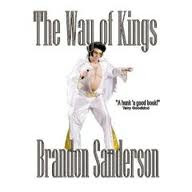
P.S.  That is not a limited-edition cover for the novel.  It is a tribute to the sadly-deleted former Amazon page for the book, created years ago due to a miscommunication.  The fake reviews were a riot, and I preserved two here.

Monday, October 26, 2009

Robert Jordan and Brandon Sanderson, The Gathering Storm


The Wheel of Time turns, and Ages come and pass, leaving memories that become legend.  Legend fades to myth, and even myth is long forgotten when the Age that gave it birth comes again.  In one Age, called the Third Age by some, an Age yet to come, an Age long past, a wind rose around the alabaster spire known as the White Tower.  The wind was not the beginning.  There are neither beginnings nor endings to the turning of the Wheel of Time.  But it was a beginning.


The wind twisted around the magnificent Tower, brushing perfectly fitted stones and flapping majestic banners.  The structure was somehow both graceful and powerful at the same time; a metaphor, perhaps, for those who had inhabited it for over three thousand years.  Few looking upon the Tower would guess that at its heart, it had been both broken and corrupted.  Separately.  (p. 49)

Robert Jordan's The Wheel of Time series has been one of the most sprawling, character-intensive epic fantasies of the past twenty years.  Spanning millions of words, this series, now reaching its twelfth volume out of a planned fourteen, has spawned dozens of fansites over the years, as well as engendering heated debates over matters ranging from how well (or not) the author managed to portray female characters to questions of character identities and motivations to even a fictional murder-mystery that still remains unresolved seven volumes after its occurrence.  Some view passages, such as the (in)famous "wind passage" that opens the first chapter of each book, as being hallmarks of a great talent.  Others read the same lines and wonder how the story ever managed to become even more turgid and bloated than the previous volume.

Debates such as these point to some intrinsic quality of the series that barely allows for there to be a middle ground.  There is something for almost everyone, depending if one likes an action/adventure tale, political intrigue, social commentary, or even elements of a puzzle novel.  Sometimes, there is too much of it all, and readers who enjoyed the earlier volumes might end up finding the past few volumes to be rather plodding, tedious affairs.  After reading the eighth and ninth volumes, The Path of Daggers and Winter's Heart, I found myself going years before even thinking of picking up the tenth volume, Crossroads of Twilight, which was perhaps the most difficult book to complete reading of them all at the time.

But then a tragic event happened.  Jim Rigney, the person behind the Robert Jordan pseudonym, contracted a rare blood disorder, amyloidosis.  Rigney spent the final eighteen months of his life battling the disease, while attempting to complete the conclusion to the series.  Sadly, he succumbed to the disease on September 16, 2007.  Fans were devastated, as for nearly three months, the matter of who would complete the series, or even if the series would be completed, was up in the air.  Toward the end of the year, Rigney's wife, Harriet McDougal, announced that she had chosen young author Brandon Sanderson, whose work to date had been three adult fantasies (Elantris and the first two Mistborn novels) and two young adult novels.  From the end of 2007 to now, Wheel of Time fans have been probing for information, trying to decide if Sanderson was the "right" choice, if he would manage to capture Jordan's narrative "voice," warts and all, and if the conclusion (now announced to comprise of three volumes spread out over three years) would be worthy of the time invested in the series.

Depending on what you enjoy most about the series, Sanderson largely succeeds in this thankless task.  For those wanting to know if Sanderson would manage to capture the essence of the late Jordan's writing style or if his passages would integrate well with the ones Jordan had completed before his death, it will be difficult for most of the time to discern which author wrote which passage.  Sanderson's interpretations of the two main characters of this story, Rand al'Thor, the Dragon Reborn, and Egwene al'Vere, the rebel Amyrlin, are almost pitch-perfect.  What I found interesting about Sanderson's treatment of the characters is just how well they are integrated with Jordan's earlier development of them.

Rand in particular has a very good character development arc in The Gathering Storm.  Hurting from his myriad mental, emotional, and physical wounds, he is a near-complete wreck.  Increasingly paranoid and worried that he is not "hard enough" to face the Dark One in the prophesied Last Battle, Rand's character displays many traits in common with soldiers suffering from Post Traumatic Stress Disorder during the Vietnam War.  This is no accident, as before his death, Rigney discussed how he himself faced a decision in Vietnam if he was to desensitize himself to the horrors happening around him or if he would fight to keep from becoming a sociopathic killer.  Rand's development from the first chapter, "Tears from Steel," to the last, "Veins of Gold," is one of the more intriguing in the entire series.  It is perhaps for me the most personal of all the mini-plots in this mammoth series and the authors do such a good job of showing Rand's descent into darkness, both figurative and literal, as well as setting up the decision he makes at the end of this book that is in many ways as important thematically as the cleansing of saidin was in Winter's Heart.

Paralleling Rand's development and his struggles to integrate his past and present memories is that of his childhood sweetheart, Egwene.  Captured at the end of Crossroads of Twilight and forced to undergo numerous punishments at the hand of her rival for the head of the Aes Sedai organization, Elaida, Egwene presents a clear contrast to Rand's choices early in the novel.  Instead of trying to harden herself by means of shutting out friends and even one's own emotions, Egwene comes to accept her situation, viewing matters such as hurt and grief not as something to avoid or to manipulate, but rather as things to accept and to use to improve one's self.  This change from the rather ambitious, self-righteous girl of the earlier volumes into a leader who realizes the importance behind the very name of "Aes Sedai," stands in sharp opposition to that of Elaida, as the authors go to great lengths to make clear in the second chapter, "The Nature of Pain."

There are even more parallels between the characters along the lines of examining the choices people make in regards to themselves and others.  It is debatable whether or not Jordan would have been quite as direct as the final draft came to be, but several times over the course of the novel, characters ranging from the two mentioned above, Perrin, Mat, and members of the Black Ajah and the Forsaken are shown via the choices they have made.  The selflessness of one clashes with the self-centered greed of another.  The desire to be viewed as being important contrasts with one who humbles herself, placing her own soul in risk of eternal perdition so the machinations of others can be revealed to others.  These parallels, which were either lacking or were not adroitly done in the past several volumes, helped make The Gathering Storm one of the better WoT volumes I have read in the past twelve years.

Despite this, there were several problems that I had with the text.  Although Sanderson eschewed the character "blocks" that Jordan used in the past few volumes, there were times that the pacing of the plot still suffered.  While Rand and Egwene's subplots were developed well and each concluded within narrative minutes of one another, Perrin and Mat's were underdeveloped and appear to be days or even weeks behind the first two.  In addition, their characters were not as well developed as were Rand's and Egwene's.  Perhaps this is in part due to the limited number of chapters each appears, but Mat's chapters, despite a near-horrific chapter occurring in a backwoods town near the kingdom of Andor, felt rather sketchy, as if Sanderson had not decided what to do with the character in the allotted space.  Perrin's arc was rather anti-climatic and it is hard to guess where he will be heading in the next volume.  Despite the near-certain protests from fans of those characters, The Gathering Storm might have been better served if those arcs had been withheld until the next volume, even though that alternative certainly would have risked backlash from those burned by the eighth and tenth volumes of the series.

The pacing was mostly good, although there were times that events long foretold in the series unfolded so quickly that there was a sense of a letdown.  But perhaps reader expectations had been built up too much from the narrative molehills, so it is hard to say particularly which events (ranging from what occurred outside a castle in Arad Doman to the use of a certain item discovered in The Shadow Rising) were done too hastily and which events were done purposely at such a breakneck pace in order to set up future character development.  For myself, the two events I allude to above served to develop Rand's character in ways that were at once surprising and logical in hindsight (especially as it relates to how he parallels Moridin more and more now in thought and action).  But others might view these scenes differently, wishing that Sanderson had spent more time setting up the events so that there would be a stronger emotional reaction.  There is something to be said for this argument, but I suspect if there had been further development of these two set scenes, the pace of the narrative would have slowed to the near-glacial creep of the previous novels.

Prose is something I value highly in a novel.  The previous eleven volumes of the WoT series were uneven to me, as powerful scenes would be offset by descriptions of clothing, of how to wash silk, and even lengthy scenes set in a bathtub.  Sanderson's prose in his novels tends to be rather too sparse at times, attempting to be too "invisible" when the occasional use of more florid language might serve to vary the prose enough to make it more interesting.  Thankfully, for most of The Gathering Storm, Sanderson managed to achieve a happy medium between his own preferred style and that employed by Jordan.  There are places where the narrative still feels clunky or choppy, but these are fewer than what I recall being present in Sanderson's own work.  The too-long descriptions of places and dress still occur on occasion, but thankfully they are reduced.  The male characters' self-conscious thoughts about their abilities with women is also much reduced, doubtless to the delight of numerous readers.  While certainly not written in a style that would lend itself to being studied by writing students, the prose here was at least acceptable and at several times, very well-written.

The Gathering Storm certainly is not an ideal beginning place for readers curious about the Wheel of Time universe, but for those who were disenchanted by the perceived lack of plot and character development over the past few volumes, it certainly is one of the faster-paced, better-written volumes.  While I would not consider it to be among the best works released in 2009, it certainly is one of the best epic fantasies that I have read.  The Wheel continues to turn and thankfully it appears to be cranking a bit faster and toward a more intriguing conclusion than I had suspected when I had suspended my reading of the series back in 2000. Highly recommended for WoT fans and recommended for those who might have become disillusioned by the previous four volumes.

Thursday, June 18, 2009

Brandon Sanderson on Warbreaker and his newest project, The Way of Kings

I was sent this interesting book trailer by one of Tor's publicists this afternoon. In this one, Brandon Sanderson (Elantris, Mistborn, soon-to-be completer of the Wheel of Time series) talks about his just-released (and NY Times bestselling) Warbreaker, as well as revealing at the end of the video his next project, The Way of Kings, which was glorified in this post.


Monday, March 30, 2009

So the "final" WoT novel has been split into three volumes

Press Release

Brandon Sanderson's comments


Don't have much time now to say anything at length, but rather than griping about "broken promises" or "greedy publishers" as some might be tempted to do (or have done on their blogs), I think what Sanderson's comments reveal more than anything else is how the various departments work with/against each other in the crafting of a manuscript into a finished product. Not to mention the influence that booksellers wield in determining what books are published/sold in their stores. So while none of this is surprising (after all, Tristam Shandy was originally published in several volumes, so this is a quite old practice), it is illuminating on several levels.

Thoughts on this announcement?

Thursday, February 26, 2009

The wotmania Files: Interview with Brandon Sanderson (11/15/2005)

Before Brandon Sanderson was chosen in 2007 to complete Robert Jordan's The Wheel of Time, he was a first-time author. One of the members at wotmania, Bryce, contacted Sanderson and the following interview was arranged. Interesting to see how things have developed a little over 3 years later, no?
As a new author, many people are starting to discover Elantris and would love to know your story. Can you tell us a little more about yourself and how you came to be a fantasy writer?

My story starts back in junior high. I’d never really read any fantasy books, though when I’d been in grade school, I’d been a big reader. My favorite series was the “Three Investigators” books, a kind of Hardy Boys style mystery series.

Well, as I grew older, people tried to give me other books to read. Most of these were realistic fiction--the types of books that bored me out of my skull. My reading habits dribbled off, and I landed in junior high as an average student who just didn’t get through many books in a year.

Then I had a wonderful English teacher--Ms. Reader, ironically--who told me I couldn’t keep doing book reports on novels that were four grades below my reading level. Instead, she gave me her copy of Dragonsbane, by Barbara Hambly. That was the beginning of the end for me! I was amazed by the book--I hadn’t realized that there were things like that out there. The book engaged my imagination to an extent none ever had. I read through every book in the Library that had “Dragon” in the title, then quickly move on to the bookstore, buying whatever fantasy I could get my hands on. I still remember when both Dragonbone Chair (by Tad Williams) and Eye of the World (by, of course, our friend Robert Jordan) came out in paperback--both books quickly hooked me as a reader, and those two became my favorite authors.

I went to college as a bio-chemistry major, but it only took me about a year to realize that I was in the wrong place. I spent all my free time writing, and eventually gave in and changed to an English major. After that, I dedicated myself to becoming an author. I learned the craft (Elantris was the sixth book I wrote) and learned the business of writing, and eventually got a contract!


As a new writer, what are some of the surprises and favorite experiences that you've had with Elantris?

I’d have to say one of my favorite experiences was getting the cover art for Elantris. This can be a harrowing experience for a writer--you know that the cover is going to make a big difference in your sales, and you worry about how someone will interpret your book into a visual medium.

Tor was great with me on this one. They asked my opinion, asked if there were any artists I preferred, and eventually decided to go with the artist I’d asked for to do the cover. Stephen Martiniere is his name--he’s done work for Lucas and for the Myst video game series. I think he did a brilliant job with the cover. (Irene, Tor’s art director, is a real genius when it comes to placing artists with books.)

Overall, in fact, the experience of working with my editor (Moshe Feder) my agent (Joshua Bilmes) and the whole Tor team was wonderful. In relation to your original question, I’d have to say that the most surprising thing for me was how kind and easy to work with everyone was. Authors were very considerate in reading the book to give it a potential cover quote--Orson Scott Card, David Farland, L.E. Modesitt Jr., Katherine Kurtz, Simon R. Green, and Kevin J. Anderson all read the book and gave it quotes. Pretty much everyone I asked was very accommodating.

After hearing about some horror stories about the publishing industry, I wasn’t expecting it to be as easy as it was to work through the editing process and work with everyone in the industry. After all of this, I can honestly say that I think Tor is a first-rate company.

From what we've seen on the internet, it looks like Elantris is receiving a great amount of praise. What was your reaction to this criticism?

Relief!

To be honest, as a new author, you really never know if your work is as good as you feel it is. Your editor and agent tell you it’s great, and your friends do the same, but honestly--how unbiased are they? Every author, I think, has a little voice inside that whispers “This book is
actually terrible, and everyone will see through you once you put it on the market. You think your book deserves to be up on those shelves with people like Asimov and Jordan?”

I realize that, in a way, my book STILL doesn’t belong on the shelves with Asimov and Jordan. Fortunately, there are only a few of them, and there is room up there for some of us who are still learning and growing. The reaction to Elantris has been nothing less than astounding--and humbling at the same time. My agent told me not to expect any foreign sales on my first book. We’ve sold in ten different foreign markets now. My editor warned that the review markets might overlook a book by a new, unimportant author. We got a starred review in Publisher’s Weekly, and got very favorable reviews in Locus, the Library Journal, and Booklist.

And, of course, there’s the praise on message boards and blogs. In all honesty, this is what means the most. Some authors write to be remembered, some to win awards. I just want to tell good stories. That’s the beginning and the end of my aspirations. I want people to read my books and get that same excited, wonderful feeling that I got when reading Dragonsbane as a teenage boy. That sense of being taken to another place, of meeting people who feel real, and of seeing things that you’ve never seen before. When readers pick up my book and feel that it was worth the time and money they spent on it, then I feel vindicated in all the years I spent trying to get published.

What is your method for writing? Do you have a daily schedule? Are the novels planned well in advance, or do you let story take shape as you write?

I think a daily schedule is very important for writers. When I was working to get published, the thing I did was get a job working graveyard shifts at a local hotel. That way, I could go to school full time, work full time, and still have plenty of time to write. By doing that, I built a schedule for myself--I went to work every night, checked people into the hotel, and by about midnight things were quiet enough to sit down and work on my novels. I wrote for four or five hours, every night, and then did my other work for the hotel.

This got me into the habit of writing. People ask me how I managed to write thirteen novels before I finally managed to sell one (as I’ve noted, it was my sixth.) It’s because I had good habits. Writing was what I loved, and so doing it so much became second nature to me. Even now, if I’m not making significant progress on my current book, I start to feel anxious. I need to be writing!

I do make outlines. Plotting is one of those things that is difficult to explain. Not because I don’t know what I do, but because I can’t ever be certain that my method will be useful to another person. The thing is, everyone works in different ways. For some, a very strict outline is essential. For others, writing a book without an outline is necessary, for this gives them the freedom to discover what they really want to write while they’re writing it.

I’ve found that people who outline a lot spend more time up front planning. People who discover their story by writing it spend more time at the end revising. It tends to even out. The danger for the outliner, however, is that they sometimes plan so long that they never get to their story. On the flip side, it’s just as easy to spend so long revising certain sections of your story that you never get around to finishing it--so the other method can be dangerous as well.

I guess what I’m saying is that it’s often very useful to try different things, and discover what works best. And, what works best is generally whatever keeps you writing and finishing things!

Anyway, here’s my method. I tend to lean a little bit more toward the ‘outliner’ side than the ‘reviser’ side of things. I like to know where I’m going. I, personally, can’t start a story until I know what the ending is. To me, that would be like starting a trip without knowing
your destination!

So, I always plan a good climax first. Then, as I’m pondering a story, I begin to pick out very important or interesting scenes. These could be climactic confrontations, moments of great character growth, or simply beautiful setting images that I want to portray. These ‘super-scenes’ will develop in my mind to the point that I’ve almost got them completely written before I put pen to paper. (Or, uh, fingers to keyboard.)

Once I have some of these scenes, and I have an ending, I decide where my beginning is. Sometimes, this is obvious. (The beginning is often one of the super-scenes.) But, if it isn’t, I try to start in a place of great motion--something has to be happening. Important events are afoot. I always tell newer authors to be wary of starting their stories too long before important things start happening!

Now I’ve got a beginning, an ending, and a smattering of scenes. I place the scenes in order, and they kind of become my destination points. It’s like a trip--I know I’m starting in LA, and I want to get to New York. I also know I want to pass through Denver, Chicago, and Boston. So, I begin building an outline. What do I have to do to take me from the beginning to the first super-scene? What character growth has to happen? What clues need to be discovered? All of these things go as bullet points on my outline beneath the ‘part one’ section heading. Then, I take myself from super-scene one to super-scene two. What needs to happen here?

I build an outline that way. After I’ve got ten or so bullet points for each section (one point roughly being a scene or chapter) I’m ready to start writing!

Also, I'm assuming that you're LDS. I could be wrong, but you teach at BYU, right? We were wondering if it would be possible to ask a question about how your religion and values influence the way that you write. I thought this was an interesting question, having just finished R. Scott Bakker's first book . If you want to answer this question, feel free. If not, don't worry about it.

No problem at all! This is the type of question that I like, since it forces me out of dry “how to write” mode and gets me talking about more personal things.

I am indeed LDS. I would be lying if I said that my philosophies on life, including my religious philosophy, didn’t influence my writing. Who we are as writers dictates inherently which kinds of conflicts we choose to put in our books, and how our story deals with them.

That said, I come down with Tolkien (and against C. S. Lewis) on the side of the debate about the didactic nature of stories. I don’t think that fiction--in most cases--should be written in order to perform some agenda, even if that agenda is to make people into better people. That undermines the story--to me, the most important thing about the book needs to be the story, and not a group of morals an author decides his readers need to learn.

So, while I deal with issues I think are important and valuable, I don’t intentionally put any sort of moralistic themes into my books. Being religious myself, I tend to deal with religious conflicts because they interest me. Those who have read Elantris realize that my antagonist is a very religious man. I did this not because I had a moral to prove in saving him, nor did I do it to show that any particular kind of religion is evil--I did it because his internal conflict fascinated me. What would a man do if his conscience disagreed with his religion? How would he react if he were told to do something terrible, but knew something even more terrible would happen if he didn’t follow orders?

In the end, I think it comes down to being true to your characters. One of the characters I enjoyed writing the most was an atheist. I knew from the start that I couldn’t put her into the novel just to have some warm-fuzzy of a conversion story--if that were her purpose, I’d not only be betraying the character, but insulting any of my readers who shared her philosophy on life. So, I worked hard to read up on the atheist worldview, and tried to present her arguments--where appropriate in the story--as forcefully and logically as possible.

Some people have told me that a side-effect of my religion is that my books tend to be inherently optimistic. I tend to write characters that are optimistic, even when they get thrown into terrible situations. I can look at it and see that they might be right, though this was never my intention. However, I guess that it really is true that you can look at an author’s soul through his writing.

When you said that you spent time working at a hotel in order to write during the nights, I had to laugh. I work nights at the Holiday Inn right now, and I tend to use that time to ponder writing and do a few things for wotmania as well. Quite the coincidence, no?

Perhaps. However, I notice that creative people I know have a singular aversion to ‘real’ work. We try and find people who will pay us to do our own thing, even if that requires us to sit at a desk over night!


Speaking of writing and what influences your style of writing, what advice would you give to aspiring writers? What important lessons have you learned that could help us (speaking for all aspiring writers at the site) to get published and generally write a better novel?

Well, lets see if I can get some quick ones down. First off, I’ll talk about writing, then I’ll give a few tips on getting published.

1) Write what you love! I believe that passion shows through in writing, and it is very important that you feel passionate about the subject you choose. Don’t switch from SF to fantasy just because fantasy seems to be selling well at the moment. Excellence will always get published--and I believe that passion has a lot to do with excellence.

2) Write something original. Don’t write what you’ve seen before. Try and capture the same feel of something you’ve read and loved without writing that same story. You do this, in my opinion, by experimenting a lot with setting, magic, and worldbuidling concepts. What was it you really liked about Tolkien? Was that he had elves and dwarves, or was it that he created new cultures that felt real?

3) Keep reading, and read a lot in a all genres to give you a broad basis of ideas.

Now, unfortunately, I’m going to have to contradict myself. See, here’s the thing--writing is a very strange job. You have to be one-half artist, and one-half realist. So, you need to have a professional mindset as well as an artistic one.

1) Write what you love, but if you love several things, write the one that will sell. If you’re a really creative person, you’ll often have a lot of ideas. Some of those ideas will be more marketable than others. Those should probably take priority.

2) Be original, but don’t be too wacky. Breaking conventions is all well and good, but you need to understand the business side of marketing. The sales department is going to know what genre sticker to slap on your book. If they can’t, they have a very tough time selling it. So, before you write, decide what about your book is going to be innovative, and what is going to be familiar. (And, if you do happen to write a brilliant western, fantasy, comedy, dark gothic romance hybrid. Just tell the editors it’s a historical fantasy and let them figure out the rest on their own.)

Just as a note, I think this, actually, is one of the best things Jordan did with Eye of the World. He was creative and clever, yet still managed to write an epic fantasy with many of the traditional elements. The books that sell, I believe, are the ones that walk the line between the familiar and the original. They have something old to love, but also something new to discover.

3) Read around in all genres, but pay attention to what is selling. Read first novels by new authors (hint hint) and see what the editors are buying. (In other words, find out which editors bought those books and which agents represented them.) It comes down to learning the business side of publishing, and learning the tastes of the different editors. You don’t have to write toward those tastes, but you improve your chances drastically if you can place your manuscripts on the desks of the editors who seem to like books similar to the ones you write.

About the WFC last weekend. Did you get to meet any authors that you previously hadn't talked to? We heard that there was some talk about R. Scott Bakker and his goings on at the WFC. How was WFC, and what role did you play there?

I got to WFC late, missing the first day and most of the panels on the second because of a booksigning in another state. So I had a fairly low profile at this con. I went to the parties Saturday night, then hit the banquet on Sunday. I did meet several people I hadn’t before--I got to talk to David Drake and Jim Frenkel at the banquet, and they were both very courteous and nice to a newcomer like me.

I’d say, however, that the last author I was really star struck to meet was Robin Hobb, who sat next to me at a booksigning at Nasfic this year. She’s one of my favorite authors, and one of the best things about being in this business is that I can actually sit next to her and feel--a little bit--like I belong there. It’s a weird feeling. (Don’t worry about my humility though--that was well restored when I had all of three people come get books signed by me, while she had quite the line. She deserves it!)

Elantris is a stand alone novel, which really excites many people here who don't prefer to get into a long series before it's well underway. You do, however, have a series planned, correct? What can you tell us about that series? Number of books, date of release, brief description, etc.

Well, if you insist. . .

First, let me say that I love having written a stand alone. I always wanted my first published novel to be a stand alone because I felt that was a much better way to introduce myself to a readership. Nothing annoys me more than looking through a bookshelf, wanting to try a new author, and only finding “Book one of this series” or “Book one of that series.” Not knowing the author, I don’t want to get bogged down by a trilogy (especially one that isn’t done yet) without having confidence that the author can tell a good story.

So, that’s why I don’t plan on a sequel to Elantris right now. I won’t say it will never happen, but it probably won’t be any time soon.

That said, however, I also love to read in a series. A trilogy of books give a reader more time to know the characters, and lets them return to a world they love and find familiar. A lot of my favorite books are part of a series. However, I told myself I wouldn’t let my series go on forever. I don’t have Mr. Jordan’s weight to throw around! I decided, then, that I would write only three books in the Mistborn series, with each book standing alone fairly well. That way, I could go on to another project, and worldbuild something new. (Which is one of my favorite parts of this process.)

So, the new series is called The Mistborn Trilogy. Book one, Mistborn, will be out in June of 2006 from Tor, and they plan to release the other two at nine month intervals. (Getting them out quickly so people don’t have to wait too long! And, don’t worry. The first two books are already turned in, so I promise that they’ll come out on time.)

Mistborn came from two concepts. First, I was watching the movie Ocean’s Eleven, and realized that some of my favorite movies (Sneakers, The Italian Job) were centered around a team of specialized thieves pulling off incredible feats. I wondered why nobody had done this in fantasy. So, I built a magic system with sixteen specialized parts, and came up with a team of underground con-artists who each specialize in one or more of these aspects of the magic system.

The second inspiration for the book came from the weight of fantasy novels I’d read when I was younger. It seemed to me that so many of them were the stories of a young peasant hero who went off to fight some powerful dark lord. I wondered what would happen if. . .well, the dark lord won. What if he squished that little peasant, as probably should have happened in all of those stories?

So, Mistborn takes place in a world where the dark lord won. A thousand years ago, a prophesied hero rose up to fight the evil power, and got abjectly defeated. Now, a millennium later, our little team of thieves is annoyed. Their prophesies failed, and the world has become a dark place where ash falls from the sky and most of humankind is enslaved. Our heroes, lead by a charismatic man with the powers of a Mistborn, decided that they’re going to take down the dark lord their own way--by stealing all of his money then bribing his own armies away from him.

Of course, they get involved with much, much more than they expected, as the story a thousand years ago isn’t quite as simple as everyone believes. (Sample chapters will be up on my website beginning in January!)

Last, but certainly not least, if you were to own several monkeys and/or midgets, how many would you own, and what would you name them?

Well, I would certainly hope that they would, indeed, be monkey midgets, rather than just one or the other. I would have an infinite number of them, of course, because then they could produce fantasy novels for me in iambic pentameter while I swung in my hammock and ruled over my unending simian empire.

Great interview, huh? For those of you curious to know more about how others have received Elantris, check out the reviews section. And Sanderson has also provided commentary on the chapters in Elantris, so feel free to check those out here.
 
Add to Technorati Favorites