The OF Blog: 2011 Reviews
Showing posts with label 2011 Reviews. Show all posts

Sunday, December 04, 2011

Yumeno Kyûsaku, Dogra Magra

Often, reviewers will settle for analogues whenever they are unable to devise an explicit explanation for what a particular story contains in its form and content.  For example, "Kafkaesque" and "surreal" are often used to denote works in which the inexplicable is occurring, often in ways that seem to indicate a fatalism that underlies complex and often fractured narratives.  It is a handy catch-all, as it allows the reviewer to say with a straight face and with some gravitas that "this shit is weird, fo' sure."  Yet there are times where such catchphrases are useful shorthands for describing works that defy traditional description.  Japanese author Yumeno Kyûsaku's 1935 novel, Dogra Magra, is one of those novels.

Describing the premise for Dogra Magra will illustrate the problems reviewers have had in attempting to distill its essence in a few pithy comments.  Ichiro, the protagonist, wakes up one day suffering from amnesia.  He is in a psychiatric ward.  He comes to learn, through the eponymous "Dogra Magra," that he has attempted to kill his fiancée.  Yet there is much more to this than just a psychological portrait of what leads one to kill what one loves.  Turns out that much of the writing in the middle section is in the form of psychiatric reports written by two doctors who may or may not be characters in Ichiro's narrative.  Furthermore, the narrative fractures into an exploration of Buddhist concepts surrounding karma, particularly how it applies to Japanese culture in the period immediately following World War I, two generations removed from the beginning of the Meiji Restoration and Japan's rapid industrialization.  And if this does not sound complicated enough, Ichiro and a female character may or may not be reincarnated souls that are experiencing the memories and mental anguish of their ancestors.

Yumeno's novel easily could be a mess, given the elements listed above.  Yet it is a strangely coherent novel in which the narrative fractures reflect off of each other to create a fascinating detective novel in which the detective is an apparent criminal (or perhaps a victim of fate) and his search (a word often repeated in the narrative) for understanding leads him further and further down the rabbithole of madness and despair.  Ichiro's entrapment may remind readers of the mysterious imprisonment and trial of Joseph K. in Kafka's The Trial.  There are certainly some parallels with how Ichiro's search for his forgotten past resembles Joseph K.'s trial, particularly in how the damning information is revealed and the effect it has on the reader.  Yet there are key differences, namely Yumeno's narrative is even stranger, more weird, than Kafka's, particularly in how the mechanics of the psychological reports are employed within the novel.  These long, oddly clinical accounts, heavily dependent on the then-current Freudian theories of the mind and its impulses, provide a sharp contrast to the portions of the novel told through Ichiro's perspective.  Here we see ideas on how the psyche works clashing with the more metaphysical, philosophical notions expressed by Ichiro and a woman he comes to meet in the psych ward who talks of how ancestral memories may be transmitted through generations to affect (infect?) the descendents.  This alternation between the scientific and the Buddhist-influenced folk belief creates a narrative tension in which the boundaries of the "real" become stretched and one is left with a sense of estrangement occurring, as if one is stepping outside the bounds of a traditional plotted novel and into something that is odd, off-kilter, not "true" or "false," but lying somewhere beyond them.

It is in the latter half of Dogra Magra where this sense of surrealness occurs most often.  Before this midpoint, the story does resemble in form and structure a detective novel, albeit one that is odd in that the protagonist seems to be either truly amnesiac or insane.  Once the reader manages to process the contents of the psychiatric reports, one begins to question as to whether or not everything is as it seems.  Yumeno's digressions into the ancestral memories, into the repetitive nature of certain memorable (and perhaps infamous) actions, causes the narrative to careen sharply away from earlier reader expectations and toward something that is inexplicable for the reader.  Furthermore, there are hints that even those reporting on Ichiro may not be what they seem.  This results in a conclusion that loops back, creating what appears to be an infinite loop that alters slightly at its end what it had begun narrating.

Dogra Magra succeeds in creating a sense of alienation and purposeful confusion.  The reader, unlike in many detective novels, is no "smarter" than the characters and if anything, they (especially Western readers reading this in French translation – it is not yet available in English translation) are perhaps even more perplexed by what is transpiring than the characters, who seem to take the incipient weirdness in full stride before the narrative almost completely fractures in the latter third of the novel.  For those readers who love weird fictions and who can read Japanese or French, Dogra Magra may be one of the best examples of 20th century weird/detective/psychological literature available.   It is certainly a novel that will need several re-reads before I am certain that I have gleaned everything essential from it, which perhaps is the greatest compliment that can be paid to this seminal work.

Tuesday, November 29, 2011

Umberto Eco, The Mysterious Flame of Queen Loana

"...I no longer knew how to go forward, and I didn't know how to go forward because I had lost what came before.  That's it, that's how I am.  I'm holding a long note, like a stuck record, and since I can't remember the opening notes, I can't finish the song.  I wonder what it is I'm supposed to finish, and why.  While I was singing without thinking I was actually myself for the duration of my memory, which in that case was what you might call throat memory, with the befores and afters linked together, and I was the complete song, and every time I began it my vocal cords were already preparing to vibrate the sounds to come.  I think a pianist works that way, too:  even as he plays one note he's readying his fingers to strike the keys that come next.  Without the first notes, we won't make it to the last ones, we'll come untuned, and we'll succeed in getting from start to finish only if we somehow contain the entire song within us.  I don't know the whole song anymore.  I'm like...a burning log.  The log burns, but it has no awareness of having once been part of a whole trunk nor any way to find out that it has been, or to know when it caught fire.  So it burns up and that's all.  I'm living in pure loss." (p. 37)

What makes each of us a "human being?"  Even that compound word, "human being," implies a sort of dynamic action, where the living person is in a fluid state between conception and death.  What are we "being?"  A series of actions, thoughts, mistakes, deceptions, and attempts to wrest order out of chaos seem to delineate human beings from rocks, trees, or even squirrels.  We are constantly "being" because of our attempts, benighted as some might see them, to remake and reorder our environs, to utilize that evolutionary tool called "memory" to recall, however imperfectly, our past experiences, never permits us to be static; we have to keep living in order to postpone dying, whether that be a metaphorical or biological death.

But what if our memories were taken from us?  What if we could not recall why that ray of sunshine shining through the patio makes us sigh and smile wistfully?  What if we hear a voice and do not associate that voice with a lover, with a child, or with a friend?  If our identity, those things that we devise to center ourselves at the crux of so many semantic associations, is lost, then who are we?  Are we that burning log described above, burning but without knowing that it was once part of something grander?

This is the issue that Umberto Eco tackles in his fifth novel, 2004's La Misteriosa Fiamma della Regina Loana, published in English translation in 2005 as The Mysterious Flame of Queen Loana.  A late middle-aged (roughly 60 years old) rare books dealer, Yambo, wakes up in a Milanese hospital in 1991 (roughly around the time that the Persian Gulf War ends, based on internal evidence) with no memory of his individual past, only the snippets of information that he learned from songs, comic strips, poetry, and prose.  Over the next couple of months, he is reintroduced to his family, his assistant (and possible mistress?) and friends before visiting his childhood home in Solari, where a treasure trove of material from his youth is stored at the family residence.

Eco is renowned for his erudite cataloging of minutiae, errata, and other material evidence of belief structures (he was a leading semiotics professor before he became a novelist in 1980).  At first glance, The Mysterious Flame of Queen Loana would seem to share little with works such as The Name of the Rose, Foucault's Pendulum, The Island of the Day Before, or Baudolino, as the narrative is grounded firmly in the present and there are no esoteric theories on reality or the structure of the universe on display.  Even the narrative contains a deceptively simpler, more personable tone to it.  Yet appearances can be deceiving.  Re-reading The Mysterious Flame of Queen Loana two years after reading his non-fiction The Infinity/Vertigo of Lists, there are certain parallels can be made between those two works and from there with his other novels.  Yambo's exploration of his past through the comic books and penny dreadful-type pulp novels that were common reading materials of Italian youth in the 1930s and 1940s opens up new possibilities.  How would we be affected if we were to see beloved childhood texts for the first time in years?  Would we have deep associational memories attached to say Harold and the Purple Crayon or Happiness is a Warm Puppy (two of my earliest books that I read)?

As Yambo delves into this obscured literary/personal history, he begins to recall more and more information.  The "fog" that he often would note (and quote from divers literary sources) starts to dissipate, with interesting new connections being revealed.  When I first read The Mysterious Flame of Queen Loana, I found these recalled memories and associations to be almost impenetrable, as they were not images of my generation (just as perhaps the post 9/11 generation might not fully grasp what the Iranian hostage situation or the Challenger explosion meant to my age cohort) and there was a barely-perceived invisible barrier that kept me from understanding what was transpiring during the latter quarter of the novel.  Although still difficult at times to process during the recent re-read, the combination of nostalgia and recalling of past dreams and memories is more understandable to me now that I'm nearing middle age.  Interesting how perceptions can change with time and experience, something that I suspect Eco had at least partially in mind as he was constructing this novel.

Despite The Mysterious Flame of Queen Loana being different in structure and focus from his previous novels, I still found it to be a challenging yet ultimately rewarding read.  It may not present at first the formidable challenges that his most famous works do, being that it is centered around a nearly-average man's struggle to recall his life and first love, but it too contains layers of depth that make it a novel that deserves several re-reads spaced out over a long period of years for more of its hidden treasures to be revealed to readers.  Eco is never an "easy read," but like its predecessors, The Mysterious Flame of Queen Loana is a worthwhile read for those readers who want a deeper challenge than what they typically find in most literature today.

Sunday, November 27, 2011

Carlos Ruiz Zafón, The Prisoner of Heaven (El Prisionero del Cielo)

– Observe la marca de agua.  Y estas líneas.  La textura...

– ¿El cabellero es un experto en falsificaciones?

– Todo es falso en este mundo, joven.  Todo menos el dinero. (p. 31)


"Observe the watermark.  And these lines.  The texture..."


"The gentleman is an expert in forgeries?"


"All is false in this world, young man.  All except money."

In 2001, Carlos Ruiz Zafón's La Sombra del Viento (later published in 2004 in English as The Shadow of the Wind) was published.  Through word-of-mouth, this book went on to sell more than 10 million copies worldwide by 2008, when the second volume, El Juego del Ángel (The Angel's Game) was published.  Nearly three and a half years later, the third volume in the planned four volume sequence of The Cemetery of Forgotten Books, El Prisionero del Cielo (to be published in English in June 2012 as The Prisoner of Heaven), has now been published to great fanfare in Spain.

El Prisionero del Cielo, unlike the previous two standalone volumes, needs to be read after them, as it depends too heavily on events in both novels for its stories.  The main action takes place in Barcelona around Christmas 1957, a little over a year and a half after the concluding events in La Sombra del Viento.  Its two main protagonists, young Daniel Sempere and his older friend and quasi-guardian, Fermín, feature heavily in this work.  The story begins with Daniel receiving a visit from a strange gentleman who deposits an old copy of The Count of Monte Cristo with the following inscription:

Para Fermín Romero de Torres, que regresó de entre los muertos y tiene la llave del futuro.

   13                    

For Fermín Romero de Torres, who returned from among the dead and who has the key to the future.

13                     

From this point, the action of El Prisionero del Cielo switches into exploring the mystery behind this inscription and just why Fermín may be near the nexus of a series of events that stretch back to the Spanish Civil War and the rise of Franco's fascist government.  The mysteries behind "13" and why The Count of Monte Cristo are explored in depth in a flashback that takes up most of the second and third sections of the book.  In the previous two books, Zafón kept the historical events in the background, to the point where there was barely any mention in La Sombra del Viento of the repression of political dissent in Franco's Spain.  Here in El Prisionero del Cielo, however, this repressive regime plays a larger role in explaining not just "13" but also who "the prisoner of Heaven" might be.  In this shift toward providing a stronger historical background to the fictional events, Zafón also introduces the first true villain of the series, albeit one who lurks in the background for most of the novel.  

Like its predecessors, El Prisionero del Cielo mixes in several references to literature.  Whereas the earlier volumes referenced in passing Benito Pérez Galdos, one of Spain's leading writers of the mid-to-late 19th century, here and there in the text are references to Miguel de Unamuno, one of Spain's greatest essayists/poets/novelists of the 20th century and one whose criticism of the nascent rebels against the Republicans did not endear himself to Franco's supporters.  Although one can read the novel without needing to be aware of Unamuno's writing, having a fair knowledge of his works can add a little touch to the plot, just as such literary references did with the previous two novels.  In addition, the aforementioned The Count of Monte Cristo plays a more direct role in the plot besides being the book in which the quoted inscription appears.  Zafón's use of these references feels more integrated here than it did in the previous two volumes, perhaps due to the book being over a hundred pages shorter than La Sombra del Viento and nearly 300 shorter than El Juego del Ángel.

El Prisionero del Cielo's shortened length is almost certainly due to not needing to introduce new characters; Fermín and Daniel should already be familiar to readers.  This does not mean that Zafón does not flesh out their characters (one of the few complaints I had about La Sombra del Viento was the sense that Daniel's character was too much of a cipher), as we see how Fermín came to be associated with the Semperes plus we witness the stress and strain in Daniel's life, first from being a new father and then later as he deals with the explosive revelations told in the flashback sequences.  We also learn a bit more about certain characters that first appeared in El Juego del Ángel, with certain surprises that lead the reader to reconsider what s/he had read in that book and perhaps in the first volume.

The past, whether it be that of the city of Barcelona or the literature of previous generations, has always played a major role in Zafón's recent novels.  This continues in El Prisionero del Cielo, not just with the literary or political references, but also with the revelations revolving around the Sempere family.  Zafón's imbuing the narrative with traces of a mysterious historical past is a hallmark of his recent writing and it continues to be a strength here.  The past, both real and imagined alike, feel "alive" throughout El Prisionero del Cielo and that local color adds immensely to the enjoyment of the plot.

Despite the novel being less self-contained than the others (not only does it depend upon the previous two for its setup, but the story also ends with a quasi-cliffhanger), El Prisionero del Cielo is a more streamlined novel that sheds some of the narrative bloat that plagued El Juego del Ángel, not to mention having the narrative PoVs narrowed down to Fermín and Daniel make for easier transitions than found in La Sombra del Viento.  This leads to a more focused story that conveys at least as much as the previous volumes but without the bloat or narrative juggling that sometimes slowed down the narratives in the previous two volumes.  The action is strong, reminiscent of the best 19th century sensational novels, with good characterization and character motivation throughout the book.  The main weakness of El Prisionero del Cielo is the seeming lack of resolution; it introduces the main villain and sets the table for what ought to be an explosive finale, but in and of itself, it concludes with the characters being able to integrate the revelations of the preceding chapters into their lives and adjusting the best they may.  Despite this lack of a strong conclusion, El Prisionero del Cielo is my favorite volume in the series to date and I cannot wait until the next time one of the characters dares visit The Cemetery of Forgotten Books.  One of the best novels I've read in 2011.

Note:  I use Spanish titles throughout due to the fact that I read each volume in the original Spanish and I've never read any of the translations.

Monday, November 21, 2011

Milorad Pavić, The Tale That Killed Emily Knorr

But all this is just seemingly so.  The underwear is something completely different and did not serve the purpose of keeping the sultan warm, for there were those to make sure that the sultans were not cold.  This underwear is covered in the finest expensive embroidery in several colors.  But this, too, is just seemingly so.  For, nothing in this world is as it seems at first glance.  The embroidery is not embroidery at all in fact, but if you look closely and can read from right to left, you can decipher numerous verses upon it, lines from the Koran, formulas and curses meant to defend the sultan's spirit and body from the enemy, wounds, illness and accidents.  These writings, vows, mantras and latches, whatever you wish to call them, had the task of protecting the sultan's life and health from all kinds of mishaps, and the colors of the silk, or thread with which these writings "against evil spells" were woven, also had an important role.  Red was supposed to protect the sultan from unhappiness in love, green made sure that the path beneath his horse's hooves would be covered in grass, yellow guarded his heart against stabs from the left and purple against stabs from below.  Blue protected him from the sword, black from the arrow... (p. 11-12)

Storytelling can be a dangerous art.  From a simple snippet of a tale (true or not does not matter), the reader/listener can be sucked into a world in which the tale teller and not the reader/listener is in full control.  In passages such as the one quoted above, when a presumably simple "man with rosy cheeks" (we later learned he wrote some Italian book called Dicionario dei Khazari) recites, people like Emily Knorr die.  What power such tales must have, if they can influence people to commit suicide or die of heart attacks!

The Tale That Killed Emily Knorr is a bilingual Serbian/English tale that barely lasts 50 pages in translation, yet over the course of its six short chapters, we witness meditations on stories, on the beliefs that people have in the efficacy of the written charms (even today we see remnants of this in the signs that many families post in their homes regarding warmth and charity), and the power of words to create and transform images.  Like most fables, it has a certain charm to it, a sense that it is not the mystery that is important as much as it is what creates a mystery out of words that possesses our thoughts as we read it.

Milorad Pavić in his unusually constructed stories (ironically, the layout for this is one of the most traditional he ever employed) often sought to capture that juju that transforms vocalizations into powerful entities that could influence human thought and action.  Here in The Tale That Killed Emily Knorr he distills this in a deceptively simple tale which allows our thoughts to meander in daydreams as he largely succeeds in pulling off a literary sleight-of-hand of shifting our focus away from the death and toward the power of the tale.

Doubtless, there will be those who will find this tale to be lacking in plot or resolution.  Those dour readers will in their denial of the story only serve to reinforce the questions implied within the text, those regarding how do stories affect us and how do readers/listeners interpret and alter those "landscapes" that the author/storyteller presents for our consideration?  It is due to these raised (and not necessarily answered) questions that The Tale That Killed Emily Knorr bears a quaint charm that only improves upon subsequent re-reading.

Friday, November 18, 2011

Teresa Milbrodt, Bearded Women

I spent the first seven months of 2010 reading hundreds of literary journals, magazines, and a few original anthologies in search of stories that would make good candidates for publication in the later-aborted Best American Fantasy 4 (here is the list of stories I wrote down for further consideration).  One of the stories that caught my attention was Teresa Milbrodt's "Cyclops," published in the Summer 2009 issue of Indiana Review).  What I liked about it was the tension between the strange (the girl born with a Cyclops eye, a reliquary inside a coffee shop) and the mundane (worries about how to fit in while struggling to accept just who you are as a person).  The weirder elements in "Cyclops" work because Milbrodt grounds the extraordinary inside a framework that forces the reader to look away from the freak-show qualities of a single-eyed girl and instead focus on how one would cope with that situation.  The payoff is quiet and poignant, but powerful in unexpectedly ways because the oddity of the protagonist's appearance does not single her out as much as it makes us all too aware of the frustrations, dashed hopes, and resigned sighs that we all experience in our lives, especially for those of us who feel stuck in dead-end jobs or stagnant relationships.

When Milbrodt contacted me a few months ago and offered me a review copy of her debut collection, Bearded Women, I readily accepted because "Cyclops" was very good and I wanted to see if her collection contained stories of a similar quality.  If anything, Bearded Women more than fulfilled my expectations because the unified themes, particularly that of how "freaks of nature" can stand in place of some very real social issues, particularly those that trouble women, with their strangeness allowing the reader to step back and see the larger picture in a way that might not have always been the case if the protagonists had been normal women.

One of the highlights of Bearded Women is the first story, "Bianca's Body."  The first-person narrator is a thirty-five year-old professional who works as a news anchor and who is contemplating whether or not to have a body.  There is one complication:  she has an attached lower torso, reproductive organs, and legs that hang at a forty-five degree angle from her abdomen that she calls Bianca.  Milbrodt uses this dual-torsoed/legged woman to make some pointed remarks about how feminine bodies are viewed:

We've been having this problem for six years, ever since we started trying to get pregnant.  Doug prefers to have sex with Bianca and for a long time I did not mind this.  I feel what Bianca feels, and to be honest she has better orgasms.  Bianca has gotten pregnant twice and both times the foetus miscarried.  For two years we've tried impregnating my walking half.  It's not easy since Bianca grows out of my body at a diagonal.  (p. 10)

***

We lapse into silence.  I don't know who to believe.  The doctors.  My husband.  Everyone has an agenda.  I know the doctors would be celebrities.  I know Doug is afraid for my health.  I also think he's afraid of losing Bianca.  Sometimes I get jealous.  Bianca is sexier than my walking half.  Her legs and hips are smooth and slender, belong to a twenty-year-old girl, while my walking legs belong to a thirty-five-year-old woman.  Even though I work out at the gym and my walking legs are muscular, there is a little cellulite and some varicose veins. (p. 12)

Notice the alternation between "my walking half" and "Bianca."  Here, Bianca stands in for the woman as an object of sexual action.  It is "Bianca" who is the preferred sex entrepôt, because her legs and lower form remind the narrator's husband of a nubile young girl.  It is the narrator who bears the burden of being on the cusp of middle age, with the sagging body parts.  It is obvious from these two excerpts that the narrator is conflicted.  On one hand, she identifies "Bianca" as part of her and it is her body, her choices, whatever the doctors or her husband Doug might say.  On the other, she is resentful of having her core body being ignored in favor of "Bianca."  The weirdness of this body underscores the conflicts women have with their bodies.

In "Mr. Chicken," there is a woman who hides her hirsute facial features by constant shaving.  She works at a restaurant where a strange, gawking man (who she nicknames Mr. Chicken) orders 100 chicken nuggets each day and as he eats them, he stares unpleasantly at her and at the other customers.  It is a touching meditation on body image and how external forces (say, the prejudices of certain males) can have deleterious effects on feminine self-image.  What makes this story so effective is that Milbrodt carefully develops the narrator's situation, as she goes into reflective monologues surrounding her awkward interactions with Mr. Chicken about how men react when they learn that she shaves every morning.  Their stammering responses and subsequent "escapes" leave hanging in the air, ready to explode upon contact, the discomfort many males feel about "masculine" and "feminine" roles, particularly when a woman seems to be violating those seemingly rigid divisions.  The psychological tension increases until it is released in a simple and yet cathartic action that ties together both the narrator's dilemma and Mr. Chicken's own rude gawking nature.

Most of the other thirteen stories are similar in theme if not in narrative structure or execution as "Bianca's Body," "Cyclops," and "Mr. Chicken."  For the most part, I found their narrative arcs and situations to be effective, in part part to Milbrodt's ability to use freakishly weird situations and characters to explore and then dismantle reader expectations regarding gender roles and sexuality.  There were very few dips in story quality and the collection as a whole serves to reinforce through reiteration and re-exploration the themes of strangeness and feminine struggle for acceptance.  Bearded Women is one of the best debut short story collections I've read over the past few years and Teresa Milbrodt will be a writer whose future I shall follow with keenness, as she already displays more command over her stories than several veteran story writers.  Highly recommended.

Thursday, November 17, 2011

2011 National Book Award non-fiction nominee: Stephen Greenblatt, The Swerve: How the World Became Modern

But atheism – or, more accurately, the indifference of the gods – was not the only problem posed by Lucretius' poem.  Its main concerns lay elsewhere, in the material world we all inhabit, and it is here that the most disturbing arguments arose, arguments that lured those who were most struck by their formidable power – Machiavelli, Burno, Galileo, and others – into strange trains of thought.  Those trains of thought had once been eagerly explored in the very land to which they now returned, as a result of Poggio's discovery.  But a thousand years of virtual silence had rendered them highly dangerous.

By now much of what On the Nature of Things claims about the universe seems deeply familiar, at least among the circle of people who are likely to be reading these words.  After all, many of the work's core arguments are among the foundations on which modern life has been constructed.  But it is worth remembering that some of the arguments remain alien and that others are hotly contested, often by those who gladly avail themselves of the scientific advances they helped to spawn.  And to all but a few of Poggio's contemporaries, most of what Lucretius claimed, albeit in a poem of startling, seductive beauty, seemed incomprehensible, unbelievable, or impious. (Ch. 8, e-book edition)

Imagine a world where our internet has crashed and petabytes of data about our lives, worldviews, and histories are irretrievably lost.  Envision the scientific method rejected out of hand due to its dangerous potential to undermine certain philosophical views of the world.  Such a place would be radically different within a few generations of this massive change.  Then try to picture someone discovering a long-lost fragment of this past society and realizing that this little scrap piece might overturn currently-accepted views of religion, cosmology, and the very nature of things.

Such a thing did happen in the early 15th century when a former secretary to the disgraced anti-Pope John XXIII, Poggio Bracciolini, discovered a long-lost manuscript of the 1st century BCE poet/philosopher Lucretius' On the Nature of Things, which until that point had appeared only in a few fleeting references in other works.  Discovered only a generation before Gutenberg developed his movable type press, this work was a slow-release detonation that rocked the foundations of late-medieval/Renaissance thought.

Professor Stephen Greenblatt, one of the founders of the literary New Historicism movement, which seeks to contextualize literary works with their times and Zeitgeist, steps back a bit from his main research area of Elizabethan literature to explore the ramifications of this book-length poem/philosophical piece being reintroduced after a millennium.  He breaks his book The Swerve:  How the World Became Modern into a historical component that revolves around Poggio's time and his motives for searching for lost manuscripts and a philosophical one that examines Lucretius' transmission of Epicurean thought and how that philosophy was so alien and enticing to several leading thinkers of the 15th century and beyond.

The eponymous "swerve" is an explanation of ancient Atomist thought.  The world is, according to Lucretius, is composed of a countless number of atoms, which interact in strange ways:

But because throughout the universe from time everlasting countless numbers of them, buffeted and impelled by blows, have shifted in countless ways, experimentation with every kind of movement and combination has at last resulted in arrangements such as those that created and compose our world. (On the Nature of Things, 1.1024-28)

This "swerve," which according to Greenblatt Lucretius variously referred to as declinatio, inclinatio, or clinamen, involves only minute motions.  But what waves are created from these motions!  Nearly-infinite particles merge and mate and clash and rip themselves apart to create new beings, new forms.  This belief, which is derived from some of Epicurus' thoughts on cosmology, has little room for gods (or God).  It is little surprise, as Greenblatt surmises at several points throughout the book, that anything with a hint of Epicurean thought to it, particularly the more "atheistic" ones that focus on the material, concrete world to the near-complete dismissal of the spiritual, was going to be denounced and destroyed by the Church leaders in the immediate aftermath of the rise of Christianity to state religion in the late Roman Empire.  Greenblatt does an excellent job centering the "lost" status of Lucretius' poem, not to mention other fragments of Epicurean thought, around the potential danger they held for the dominant philosophical/religious system in Europe after the collapse of the Western Roman Empire in the late 5th century.

It is hard to find fault in Greenblatt's presentation, as he builds a persuasive case for the importance of Poggio's discovery through the use of early chapters devoted to reconstructing the dominant religious ideology and the constraints many philosophers of the time operated under (or against) before he lays out in detail just how the rediscovery of Lucretius' poem introduced new ways of thinking into a society that was seeing the reemergence of long-distance markets, both commercial and philosophical alike.  Perhaps Greenblatt could have provided more counter-evidence to test his argument that exposure to Lucretius' Epicurean-influenced work irrevocably changed European thought, but that would be splitting hairs, as most historians would readily admit that the rediscovery of works such as that of Lucretius and other ancient poets and philosophers did have a profound impact on the course of modern philosophy.  In fact, if it weren't for the discovery of such works, it would be almost impossible to imagine our modern world-views developing in the patterns that they did.

The Swerve is one of the best cultural/philosophical histories that I have read in recent years.  Its scholarship is superb and Greenblatt eloquently argues his points without neglecting to provide evidence to support his arguments.  If I had written this review before last night's awards announcements, I would have listed more reasons why I felt this was by far the best of the nominees for the 2011 National Book Award for Non-Fiction, but it did win the award and it certainly is a very deserving winner.

Wednesday, November 16, 2011

2011 National Book Award non-fiction nominee: Manning Marable, Malcolm X: A Life of Reinvention

On March 17, 1945, Malcolm was arrested and turned over to the Detroit Police Department, charged with grand larceny.  Wilfred posted a bond of a thousand dollars, and for a short time Malcolm found menial jobs at a Lansing mattress maker and then a truck factory.  When his trial was postponed, he decided that his best move was to get out of town.  Sometime in August 1945, he fled the jurisdiction; a warrant was issued for his arrest.

The Autobiography is completely silent about these events.  Undoubtedly, Malcolm was profoundly ashamed about this phase of his past.  He likely felt that the deepest violation he had committed was the humiliation he inflicted on his family through his career as a pretty criminal.  But he may have also dropped these incidents from his history as part of the attempt to shape his legend.  His amateurish efforts at gangsterism in Boston and Lansing – the clumsy theft of his aunt's coat, the ridiculous armed robbery of an acquaintance – undermined the credibility of his supposed criminal exploits in New York, and even he must have realized that the Michigan arrest warrant, combined with his parole violation from Massachusetts, would follow him across the country.  If he was ever arrested again for even a minor crime, these other violations would be brought against him.

He first returned to New York City and subsequently to Boston, desperately trying to survive through a variety of hustles.  It was during this time that Malcolm encountered a man named William Paul Lennon, and the uncertain particulars of their intimate relationship would generate much controversy and speculation in the years following Malcolm's death. (Ch. 2, e-book edition)

Even forty-six years after his assassination in February 1965, Malcolm X still remains one of the most controversial figures in 20th century American history.  One of the leaders of the Nation of Islam before his 1963 ouster and subsequent conversion to orthodox Sunni Islam, Malcolm X has sparked all sorts of outrage over his racially-charged speeches decrying integration and his diatribes against the "blue-eyed devils."  Some see him as a prophet of freedom, others as a vile race-baiting firebrand whose words worsened the racial violence of the late 1950s and 1960s.  Even the Autobiography of Malcolm X, published just after his death and "told to" Alex Haley (of Roots fame), provokes more questions than it answers.  Just who in the world was Malcolm Little/X and why does he spark such diametrically opposite opinions from Americans of all walks of life?

Marable's biography attempts to fill in the gaps found in The Autobiography of Malcolm X; it also is a critical look at how Malcolm X and his supporters may have distorted his pre-Nation of Islam and NoI time in order to cast him in a more positive light.  Marable's history of Malcolm Little/X cites extensively from several recent biographies written about him, some of which raise contentious points such as the case of Malcolm's rumored homosexual acts for pay during his street hustler days in the mid-to-late-1940s.

The passage quoted above is indicative of Marable's approach.  Marable often begins discussion of important episodes of Malcolm's life by first concisely presenting the known facts.  He then refers to The Autobiography of Malcolm X to see if such episodes are mentioned before then analyzing these events based not just on the available evidence but also on commentary with former associates and family members whenever possible.  At times, Marable feels compelled to rely upon conjecture, such as the case of Malcolm's rumored acts with William Paul Lennon.  This approach does open Marable up to criticism from those who either believe what Malcolm told Alex Haley or those who believe rumor and innuendo about Malcolm's sexual past are calculated attempts to destroy the myth surrounding Malcolm X that has been built up during the 46 years since his assassination.

Reinvention certainly is the focus of Marable's biography.  He posits that Malcolm was conscious of his legacy and that during the last two years of his life, he made conscious efforts to sanitize certain parts of his life, mostly through omission of facts or details, or, conversely, he set out to create more striking differences between his pre- and post-conversion lives.  The Malcolm X of legend was a gangster who did a complete 180° after he was exposed to the teachings of Elijah Muhammad while he was serving a prison sentence for robbery.  The Malcolm that appears in Marable's biography is more of a small-timer who hustled in order to live and whose outlook on the world and on race relations did not as much shift radically during his time in prison and his subsequent joining of the Nation of Islam as it gradually shifted over time while maintaining a continuity of outlook that stretched back to his youth in Michigan being raised by parents who were supporters of Marcus Garvey.  Much of Marable's book is a welcome fact checking and questioning of the Malcolm X legend and this marks an important transition in Malcolm's life going from a near-hagiography (as found in The Autobiography of Malcolm X and a few subsequent biographies and bio-pics released by admirers such as Spike Lee) or demonized individual (as found in several news articles of the times; see The New York Times' obituary article on him) to a more balanced look at a person whose internal conflicts manifested themselves during the most contentious decade of the Civil Rights Movement.

Yet while Marable's biography is a welcome addition to the conversation about Malcolm X's life and his influence on others, it is not a perfect book.  There were too many times during the course of the book where Marable took opinion or supposition and stated it, similar to what he did in the passage quoted above, as if it were fact.  Malcolm's sexuality receives an inordinate amount of time, as the most the tenuous evidence (namely, Malcolm's telling of a possible fictional friend who did certain acts for pay for Lennon that sounded too much like the creation of an alter ego to stand in place of his actual deeds) hints that he was desperate for money, as the issue is mostly dropped after that single period in his life.  Malcolm's wife, Betty Shabazz, comes under harsh scrutiny during the book, with lots of descriptions about Malcolm's apparent fleeing from his wife's bedside immediately after their children were born and the rumored sexual dysfunction that he suffered while with her.  This information is jarring not just because it feels as though the private life of the biographical subject is being explored in too much detail, but also because these passages do not connect well with what is known of Malcolm's private and public statements regarding his wife.  This is the weakest part of Marable's book, as he just does not provide enough supporting evidence to confirm his arguments on an issue that is at best peripheral to the biography.

Malcolm X:  A Life of Reinvention is a well-researched biography, yet its occasional reliance on rumor and hearsay, especially when it comes to Malcolm's sex life as well as the possible "real murderers," weaken the biography considerably.  Malcolm X continues to be a fascinating, controversial character and while Marable's book certainly underscores the difficulties in writing a balanced account of his life and importance, it contains enough flaws in its presentation to leave the door open for more substantive biographies to be written in the future.  It is worth reading, provided one has an interest in the subject, warts and all.

Tuesday, November 15, 2011

2011 National Book Award non-fiction nominee: Mary Gabriel, Love and Capital

Marx was proud of Jenny – proud of her beauty, which even amid the celebrated women of Paris was remarked upon, but also of her intelligence.  From the earliest days of their marriage, he regarded Jenny as an intellectual equal, and that was no mere token sentiment:  Marx was ruthless when it came to things of the ind, and he would not have relied on Jenny's judgment if he did not think she was in fact brilliant.  Indeed, throughout his life Marx held only one other person in a position of such high esteem and trust, and that was his alter ego and collaborator, Friedrich Engels.  But where Engels understood and supported Marx intellectually, Jenny also humanized him.

In private Marx was warm, loving, kind, and generally described as excellent company when he was not plagued by sleepless nights or stricken by disease, both due to anxiety over his work.  In public, however, he was most often fiercely argumentative, intellectually arrogant, and notoriously impatient with anyone who disagreed with him.  His frequent drinking episodes with colleagues throughout the years in Bonn, Berlin, and Cologne often devolved into verbal if not physical fights.  He had little time for social niceties; for someone so conceptually fascinated by the alienation of man, Marx routinely alienated those who encountered him.   (Ch. 5, e-book edition)

Karl Marx the man is difficult to separate from the revolutionary philosopher who still sparks arguments almost two centuries after his birth about just what constitutes Marxism and whether or not Marxism (however it might be understood by the persons arguing) is a viable socio-economic theory in the early 21st century.  There certainly are grounds for exploring Marx the man and Marxism the theory in today's troubled times, when some of the old criticisms of capitalism are reemerging as a possible explanation for the recessed and depressed masses of the so-called "99% percenters" who are searching for an answer to the difficult problems confronting their societies.

Mary Gabriel, a former Reuters editor, does not try to tackle the Gordian's Knot of defining Marxism.  Instead, she is much more interested in Karl Marx the husband, father, and friend.  Naturally, Marx's ideology is going to take up much space in Gabriel's massive book, Love and Capital, but Gabriel concentrates much more on the private Marx and how his complex personality is tied into his philosophical writings.  However, with as complex of a personality as Marx's, it is very difficult to separate the wheat of his private life from the chaff of his volatile public activities and writings and there are several places in Gabriel's biography where Marx the revolutionary takes over and the Karl Marx of modest means retreats with his wife and children to the background.

Unlike most biographers who are interested in Marx from the 1840-1883 period, Gabriel surveys not just his life growing up in the German Confederation but also continues the narrative nearly three decades after his death, when his last legitimate child, Laura, dies in a suicide pact with her husband.  At times, this longer view provides more perspective on Marx and how his ideas were transformed by his self-proclaimed followers into various Marxist ideologies (such as the mutated forms that Lenin/Trotsky/Stalin and Mao utilized to gain control of Russia and China respectively), but at the same time, these chapters are largely devoid of the energy found in the earlier chapters devoted to Marx's first years with Jenny just prior to the 1848 Revolutions.

Gabriel's greatest strength is her ability to humanize Marx, to suss out his shy, awkward habits and to center his public outbursts around the pressures he put upon himself due to his discomfort being in the spotlight.   She also for a time helps bring Jenny into the spotlight, illustrating in several passages, such as the one quoted above, how she was more than just the wife and mother to Marx's legitimate children.  It is during those moments when Love and Capital is at its best, as it provides new insights into Marx's life and how his private life may have influenced his political writings.

Conversely, Gabriel is weakest whenever she tries to explain Marx's political philosophy and how it was applied by his followers (and some of his critics) over the years.  While the time is ripe for a new study of Marx's writings, Love and Capital fails to provide any in-depth understanding of Marx's positions.  This is especially lamentable when it comes to covering Marx's thoughts on gender roles.  Not much has been said about this outside of the recent second and third-wave feminist critiques of Marxism and their adaptation of Marx's epistemological approach to outlining the development and external/internal conflicts inherent within the establishment of gender roles and functions.

Ultimately, Love and Capital is a promising work that falls short in a few key areas.  As a love story, Gabriel covers adequately the Marx family dynamics, yet there is a sense of sketchiness in several areas, particularly during Marx's latter years.  This likely is due to a paucity of non-Marx family primary sources, but it is worth reminding that for a person as controversial as Marx has been over the past 170 years, the source material is often too unreliable for clear, unassailable opinions on the man and his work.  Unfortunately, this seeming lack of verifiable primary sources outside the Marx letters and Engels' preserved correspondence makes it difficult to evaluate the veracity of opinions on Marx.  There is still much wiggle room for another biographer or historian to write a new history of Marx and Marxism that could incorporate the strengths of Gabriel's biography while shoring up the deficiencies of her text.  Love and Capital is certainly a positive contribution to Marxist studies, yet its incompleteness can leave readers wishing there was more to the story than what we were told.


2011 National Book Award non-fiction nominee: Deborah Baker, The Convert

According to the Mawlana, among every people in every period of history there have been the good and the righteous and, whatever creed they professed, they are the true Muslims.  He saw these qualities in me.  There were even true Muslims before the time of the Prophet (peace be upon him), a period traditionally held to be a time of total pagan ignorance, or jahiliyya.  The Mawlana believes that Western values exported to the Muslim world by colonialism created only the most recent manifestation of this sorry state, and, like me, he went through a period of ignorance and upheaval before alighting on the Right Path.  In Arabic they call this path the Sunnah, meaning the Way of the Prophet.

On the advice of the jailed Islamic leader Sayyid Qutb of the Muslim Brotherhood in Cairo, over a year ago I sent the Mawlana Mawdudi some of my writings on Islam as a way of introducing myself.  He responded with an invitation to share the coming Ramadan holiday with his family in Pakistan.  "When I was reading your articles," Mawdudi wrote me, "I felt as if I were reading my own mind."  He was certain I'd feel the same when I read his work and of course I did.  He was impressed but only midly surprised that a girl born and brought up in America could come to hold the exact same views he had been preaching for the past thirty years of his life.  Naturally, Mawlana Mawdudi wanted to know how a young American girl, from a Jewish family, no less, could arrive at a clear and genuine conception of Islam all by herself.  He asked if I might find the time to write a brief story of my mental evolution and send it to him.

For the past few weeks, I've been trying to order my thoughts on Deborah Baker's biography of the former Margaret Marcus, a native New Yorker of Jewish ancestry, who converted to Islam in 1961 and changed her name to Maryam Jameelah.  It is a fascinating story, one that promises a look at that hardest of creatures to pin down in writing, the possibly crazed/inspired fanatic, but yet there are some troubling aspects to Baker's book that made The Convert a disappointing read.

Baker traces Margaret/Maryam's journey from a possibly mentally ill young woman (she spent two years in voluntary commitment at a New York psychiatric hospital in the late 1950s) to one of the more prominent voices in a radical Islamist movement in Pakistan, the Jamaat-e-Islami, the forerunner to the current jihadist movements and an important influence on both the Ayatollah Khomeini and Osama bin-Laden.  The main source for The Convert are a series of letters that Margaret/Maryam wrote to her parents and whose copies she later donated to the New York Public Library over a period from 1961 to 2005.

Baker quotes extensively from these letters, using them as a framework to analyze Maryam's theological development from a secular Jew to a radical Islamist.  She explores Maryam's childhood, her troubled relationship with her Jewish heritage, her growing fascination with Islam, and how from an early age she displayed an "all or nothing" approach (one that caused her all sorts of problems in both New York and Pakistan).  Maryam's letters, as presented, are fascinating in that there is this growing sense that she is not quite in touch with reality, a point that Baker insinuates but rarely directly discusses in The Convert.  Baker divides her chapters by broad chronology, with some emphasis given to certain thematic points in her letters during these span of years.  Much of the writing is devoted to Maryam's early years as a convert and her explanations to her parents back in New York what she is doing in Lahore, Pakistan.

Valuable as primary sources can be in constructing biographies and other histories, they can also be notoriously unreliable.  It is enough to know early on that Maryam is not stating every thing that is happening, but there are also times in which there is a sense that Baker herself is editing out information that would challenge the picture she presents of Maryam as a talented and yet troubled activist.  For many, and I am one of this group, such manipulation of the source material (the reader doesn't learn until late in the book that Baker rewrote most of Maryam's letters to make them more concise and less rambling) makes it very difficult to trust what truth is being presented.  Ranke's maxim of Wie es eigentlich gewesen (What truly happened) certainly is violated here.

In the end, The Convert is not as much of a non-fiction as it uses non-fictional materials to construct a portrait of its subject that may or may not be accurate in the general features as in its particulars.  It tries to capture the complexities of its subject, but due to the mistrust engendered by the author's admission that she rewrote several of the quoted letters, not to mention Baker's reluctance to spend much time on how Maryam's writings became influential in jihadist circles, it is impossible for me to view The Convert as a terribly flawed work that raises more mysteries about its subject than it answers over the course of its pages.  Certainly it is by far the weakest of the shortlisted books for the National Book Award for Non-Fiction.

2011 National Book Award non-fiction nominee: Lauren Redniss, Radioactive

Encouraged by his father, a physician in the lab of neuroanatomist Louis Pierre Gratiolet, labeler of brain lobes, Pierre tracked salamanders and frogs in the forests outside Paris.  He was a draydreamer; it was suggested he was perhaps even a bit dim. PIERRE:  "I can't let my head go with every breeze, losing it to the slightest breath it meets."  He began studying Latin and math, and soon dispelled the early doubts about his intelligence.  By fourteen, he was working to expand the mathematical theory of determinants into the third dimension.  By sixteen Pierre had a university degree.  At twenty-one he published a paper on heat waves.  After joining the Sorbonne's laboratory of mineralogy, he began an extended study of crystals.  He was fascinated by the symmetries he found in crystalline structures, mirroring spun out in all directions. (p. 16)

At first glance, it would be tempting to dismiss Lauren Redniss' Radioactive:  Marie & Pierre Curie:  A Tale of Love and Fallout as a cutesy survey-level biography of two of the most prominent scientists of the early 20th century, leavened with illustrations meant to take the place of "serious, scholarly work."  Such a presumption would be wildly off the mark, for Redniss adroitly mixes in biographical information about the Curies, evocative illustrations full of glowing colors that remind readers of the radioactive elements that they devoted their lives to studying, and concise yet detailed looks not just at their time but also at the world shaped by their discoveries.


Radioactive is a survey-level biography, but that is not said with a sneer or dismissive tone.  Rather, it is a well-designed illustrated non-fiction that tells a compelling story of their lives and how their personal lives intertwined with their research.  Redniss' illustrations contain a sense of foreboding. particularly when we see x-ray-like drawings of the two near passages describing their experiments on themselves and others using radioactive elements such as polonium and radium, the latter which they discovered and named.  She mixes in reproductions of letters, both from the Curies' time and from redacted documents related to the later American research during the Manhattan Project, to provide an even greater sense of verisimilitude to this combination of a love story, tragedy, and scientific history.

Histories of even the most intriguing characters and situations risk being tedious affairs if the historian is not able to present his/her information in an enticing package.  Radioactive works as a history because Redniss not only provides an eye-appealing illustration-filled layout, but also she carefully researched the information and provides simple and yet direct social commentaries on the prejudices Marie Curie faced, both before, during, and after Pierre's accidental death, as well as remarking upon the consequences of their research in the century following their initial discoveries.

Although, as noted above, some readers may find the presentation to be "cutesy" and not of a "serious" nature, Radioactive for the most part balances the needs of providing a good introduction for those readers unfamiliar with the histories of the Curies with those who want to see their stories placed within a broader historical context.  While there were a few times, namely during the latter part of Marie Curie's life, where I would have liked more discussion of how she interacted with fellow scientists (and lovers), for the most part I thought Redniss did an excellent job in covering the topic in a fashion that mostly sates the curiosities of both causal readers and those who are more used to scholarly tomes without leaving the sense that she either dumbed down everything or overloaded the book with endnotes.  Radioactive is a very good biography, one that I can understand being on the National Book Award shortlist for non-fiction. 

Monday, November 14, 2011

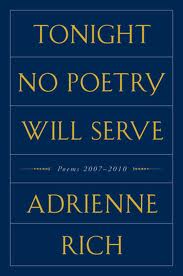
2011 National Book Award poetry nominee: Adrienne Rich, Tonight No Poetry Will Serve

It's not new, this condition, just for awhile
       kept deep
in the cortex of things imagined 
Now the imagination comes of age 
I see ourselves, full-lipped, blood-flushed
in cold air, still conflicted, still
       embraced 
boarding the uncharter'd bus of vanishment.

– taken from "Confrontations" (p. 59)


With the possible exception of Yusef Komunyakaa, Adrienne Rich's collection, Tonight No Poetry Will Serve, is the most varied of the five finalists in turns of theme and poetic presentation.  She covers topics such as authority, past and present wars, internal and external conflicts, among other, more personal topics.  She cites other writers such as Chekhov ("Fracture") with lines like this:

This fine clear summer morning/ a line from Chekhov:
it would be strange not to forgive.

(I in body now alive)

All are human/ give/ forgive
drop the charges/ let go/ put away

These lines never follow a determinate scansion but instead are protean in their ability to adapt the lines to suit the mood and tone of the emotions being explored in these pieces.  For most of her poems, Rich captures the subtleties of human interactions.  "Confrontations" is one of my favorites from Tonight No Poetry Will Serve because I can "hear" within its lines those pauses, those little caesurae that allow the reader to hesitate, to ponder not just the word choice but their import within the poem.  The image of boarding the "uncharter'd bus of vanishment" sparks thoughts on how each moment of our imagined, conflicted lives allows us, if only for a moment, to wander through unexplored thoughts before those daydreams burst like soap bubbles. 

Although several of Rich's poems depend upon nuance and slow understanding, in some of her poems, such as "Ballade of the Poverties," she hits the reader full-force with some unsettling images:

There's the poverty of the cockroach kingdom and the rusted toilet bowl
The poverty of to steal food for the first time
The poverty of to mouth a penis for a paycheck
The poverty of sweet charity ladling
Soup for the poor who must always be there for that
There's poverty of theory poverty of swollen bully shamed
Poverty of the diploma or ballot that goes nowhere
Princes of predation let me tell you
There are poverties and there are poverties.

Here she goes beyond the metaphorical and into the realm of the concrete.  Most of us have known others who have experienced these poverties; perhaps some of us have experienced them first-hand.  There is no sidestepping the brutal realities on display here; our world is a harsh, tragic place, sometimes.  When juxtaposed with the more personal pieces, "Ballade of the Poverties" and a few others like it help make Tonight No Poetry Will Serve into a diverse yet uniformly excellent collection that is worthy of its nomination for the 2011 National Book Award.


Sunday, November 13, 2011

2011 National Book Award poetry nominee: Nikky Finney, Head Off & Split

By forty-two, you have pieced & sewn many things together in segregated Alabama.  You have heard "Nigger Gal" more times than you can stitch yourmanners down.  You have smelled fear cut throughthe air like sulfur iron from the paper mills.  The pants,shirts, and socks that you have darned perfectly, routinely,walk perfectly, routinely, by you. (Afternoon.  How do.)Those moving along so snug in your well-made, well-sewnclothes, spit routinely, narrowly missing your perfectlypressed sleeve.
taken from "Red Velvet"


Of the five finalists for the 2011 National Book Award for Poetry, Nikky Finney's Head Off & Split is easily the most political.  In poems such as "Red Velvet" (quoted above) and "The Condoleeza Suite," Finney skewers not just old-time segregationist ideology, but also neo-Conservatives such as former Secretary of State Condoleeza Rice and President George W. Bush.  Finney pulls no punches, as evidenced in lines such as the ones quoted above, where she directly confronts the social hypocrisies of the day (and of today).

There are advantages to being so direct and concrete in verse.  There certainly is little chance that readers aware of the issues Finney addresses will miss the thrust of her poems.  Yet such directness can risk turning deftly-worded verse into sledgehammer lines that bludgeon readers into submission or flight.  Although there are a few occasions here and there where Finney goes to the well one too many times, for the most part, she varies the rhythm of her free verse and peppers them with indelible images, such one stanza of "Dancing with Strom":

The favorite son of South Carolina has already
danced with the giddy bride and the giddy bride's
mother.  More women await:  Easter dressy,
drenched in caramel, double exposed, triple cinched,
lined up, leggy, ready.

Lines such as these make Head Off & Split wonderful to read, as Finney certainly constructs powerful metaphors to support the points she makes in her poems.  However, there are limitations to having the vast majority of the poems being about political/racial issues.  Regardless of how powerfully Finney makes her points, the poems risk being bent to serve the purpose of the ideas rather than the ideas being subsumed into poems that can capture a multitude of moods and serve multiple purposes.  I found it difficult to say much more than "Finney makes her points with eloquent and moving lines" because there is no ambiguity to the verses that allows me to ponder what she might possibly have meant and whether or not my initial interpretations may have been correct.  Head Off & Split makes for a great initial read, but I am hesitant to state it would be as worthwhile on re-reads as the previous poetry finalists will be.


Saturday, November 12, 2011

2011 National Book Award poetry nominee: Yusef Komunyakaa, The Chameleon Couch

You wish to know if I cherished a thought
     beyond lore & decorum, if a bloodless virtue
like some fury of wings beating in a cage
     ushered me beyond paradise.  Unbelievable
as I am, I shall say this:  if I am Beatrice
     or Beatitude, muse or pale siren, I am flesh
born to another dream of flesh.  If I am clay,
     it is the same merciless clay you are made of,
with a red vein of iron running through it, the same
     naked prayer in the dark holding the song together.
 
– from "Flesh" (p, 68)

Compared to the more overt thematic union of Bruce Smith's Devotions and Carl Phillips' Double Shadow, it is not as easy to discern a unifying theme to Yusef Komunyakaa's thirteenth poem collection, The Chameleon Couch.  Unless perhaps one looks at the various skins Komunyakaa inhabits in his poems (here at the beginning of "Flesh" he references Dante's muse/idealized love, Beatrice) and sees chameleon-like qualities to the sometimes languid, sometimes frantic poems found in this 115 page collection.  When reading this collection for the first time last week and even more when I thumbed through it earlier tonight, I was reminded of a jazz beat that plays in the background, altering its rhythm from 4/4 time to whatever beat was needed to imbue a poetic piece with its own unique melody.

At times, Komunyakaa reminds me of Walt Whitman in his joie de vivre, particularly in a little line found in "Aubade at Hotel Copernicus":

A blade of grass in a bottle made me sing
& count footsteps to the hotel.
At other times, for example in the conclusion to "Fata Morgana," there were echoes of the wistfulness found in several of Emily Dickinson's poetry:

...I knew beforehand
what surrender would look like after
long victory parades & proclamations,
& could hear the sounds lovemaking
brought to the cave & headquarters.

Yet at no point do Komunyakaa's poems feel like mechanical reproductions of original verse and meter.  Instead, his poems insinuate that there is a commonality with past masters, but without ever aping the complete style of any particular source.  Komunyakaa references the past, both historical and poetic alike, but he does not linger overlong in any locale or poetic metaphor.  We might see mention of a succubus or labyrinth, but he does not belabor the initial associations we might make with citing "We Shall Overcome," as he quickly moves on in a poem such as "Green" to say:

I've known how "We Shall Overcome"
feels on a half-broken tongue,
but not how deeply sunsets wounded the Peacock Throne.

If a synonym needed to replace the titular "chameleon," the closest and most apt would be "protean."  Komunyakaa's narrators, as well as their themes and references, morph from poem to poem, never staying constant, unless one were to argue that their inherent mutability is the point of these poems and that each interconnects with another to create a thematic mosaic that is more intricately interlocked because of the disparate nature of the poems and their meters.  For some, this might make for a disjointed read, as the reader would need to understand global myths and stories in order to connect most of the narrative dots found in Komunyakaa's poetry.  But for those willing to put forth this effort to process what s/he is reading, The Chameleon Couch will be a rewarding experience.


2011 National Book Award poetry nominee: Carl Phillips, Double Shadow

...Brokenness, you do surprise me –
here I could have sworn I'd lost my taste for you,
you being an accident like all the others that, one
by one, constellate, first becoming a life, and then
as if the only one, as if no other were possible.  Since
when does that make a world?  Whose business
but mine is it if now, when I grieve, I grieve
this way:  crown in hand, little flowers of gold? 
from "Glory On" (p. 34)

Some people listen to the same song, over and over again, when emotion overwhelms them and they seek comfort in verse and song.  Others burst out in a melody either borrowed or composed from the vibrating life strings.  For myself, I turn to poetry when I need an emotional salve.  Although I had planned to write a review of Carl Phillips' Double Shadow for days now, perhaps it was fate or (mis)fortune that I had the book image saved and the labels ready for me to write of the nearly three dozen poems that appear in this slender 58 page collection before I received word this morning that my maternal grandmother had died this morning after battling dementia for over three years.  I re-read several of the poems in Phillips' collection, as several deal with that "double shadow" that constitutes life, death, and the struggles between eros and thanatos, until I read the final half of "Glory On" and I found something that resonated closely with my own situation.

Later, I will write more about the importance of my grandmother in my life as a reader, perhaps after her funeral Monday, but I do want to look at the lines I quote above.  Although I had thought I was long prepared for this day, it still surprised me with its sudden ache.  As a child, I remember vividly three family members dying within two years of one another.  I recall the heartache and confusion at learning over and over again what death is.  There were times that I would come close into sinking into that pattern outlined above, where such trauma "first becoming a life, and then/as if the only one, as if no other were possible."  Phillips nails it here for me, that peril of fetishizing loss and grief.  But how we deal with grief can change with time and what business is it, I find myself asking in response to the narrator here, how I grieve?  Maybe it's best to celebrate the release that has taken place from that most hideous of terminal illnesses (some may argue cancer is worse, but would you want to lose your personality and what makes you you rather than dealing with acute physical pain and discomfort?  'Tis a horrible choice), as what made my grandmother herself had mostly died in the weeks and months before her body shut down due to further destruction of the brain tissue.  "Crown in hand, little flowers of gold;" doesn't that sound as though there is some vague optimism through the grief at hand?

Phillips' other poems also speak of the complexities of life and our frustrations, fears, and hopes.  Take for instance the imagery of bells in "The Heat of the Sun":

...Maybe the mistake
of hoping
          never to make mistakes is the only
pattern we get to leave behind us:  no bells – just
a calmness, after; the air so clear, we forget what
hurt so much and, in forgetting it, think it's disappeared.

Bells ring to mark special occasions:  marriages, ceremonies, calls to worship, death tolls.  What happens when they stop ringing and the air is calm?  Phillips suggests ambiguously that there is a forgetting, whether that is for good or nil is up to the reader to decide.  Something else to consider, I suppose.

There are so many other examples that I could quote to illustrate Phillips' adroit use of metaphor to reflect upon the nuances in our lives.  Lines such as this taken from the first poem in the collection, "First Night at Sea":

...As affection was never 
twilight, but a light of its own, blindness not at all
a gift to be held close to the chest, stubborn horse
meanwhile beating wild beneath it, stubborn heart,
a dark, where was a brightness, a bright where dark.

The dualities here between light/twilight and blindness/sight set the tone for the remaining poems.  Phillips does not suggest answers, only possibilities.  This, however, is more than sufficient, as it allows the reader to adapt these lines to suit his/her needs.  When beginning (or ending) the grieving process, there is some hope to be found in "a bright where dark," or conversely, a sense that the narrator can sympathize when there is "a dark, where was a brightness."  Our emotions, as Phillips reminds us in this excellent but short collection, are ours to treat as we may.  Sometimes poetry serves to remind us of those conflicts and contradictions that dwell within us.  Double Shadow certainly does this and I am grateful that I had this in my possession when I learned the expected sad news this morning.


2011 National Book Award poetry nominee: Bruce Smith, Devotions

I backed away from the revolving door to let the man
stir himself in.  He looked like he had served two-thirds of his time,
(I had worked at Lewisburg.  I knew an ex-con
when I saw one) – and now was on parole, careful to defer to the pushy,
the striving, the vaulting who have inherited the earth since his send up
for his crimes.  He had been, in my mind, among the slightly more vicious,
fraudulent, and unruly, and thank Bush for jails.
quoted from "Devotion:  Changeling" (p. 39)

Bruce Smith's sixth poetry collection, Devotions, is replete with poems such as "Devotion:  Changeling."  These opening lines serve to paint a vivid picture of a drifter perhaps, someone who has seen rough times and whose "look" is that of a released criminal who approaches the world and its people in a way different from those who are sitting comfortably in their chairs, reading this short review, perhaps after thinking of their jobs or their studies or something that seems of paramount interest to them.  Yet there are questions overlaying the text here.  Who is the narrator?  How does s/he know what to look for when looking at a possible ex-con?  How is that person's judgment, of the "slightly more vicious,/fradulent, and unruly, and thank Bush for jails," come into play here?  The tone is that of someone who has working knowledge of criminals and yet is not one him/herself (I waver on the possible genders of this narrator, as male and female narrators very likely could approach this in different ways, even when using the same words).  Then I read on:

... I looked up at him
who was looking at me, a man my age, my changeling, with a face
come into the face he deserved at sixty, a felonious face shadowed there,
inside the building and wearing clothes I once wore, but shabbier, dingier,
the worse for wear, and around him a caged halo like submarine creatures
have in dense refracted light.

Opinions shift.  Certainly a male now and one has his own past issues.  A changeling, someone who could have been that narrator, yet who now is seen as a fraud, one who is "shabbier" and "the worse for wear," certainly not what the narrator himself has come to be.  Still mysteries to be resolved, such as the "devotion" the narrator's father had (stated to be an elementary school teacher) to being small in the world and how this contrasts with the changeling's hardened ex-con view of the world around.

"Devotion:  Changeling" is but one of about 60 poems that appear in Devotions.  The majority of these poems have a similar free verse structure, where the narrators muse and reflect on their lives, their (and others) devotions to things such as baseball games, car wrecks, dusk, nature, the city of Syracuse (Smith is a professor there), and the Midrash, just to name a few of the topics (and devotions) that he explores.  It is easy to get lost in reflections on that maddening game of baseball, which Smith captures so eloquently in "Devotion:  Baseball":

Pinetar, a sluice of tobacco, sunflower seeds, and juju.
Lena Blackburne rubbing mud, gum, the glues and salves
for doing things fairly – one out of three
swipes at the ball and a flare to right, a dying quail, a 3-
2 change popped up with a shitfuck, handcuffed, tomahawked
the high hard stuff or took a backwards K when made to look ugly
as we often were:  Humility 3 Arrogance 1 after seven innings.

In "Devotion:  Changeling," I had only a vague, reflecting musing on the poem's message, but here in "Devotion:  Baseball," having grown up in a baseball-loving family (and having suffered miserably for three years from 9-11 playing it before realizing that a bad right eye kept me from seeing the ball's rotation until it was too late to connect sweetly), something emotional clicks.  I can not just visualize the action, but I am reacting to it, I am thinking of the "please, oh please God, let Gibson on his two bad knees be able to get a hit off of Eckserley" back in October 1988 and the jubilance when he hit that memorable pinch-hit homerun.  Smith captures the triumphs of pitfalls of that cruel game in just a few lines.  "Humility 3 Arrogance 1 after seven innings" – so true.

The other poems are similar in that they take our musings, our vague and sometimes disjointed dreams and yearnings, and they present them in free verse.  Smith's poems are almost uniformly evocative and they improve upon multiple re-readings.  Devotions will be a collection that I will revisit in the years to come.  Certainly worthy of its nomination for the 2011 National Book Award.


Thursday, November 10, 2011

2011 National Book Award YA nominee: Franny Billingsley, Chime

I've confessed to everything and I'd like to be hanged.

Now, if you please.

I don't mean to be difficult, but I can't bear to tell my story.  I can't relive those memories – the touch of the Dand Hand, the smell of eel, the gulp and swallow of the swamp.

How can you possibly think me innocent?  Don't let my face fool you; it tells the worst lies.  A girl can have the face of an angel but have a horrid sort of heart.

I know you believe you're giving me a chance – or, rather, it's the Chime Child giving me the chance.  She's desperate, of course, not to hang an innocent girl again, but please believe me:  Nothing in my story will absolve me of guilt.  It will only prove what I've already told you, which is that I'm wicked. (p. 1)


Ever read a book that had a powerful first-person narrator, one who promised mysteries and deceptions from the very first page?  A story that contains hidden folk legends, threats of death due to being something alien to the surrounding population?  And despite it being "good" in terms of prose presentation, characterization, and even plot, it just doesn't "click" for you?  If so, you might understand my initial reaction while reading Franny Billingsley's Chime.

Chime is set in a remote village/swamp region, the Swampsea.  Young Briony, who learns she can see the Old Ones (akin to the Brownies of Celtic legend), believes that she is evil, that she has caused her stepmother's death and her sister's incapacitation.  She worries that the secret she is hiding, that she is a witch, will lead to her death.  Therefore she throws up protective barriers, both physical (removing herself from the hum-drum of village life) and emotional (refusing to become close to others).  This changes with a leonine man-child, Eldric, appears and he begins to assault those barriers that she has cast up between her thoughts and her emotions.

On the surface, such a tale can either be trite, treacly rehashing of romantic tales or it can be a moving, emotionally charged work despite (because of?) these elements.  For the most part, Billingsley avoids creating an Edward Cullenesque male lead that sucks (pun intended) the soul out of each scene.  There is a charming naivety about them and how the two grow closer to one another, yet it never completely goes off the rails into the realm of smothering romance.

Yet despite Billingsley's obvious talents as a writer, Chime just did not appeal to me as a reader.  This is not an indictment of Billingsley or her story, but rather an admission that some stories just will not appeal to certain readers.  Having read several earnest socio-historical books just prior to reading Chime, it was jarring to read a fantasy/suspense/romance story, even one that is as well-written as Billingsley's.  I found myself losing my focus while reading it, craving something else, ultimately forcing myself to soldier on in order to complete writing reviews of the five shortlisted titles in the Young People's Literature category.  This is not fair to the novel, but yet in reviewing the novel, this sense of disconnect has to be noted.

Despite this estrangement between text and reader, most other readers are likely to find Chime a charming read.  As noted above, its prose is a notch above what might be expected in this subgenre of YA literature.  The characterizations are likely appealing to most and the plot flows swiftly towards a conclusion that will be satisfying to many readers.  Unfortunately, I cannot number myself among the satisfied readers and it is with some regret that I consider Chime to be out of step with the other National Book Award finalists, as their narratives and stories were much more to my liking, as well as most of them being strong narratives in their own right. 
 
Add to Technorati Favorites