The OF Blog: Umberto Eco
Showing posts with label Umberto Eco. Show all posts

Sunday, February 21, 2016

A few thoughts on the passings of Harper Lee and Umberto Eco

This past Friday saw the passing of two of my favorite writers, Harper Lee and Umberto Eco.  For very different reasons, each has influenced me as a reader.  At the risk of writing treacly tripe, I just wanted to share a bit about what I enjoyed about their works.

I first encountered Lee's To Kill a Mockingbird as part of my college prep junior English summer reading list.  Although there were several other "worthy" books there that I also enjoyed (Daniel Keyes' Flowers for Algernon being one of them), there was something special about Lee's book that took me years to understand.  Perhaps it was a shared affinity for our hometowns, despite the ugliness that underlay local society.  Perhaps it was just the games of youth created before the age of internet and advanced video games that captivated me.  Or maybe it was this nascent, barely self-aware, sense of outrage at the world's cruelties that fascinated me.  But I suspect, in addition to these possibilities suggested to me through my experiences as an adult, what I really enjoyed about To Kill a Mockingbird was that it was a story of juvenile growth that did not dismiss the worries and concerns of childhood, but instead it was a story of humaneness in the midst of casual injustice.

Lee's interest in exploring Scout's growing awareness of the social hypocrisies around her is seen even further in the pre-Mockingbird draft, Go Set a Watchman, that was published last year.  Despite the controversies surrounding its publication and some of the character arcs, I found that novel exploring certain intriguing avenues (such as Jean Louise's clashes with her father and uncle) that the later To Kill a Mockingbird obfuscated due to its switch in focus to Scout's formative years.  As a Southerner who has conflicted views about his native region, I found Lee's exploration of similar concerns to be comforting, as her characters worked through certain doubts and conflicts in a fashion that enabled me to work through my own issues as a teenager.

But if Lee's works sparked an emotional response to matters of society and racism (and the hypocrisies that exist at their merging bounds), then Umberto Eco's works, fiction and non-fiction alike, stimulated a more intellectual response to human conflicts and the desire to understand collected knowledge.  I remember first discovering Eco by accident a little over twenty years ago, when I was outside looking through the free bin at the Knoxville McKay's used book and music store when I discovered a battered paperback, missing the front cover.  The blurb about a medieval mystery intrigued me, so I kept it for Christmas Break reading a few weeks later. 

Having taken courses in medieval intellectual history and Latin provided me with some insights into what Eco's characters were discussing and what really fascinated me was how easily he mixed the arcane with the familiar, the secular with the religious.  There was a very palpable narrative tension (William Weaver did an outstanding job with the translation; the original Italian was only slightly smoother in shifting between the erudite discussions in Latin and the vernacular) throughout the novel, yet the source of this tension was something I had never really encountered in fiction before.  Over the next few years, I read his latter novels (reading the last three soon upon their publications, the last two in Italian before the English translation was published) and found myself mesmerized by how he could mix in conspiracy theories, legenda, and humor to create engrossing tales.

Yet the more I read Eco, the more curious I became about his non-fiction.  I knew something of semiotics from grad school, but reading translations of Serendipities, Kant and the Platypus, and Mouse or Rat?, not to mention his illustrated books on beauty, ugliness, and lists, deepened my appreciation for him as a thinker.  Reading Eco is not best for more passive readers.  He wants the reader to engage with the texts, both as if they were veritable scriptures and as if they were elaborate forgeries that had to be cracked.  He "lies" to us, or perhaps reveals our possible self-deceptions through his examination of texts.  As he states in the opening chapter, "The Force of Falsity," to Serendipities regarding historical forgeries:

And yet each of these stories had a virtue:  as narratives, they seemed plausible, more than everyday or historical reality, which is far more complex and less credible.  The stories seemed to explain something that was otherwise hard to understand. (p. 17)
This "falsification" of the inexplicable in order to create coherency (albeit not a truthful one) is something he explores in multiple fashions across his works.  It is, as he said in the introduction to his book Dire Quasi la Stessa Cosa (Saying Almost the Same Thing):

Ecco il senso dei capitoli che seguono:  cercare di capire come, pur sapendo che non si dice mai la stessa cosa, si possa dire quasi la stessa cosa.  A questo punto ciò che fa problema non è più tanto l'idea della stessa cosa, né quella della stessa cosa, bensì l'idea di quel quasi. (p. 10)
This is the meaning of the following chapters: trying to understand how, despite knowing that although one never says the same thing, you can say almost the same thing. At this point the problem arises is not so much the idea of the same thing, nor that of the same thing, but the idea of that almost.

As my Italian reading comprehension is weaker than my Spanish or Portuguese, the translation is likely "rough," but yet that roughness and imprecision serves to underscore Eco's point.  It is never about saying the exact thing, providing the exact truth, but rather it's more about those almost truths from which we construct our understandings of the world and our perceived realities.  Embedded within this are our semantic memories (a topic he explores within his relatively underrated The Flame of Queen Loana), the fount from which our world views arise.

In reading Eco, especially his non-fiction, I found my interpretations of reality to be tested.  Certain narratives were rejected in favor of other, perhaps equally "false" but still more plausible, ones.  Sometimes it felt as though I were slowly being let in on a grand joke, albeit one in which I was partially the punchline.  In re-reading some of his works these past two days, I cannot help but feel we have lost a great thinker and forger of plausible lies.  Coupled with the emotional resonance I found in Lee's work, these two now-departed writers perhaps, more than most, if not all other writers, have helped mold me as a reader.  But while in certain senses the Authors are Dead, their texts still live on.  Now to free up some time to delve back into them and see how I shall be touched again on a re-read and how I might still be transformed as a reader.


Monday, December 30, 2013

Best of 2013: Non-Fiction


2013 Non-Fiction Read:


Lauren Elkin and Scott Esposito, The End of Oulipo?
Justin Landon and Jared Shurin (eds.), Speculative Fiction 2012
Carolyn Dalgliesh, The Sensory Child Gets Organized
Martín Arias and Martín Hadis, Professor Borges:  A Course on English Literature
Naoki Higashida, The Reason I Jump
Giacomo Leopardi, Zibaldone
Wendy Lower, Hitler's Furies
John Lewis, Andrew Aydin, and Nate Powell, March: Book One
Al Gore, The Future
Denise Kiernan, The Girls of Atomic City
Gene Yuen Yang, Boxers/Saints
Umberto Eco, Storia delle Terre e dei Luoghi Leggendari 
Umberto Eco, Le Sette Meraviglie
George Packer, The Unwinding

I read more non-fiction in 2013 than in any of the previous four or five years.  There were popular histories, collections of essays (including one in which two 2012 pieces of mine appeared), autobiographies, graphic novel renderings of histories, art books in Italian, translations from Italian and Japanese, guides to help people understand special needs children, and a transcription of a college lecture series.  Even the one book on the above list that appears on my Most Disappointing Releases list will hold quite a bit of interest for the lay reader (alas, I cannot claim to be such when it comes to the Nazi era).  I learned a lot from reading these books (the Dalgliesh and Higashida in particular opened my eyes further when it came to sensory/children with autism and both provided insight that has helped me immensely at both of my current jobs) and hopefully in the years to come I will discover even more excellent non-fictions that will educate me as much or more as these did this year.  Now for the list of the three that have stuck with me the most:

3.  John Lewis, Andrew Aydin, and Nate Powell, March:  Book One
I discussed my reasons for liking this graphic novel rendering of Rep. John Lewis's early life up to the 1960 Nashville sit-ins in my previous listing of graphic novels and anthologies read this year.  It is a book that I would love to use as a supplementary reading material if I ever choose to teach 11th grade US History again.
2.  Umberto Eco, Storia delle Terre e dei Luoghi Leggendari 

Excellent art/history of how people over the centuries have envisioned both real and legendary lands near and far.  See my earlier comments in my listing of the best foreign language works released this year.

1.  George Packer, The Unwinding 

Winner of the 2013 National Book Award for Non-Fiction.  Packer interviewed several Americans from all walks of life, from tech founders to those who lost their jobs when the physical economy began to shift toward a service economy in the late 1970s.  Each of these Americans' stories are fascinating and Packer does an excellent job in breaking these narrative threads into chronological years that show the various ways in which people even conceive of "America" has changed since 1980.  One of the best books I've read this year.

Sunday, December 29, 2013

Best of 2013: Foreign Language Works

2013 Foreign Language Works:  

João Barreiros (ed.), Lisboa no Ano 2000 (Portuguese)
Alliah, Metanfetaedro (Portuguese)
Ildefonso Falcones, La reina descalza (Spanish)
José Ovejero, La invención del Amor (Spanish)
Umberto Eco, Storia delle Terre e dei Luoghi Leggendari (Italian)
Umberto Eco, Le Sette Meraviglie (Italian; e-book-only)
João Tordo, O Ano Sabático (Portuguese)
Mariano Villarreal and Luis Pestarini (eds.), Terra Nova:  vol. 2 (Spanish)

Despite making an effort to read at least a 1/3 of my 2013 total reads in a foreign language (current count has me at a little over 180 books read in a language other than English), it is very difficult to get very recent works.  Thankfully, more and more publishers are releasing e-editions (more so on iBookstore than on the Kindle store, I've noticed) where US readers such as myself can read them.  Three (and one of those, Lisboa no Ano 2000 was sent to me as a review copy by the publisher) of the books listed above were purchased books; the other five were e-books.  The genres are also varied, with three being SF/F, one historical fiction, two non-fiction/art books, and two more contemporary fictions.  Likely about half of these books will be translated into English in the near future (the first Eco already has, the Falcones is a near-certainty, and I suspect Ovejero and Tordo will see their works translated at some point).  All in all, the number of strong literary works belies the paucity of numbers on this list.

3.  José Ovejero, La invención del Amor 

This 2013 Premio Alfaguara winner is about love, yes, but even more about us humans who "invent" it in order to connect with one another.  I plan on re-reading it and writing a formal review sometime in 2014.

2.  João Tordo, O Ano Sabático

Tordo won the Premio Saramago for an earlier work, As Três Vidas and while I wouldn't go as far as to say that his latest matches that excellent work, it does come very close.  His characters, particularly the protagonist Hugo, are dynamic, fully-realized, with memorable scenes.  Will be reading more of his works in 2014.

1.  Umberto Eco, Storia delle Terre e dei Luoghi Leggendari

This is the fourth in a series of non-fiction/art books that Eco has written in recent years.  This time, the subject is the fantastical lands created by millennia of explorers, writers, and other mythmakers.  The accompanying art is beautiful and the essays are erudite without being too overwhelming for readers.  Although I think Eco's books on Beauty and Ugliness are better, this volume is one of the best books I've read this year.  A must-own/read for most sorts of readers (the English translation is already available).

Tuesday, August 28, 2012

Which of these rings truest to you?

I am slowly making my way through Umberto Eco's Dire Quasi la Stessa Cosa (much of the content can be found in two separate books on translation, Mouse or Rat?  Translation as Negotiation and Experiences in Translation), as it takes some time to digest the points Eco is making regarding the choices with which translators are faced (well that, and reading it in Italian to see what was included here that wasn't in the English-language books).  Here was an interesting passage regarding one of Dante's poems dealing with Beatrice.  I'll quote the original first and then provide the four English translations Eco provides (bold in the original is due to Eco's emphasis on certain words):

Tanto gentile e tanto onesta pare
la donna mia, quand'ella altrui saluta,
ch'ogne lingua deven tremando muta,
e li occhi no l'ardiscon di guardare.
Ella si va, sentendosi laudare,
benignamente d'umiltà vestuta;
e par che sia una cosa venuta
da cielo in terra a miracol mostrare.

Here is how Dante Gabriele Rossetti translated his namesake:

My lady looks so gentle and so pure
When yielding salutation by the way,
That the tongue tremble and has nought to say,
And the eyes, which fain would see, may not endure.
And still, amid the praise she hears secure,
She walks with humbleness for her array;
Seeming a creature sent from Heaven to stay
On earth, and show a miracle made true.

And now one from Mark Musa:

Such sweet decorum and such gentle grace
attend my lady's greetings as she moves
that lips can only tremble in silence
and eyes dare not attempt to gaze at her.
Moving, benignly clothed in humility,
untouched by all the praise along her way,
she seems to be a creature come from Heaven
to earth, to manifest a miracle.

And Marion Shore:

My lady seems so fine and full of grace
When she greets others, passing on her way,
That trembling tongues can find no words to say,
And eyes, bedazzled, dare not meet her gaze.
Modestly she goes amid the praise,
Serene and sweet, with virtue her array;
And seems a wonder sent her to display
A glimpse of heaven in an earthly place.

And finally, Tony Oldcorn's 2001 translation:

When she says he, my baby looks so neat,
yhe fellas all clam up and check their feet.
She hears their whistles but she's such a cutie,
she walks on by, and no, she isn't snooty.
You'd think she'd been sent down from the skies
to lay a little magic on us guys.

Each of these translations diverges in some form or fashion from Dante's original text.  It might be a deviation of a word or phrase in order to make a passage rhyme in ABBCCDDA (Rossetti, Shore), 10 syllable lines (Musa), or even a total rehauling of the imagery (Oldcorn).  Yet the "truth" of a translation does not necessarily lie within its lack of deviance from the original's form.  With this in mind, which of the four translations do you think "feels best" or "truest" to you?

Tuesday, November 29, 2011

Umberto Eco, The Mysterious Flame of Queen Loana

"...I no longer knew how to go forward, and I didn't know how to go forward because I had lost what came before.  That's it, that's how I am.  I'm holding a long note, like a stuck record, and since I can't remember the opening notes, I can't finish the song.  I wonder what it is I'm supposed to finish, and why.  While I was singing without thinking I was actually myself for the duration of my memory, which in that case was what you might call throat memory, with the befores and afters linked together, and I was the complete song, and every time I began it my vocal cords were already preparing to vibrate the sounds to come.  I think a pianist works that way, too:  even as he plays one note he's readying his fingers to strike the keys that come next.  Without the first notes, we won't make it to the last ones, we'll come untuned, and we'll succeed in getting from start to finish only if we somehow contain the entire song within us.  I don't know the whole song anymore.  I'm like...a burning log.  The log burns, but it has no awareness of having once been part of a whole trunk nor any way to find out that it has been, or to know when it caught fire.  So it burns up and that's all.  I'm living in pure loss." (p. 37)

What makes each of us a "human being?"  Even that compound word, "human being," implies a sort of dynamic action, where the living person is in a fluid state between conception and death.  What are we "being?"  A series of actions, thoughts, mistakes, deceptions, and attempts to wrest order out of chaos seem to delineate human beings from rocks, trees, or even squirrels.  We are constantly "being" because of our attempts, benighted as some might see them, to remake and reorder our environs, to utilize that evolutionary tool called "memory" to recall, however imperfectly, our past experiences, never permits us to be static; we have to keep living in order to postpone dying, whether that be a metaphorical or biological death.

But what if our memories were taken from us?  What if we could not recall why that ray of sunshine shining through the patio makes us sigh and smile wistfully?  What if we hear a voice and do not associate that voice with a lover, with a child, or with a friend?  If our identity, those things that we devise to center ourselves at the crux of so many semantic associations, is lost, then who are we?  Are we that burning log described above, burning but without knowing that it was once part of something grander?

This is the issue that Umberto Eco tackles in his fifth novel, 2004's La Misteriosa Fiamma della Regina Loana, published in English translation in 2005 as The Mysterious Flame of Queen Loana.  A late middle-aged (roughly 60 years old) rare books dealer, Yambo, wakes up in a Milanese hospital in 1991 (roughly around the time that the Persian Gulf War ends, based on internal evidence) with no memory of his individual past, only the snippets of information that he learned from songs, comic strips, poetry, and prose.  Over the next couple of months, he is reintroduced to his family, his assistant (and possible mistress?) and friends before visiting his childhood home in Solari, where a treasure trove of material from his youth is stored at the family residence.

Eco is renowned for his erudite cataloging of minutiae, errata, and other material evidence of belief structures (he was a leading semiotics professor before he became a novelist in 1980).  At first glance, The Mysterious Flame of Queen Loana would seem to share little with works such as The Name of the Rose, Foucault's Pendulum, The Island of the Day Before, or Baudolino, as the narrative is grounded firmly in the present and there are no esoteric theories on reality or the structure of the universe on display.  Even the narrative contains a deceptively simpler, more personable tone to it.  Yet appearances can be deceiving.  Re-reading The Mysterious Flame of Queen Loana two years after reading his non-fiction The Infinity/Vertigo of Lists, there are certain parallels can be made between those two works and from there with his other novels.  Yambo's exploration of his past through the comic books and penny dreadful-type pulp novels that were common reading materials of Italian youth in the 1930s and 1940s opens up new possibilities.  How would we be affected if we were to see beloved childhood texts for the first time in years?  Would we have deep associational memories attached to say Harold and the Purple Crayon or Happiness is a Warm Puppy (two of my earliest books that I read)?

As Yambo delves into this obscured literary/personal history, he begins to recall more and more information.  The "fog" that he often would note (and quote from divers literary sources) starts to dissipate, with interesting new connections being revealed.  When I first read The Mysterious Flame of Queen Loana, I found these recalled memories and associations to be almost impenetrable, as they were not images of my generation (just as perhaps the post 9/11 generation might not fully grasp what the Iranian hostage situation or the Challenger explosion meant to my age cohort) and there was a barely-perceived invisible barrier that kept me from understanding what was transpiring during the latter quarter of the novel.  Although still difficult at times to process during the recent re-read, the combination of nostalgia and recalling of past dreams and memories is more understandable to me now that I'm nearing middle age.  Interesting how perceptions can change with time and experience, something that I suspect Eco had at least partially in mind as he was constructing this novel.

Despite The Mysterious Flame of Queen Loana being different in structure and focus from his previous novels, I still found it to be a challenging yet ultimately rewarding read.  It may not present at first the formidable challenges that his most famous works do, being that it is centered around a nearly-average man's struggle to recall his life and first love, but it too contains layers of depth that make it a novel that deserves several re-reads spaced out over a long period of years for more of its hidden treasures to be revealed to readers.  Eco is never an "easy read," but like its predecessors, The Mysterious Flame of Queen Loana is a worthwhile read for those readers who want a deeper challenge than what they typically find in most literature today.

Monday, November 07, 2011

Umberto Eco, The Prague Cemetery

24 marzo 1897 
Provo un certo imbarazzo nel pormi a scrivere, come se mettessi a nudo la mia anima, per ordine – no, perdio! diciamo su suggerimento – di un ebreo tedesco (o austriaco, ma fa lo stesso).  Chi sono?  Forse è più utile interrogarmi sulle mie passioni che sui fatti della mia vita.  Chi amo?  Non mi vengono in mente volti amati.  So che amo la buona cucina:  al solo pronunciare il nome de La Tour d'Argent provo come un fremito per tutto il corpo.  È amore? 
Chi odio?  Gli ebrei, mi verrebbe da dire, ma il fatto che stia cedendo così servilmente alle istigazioni di quel dottore austriaco (o tedesco) dice che non ho nulla contro i maledetti ebrei. 
Degli ebrei so solo ciò che mi ha insegnato il nonno:  – Sono il popolo ateo per eccellenza, mi istruiva.  Partono dal concetto che il bene deve realizzarsi qui, e non oltre la tomba.  Quindi operano solo per la conquista di questo mondo. (p. 11)
March 24, 1897
I feel a certain embarrassment in having to write, as if my soul were laid bare, at the order – no, for God's sake! we say at the suggestion – of a German Jew (or Austrian, it is the same).  Who am I?  Perhaps it is of more use to interrogate me over my passions which are the facts of my life.  Who do I love?  The faces of lovers do not pass through my mind.  I know that I love good cooking:  only pronounce the name of the La Tour d'Argent to prove how a shiver runs throughout my body.  Is it love? 
Who do I hate?  The Jews, I would like to say, but the fact that I have acceded so servilely to the instigations of that Austrian doctor (or German) says to me that I have nothing against those damned Jews. 
Of the Jews I know what my grandfather taught me:  "They are an atheistic people par excellence," he instructed.  They believe that good ought to be completed here and not beyond the tomb.  Therefore they operate only for the conquest of this world. (Translation is my own; rough draft)

Umberto Eco's novels often contain a mixture of the arcane and the profane; in his recent non-fiction book, This is Not the End of the Book, he references in a transcribed conversation with Jean-Claude Carrière his love for books that contain errata.  After dealing with conspiracy theories (Foucault's Pendulum), deliberate distortions of history (Baudolino), lost knowledge (The Name of the Rose), strange orderings of the world (The Island of the Day Before) and the frailties of memory (The Mysterious Flame of Queen Loana), perhaps it is no surprise that Eco has turned toward exploring that seamy underbelly of late 19th century European anti-Semitic conspiracy theories.  The Prague Cemetery, like its predecessors, is much more than just a look at the nationalistic mutation of anti-Semitism; it attempts to portray a civilization just prior to its violent collapse that views itself as being enlightened while its actions show otherwise.  For many, to even touch upon such a topic is too outre for their liking; the Vatican's official newspaper strongly condemned the novel upon its Italian release last year for the possibility of persuading readers that the vile anti-Semitic conspiracies contained within might have a kernel of truth to them.  Strange things happen when tales are told from the antagonist's point of view, among them otherwise sensible critics often missing the entire point of the novel.

At first glance, The Prague Cemetery is told through the perspective of its main first-person narrator, Simone Simonini, a master forger whose adventures stretch back from the literary present of 1897 to the immediate aftermath of the 1830 July Revolution in France.  Through his narration, full of malice and deceit, we are presented with a fractured, stained portrait of revolutionary 19th century France and Italy.  We experience Simonini's suspicion and hatred of the Jesuits (who, after the Jews, were often at the nefarious center of most conspiracy theory webs), of the conservative elements in Italy, the struggles within the Risorgimento, and behind it all, his growing and mutating hatred of Jews.  The historical 19th century saw the change in anti-Semitic sentiment from a religious-based antipathy (that the Jews were the accursed Christkillers) to a nationalist view, tempered by the emerging Social Darwinist belief in racial "survival of the fittest," in which the Jews are extra-national and thus in a world beset by a growing arms race between the dominant industrial powers (Britain, Germany, France, Austria, and to an extent Russia) they are seen as a wild card who may tilt the balance of power against any of the powers in whose fatherlands they might dwell.

Looking back on this period through the lens of the Holocaust, we may shake our heads in bafflement that such an odious ideology ever gained ground in a century full of other, more attractive "-isms" such as positivism and rationalism, yet it is that cultural/philosophical hypocrisy that makes this period so fascinating to historians and to erudite individuals such as Eco.  How willingly people self-deceive!  It is this that intrigues Eco and it is through Simonini's rantings and the other, briefer accounts given by a an anonymous third narrator and the letters of a Jesuit priest, Abbé Dalla Piccola, that these hypocrisies are laid bare.

Yet one has to be cautious when reading any of Eco's fiction, as he often seeks to play around with conceptual understandings in order to explore why falsehoods are so attractive to people.  It is rather trite to say that Simonini (and the other narrators) is an "unreliable narrator;" he is very reliable in as far as his viewpoint of the world never changes.  It is the reader who becomes the subject of unreliability here; we are, after all, notoriously inclined to swallow whole what a narrator might imply until the implications of such make us do a 180° and refute what we had earlier held as truth, despite the narrator not changing his stance at all.  This sense of narrative deceit can be unappealing to many readers; my first read of The Prague Cemetery last year left me feeling underwhelmed and a bit discomfited by what I had read and to what I reacted, yet a re-read recently led me to reassess this work.

The Prague Cemetery is not by any stretch of the imagination an "easy" or "accessible" work.  It requires the reader to be inquisitive, to ask questions, and to learn some unsettling facets of 19th century European social, cultural, and political history in order to delve further into the world that culminated with the infamous 1905 publication of The Protocols of the Elders of Zion (as well as understanding the milieu that produced that "Austrian doctor" alluded to in the translated passage above).  For some, this is not an enjoyable task, but for those readers who do know something of these topics and who are willing to sift through the intentional false leads and deceptive commentaries embedded in this novel, The Prague Cemetery may yield surprising results.


Friday, December 03, 2010

Umberto Eco and Javier Negrete Book Porn


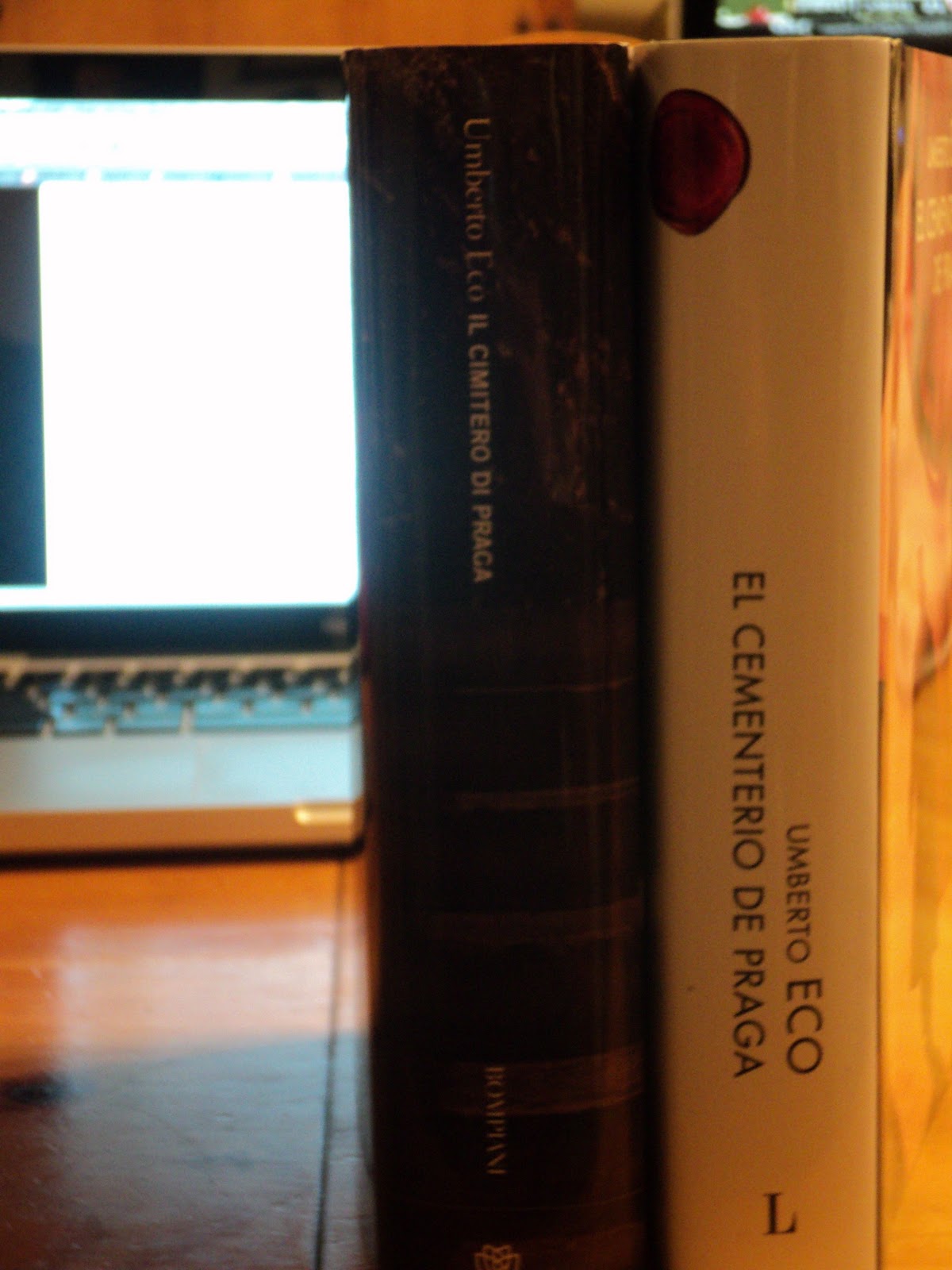
Now that my copy of the Spanish translation of Umberto Eco latest novel has arrived, I thought I'd post three pictures of that and the Italian original side-by-side for readers here to judge which is the better-made (or at least covered) edition.


For those that can read it, the Spanish edition has on its back a description of the book's contents, while the Italian is suitably black (the description there is inside one of the flaps).


Enjoy the MacBook in the background?


In addition to the Eco, I also received my long-awaited copy of Javier Negrete's latest novel, Atlántida, which so far is a fairly good book set in near-future times dealing with a possible landmark discovery of the "real Atlantis."  As with the Eco, I will review it in the near future.

So, besides choosing which Eco edition looks best, what do you make of the Negrete cover?

Tuesday, November 16, 2010

New Umberto Eco novel, Il Cimitero di Praga


I see Umberto Eco has recently published his sixth novel, Il Cimitero di Praga, and although my Italian is weaker than my reading comprehension of Spanish or Portuguese, it is good enough that I should be able to understand most, if not everything, that I read.  Interesting cover art as well; reminded of Zafón's covers for some reason.  Uncertain, but I think the English translation will be out in the next 1-2 years.

Want?


And as a bonus, here's the Spanish cover art for the book.  Very tempted to order it in both languages as an early Christmas gift to myself.

Wednesday, December 02, 2009

Umberto Eco, The Vertigo of Lists


Animals are divided into: (a) belonging to the Emperor, (b) embalmed, (c) tame, (d) sucking pigs, (e) sirens, (f) fabulous, (g) stray dogs, (h) included in the present classification, (i) frenzied, (j) innumerable, (k) drawn with a very fine camelhair brush, (1) et cetera, (m) having just broken the water pitcher, (n) that from a long way off" look like flies.

 Lists are fun.  Whether it be goals to do, things to buy, people to meet, enemies to beat, list making is a near-universal activity among humans.  From how we order our affairs to how certain religions rank their divine masters, lists also serve as a visual representation of hierarchical arrangements.  We just cannot seem to escape this seeming need to classify and to arrange objects, ideas, and people along various schema.

Umberto Eco's latest non-fiction quasi-coffee table book, The Vertigo of Lists (available in the US as The Infinity of Lists), is a continuation of his explorations begun in History of Beauty and On Ugliness.  It is in equal parts a celebration of the near-boundless human imagination and a critical look at how we classify and arrange information and how those classifications have shifted and changed with the tides of time.  As with the earlier two volumes, The Vertigo of Lists contains several dozen illustrations, literary passages, sculptures, and other material artifacts that serve as visual representations of Western culture and its values over the past five millennia.

Eco organizes this book in a loose chronological order, starting with Achilles' shield and ending up in the realm of Andy Warhol's Campbell's Soup Can illustrations.  In-between, he explores notions of how the Sublime was configured in art and literature, how medieval philosophers categorized the world, from the species to the human tongues spoken in all imagined corners of the world.  While this book perhaps would have been even stronger if there would have been more (or frankly, any) coverage of African, east Asian, and Amerindian concepts of order and time, for the most part Eco's essays complement the gorgeous artwork and moving literary passages.  Eco is very erudite and in his essays on the various aspects and uses of lists over time/space, he demonstrates a depth and clarity of thought that is vital if books such as this will be valued for more than their reproductions of artwork.

A real strength in this book is the notion that underneath the organization of lists (including Eco's own, in the form of this book) is that several questions are hinted at in Eco's discourse.  Why have lists?  What value do we derive from list making?  What do our lists say about us? (I'm finding myself wondering how Eco could have worked in Rolling Stone's annual Hot List into his essays.)

While doubtless several will find this book worth its weight in gold just for the illustrations and passages cited, I believe Eco's essays will serve to provoke quite a few questions among those readers who dare to ask themselves why things are organized in the way they are?  Why not classify animals like the Chinese did in that passage that Borges quoted and Michel Foucault lifted for his own book on classifications, The Order of Things?  Why do we have five "kingdoms" of life, from Bacteria to Protozoa to Fungi to Plants to Animals?  Why not organize it based on those organisms that are free to move and those who are relatively constrained to a single place?  While these sorts of questions are not directly raised in Eco's essays, he certainly leaves the reader free to consider the implications of the questions that he does raise there.  For this alone, The Vertigo of Lists is a valuable book.  The plenitude of inspiring artwork is just an added bonus. 

Saturday, November 28, 2009

New Umberto Eco book, The Vertigo of Lists


Only just learned about this via a search of the author's site for any possible upcoming releases.  This book was released in English translation almost two weeks ago.  I just placed my pre-order in hopes of receiving it on the 1st.  I think I just had one of my biggest bookgasms ever when I read the book description.  I guess Christmas just came early for myself!
 
Add to Technorati Favorites