The OF Blog

Thursday, February 06, 2014

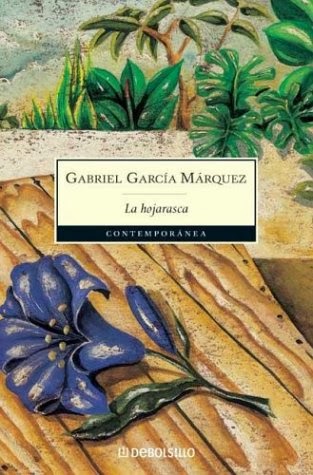
Gabriel García Márquez, La hojarasca (Leaf Storm)

Por primera vez he visto un cadáver.  Es miércoles, pero siento como si fuera domingo porque no he ido a la escuela y me han puesto este vestido de pana verde que me aprieta en alguna parte.  De la mano de mamá, siguiendo a mi abuelo que tantea con el bastón a cada paso para no tropezar con las cosas (no ve bien en la penumbra, y cojea), he pasado frente al espejo de la sala y me he visto de cuerpo entero, vestido de verde y con este blanco lazo almidonado que me aprieta a un lado del cuello.  Me he visto en la redonda luna manchada y he pensado:  Ése si yo, como si hoy fuera domingo. (p. 13)

For the first time I have seen a corpse. It's Wednesday, but I feel like it's Sunday because I have not gone to school and I have this green corduroy dress that squeezes me somewhere. From Mom's hand, following my grandfather groping with his stick at every step to avoid tripping over things (he can not see well in the dark, and is lame), I passed by in front of the mirror in the room and I've seen my whole body, dressed in a green and white starched tie that squeezes my neck to one side. I have seen myself in the round stained moon and I thought: That's like me, as if today were Sunday.

As early as his first novel, La hojarasca (1955), Gabriel García Márquez had begun to experiment with utilizing dramatic first paragraphs set in media res in order to capture immediately the reader's attention.  There is a hint here of García Márquez's memory of ice scene at the beginning of his 1967 masterpiece, Cien años de soledad, not just in the conflation of (near) death and childhood, but also in way that the present and past merge to create something that occupies a nebulous space between the two.  Yet despite this, there is a sense that La hojarasca is less nuanced, as if García Márquez were just experimenting with themes and motifs that he would explore in his later fiction.

The story revolves around the recent death of an unnamed doctor who arrived in Macondo in the wake of United Fruit's arrival, one, but an infamous one, of the wave of hojarascas (a rough equivalent in English would be drifters) that came to Macondo in the early 20th century.  This doctor was greatly despised by the villagers for reasons that only become apparent late in the story.  There are only three people, the elderly grandfather (a former colonel), his daughter, Isabel, and her young grandson, who observe any sense of decorum.  In a sense, made crystal clear by the quote provided in the epigraph, each of the three plays in some form or fashion the role of Antigone, seeking burial for the hated deceased.

García Márquez does not tell this tale in a linear fashion.  As the PoV moves between the three generations of the grandfather's family, elements that happened just recently bump up against those of decades before.  Each family member express themselves through a stream of consciousness that manages to capture the tumult of Macondo's past.  Echoes of Columbia's devastating early 20th century civil war are seen not just in the first, brief appearance of Aureliano Buendía, but also in references to other characters who gain a greater, sometimes more tragic depth in the later Cien años de soledad.  Through it all, the situation of the now-dead doctor becomes clearer and more central to other events that transpire (or are merely hinted at in certain scenes) throughout the novel.

For a first novel, La hojarasca is better than average, with themes of tragedy and solitude that are later echoed in García Márquez's later fiction.  Yet La hojarasca feels incomplete, as if there were other, more symbolic, narrative layers that García Márquez did not develop fully.  The entangled web of village hurts and anger only hints at what he later covered in subsequent Macondo stories.  The characters are sketchier, as if García Márquez was uncertain how to develop them beyond the plot exigencies.  These weaknesses, which perhaps are such when compared to the author's later works, do not make La hojarasca a poor or mediocre novel.  But they do serve as a reminder that García Márquez continued to mine the material that he developed (or perhaps discovered is a more apt verb to describe what occurs here?) to great effect in the following twelve years.  If only there were more first novels that were like this.

Wednesday, February 05, 2014

This is my 2500th post here

Hard to believe that it's been 9.5 years that I've been posting things here.  While I plan on writing something much more substantial for my 10th blogging anniversary, it is strange to look back on what I posted in 2004-2006 (and pre-dated for 2003 when I was porting interviews over from wotmania in 2009) and see the twists and turns in my reading, professional, and personal life.  Although I doubt there are many that have been there for all of the ride, for those who have been visiting for years and leaving the occasional comment, thank you.  It is hard sometimes to think of material to write and while the squirrel posts et al. are fun, hopefully there have been some posts that made you think about something in a different light. 

Now that the warm fuzziness is over, time to rile up people shortly.

P.S.  If 43 people were to respond to this, even if it were to contain squirrel spam haiku, 10,000 total comments would be reached.  Not that I'm encouraging people to spam, that is...

P.P.S.  Post #2501 will bore you.  Or maybe not.

P.P.P.S.  There was a silly point that I was going to make here, but I edited it out prior to thinking it.

Tuesday, February 04, 2014

Starting my commentaries on Gabriel García Márquez's fiction this week, other plans

Had a lot to do this weekend, so I had to postpone until later this week (most likely Thursday) my series of commentaries/short reviews of Gabriel García Márquez's major (and some minor) fictions and non-fictions.  Probably going to write (depending on how much reading time I have) 3-5 commentary-reviews a week for the next 4-6 weeks.  The format will be similar to my June-August 2010 "Borges Month" in that the length will vary by what is covered and that there might be more of a focus on particular elements that interest me.  I plan on covering the pre-1967 fictions first and would like to write about Cien años de soledad/One Hundred Years of Solitude around Presidents' Day weekend, when I'll have a bit more time to write.

There will be other posts.  I'll be continuing, at 1-2 posts/week, my commentaries on my old 1994 translation notes of Book I of Vergil's Aeneid, and there will be reviews of at least two works in the next week or so, Jeff VanderMeer's Annihilation and Kyle Minor's Praying Drunk, both of which officially were released in the US today.  So far this year, I have managed to make at least one post a day and I'm going to attempt to continue this for as far as I can, so expect more commentaries and reviews in the days to come, perhaps some that will be a (hopefully pleasant) surprise to readers.  From a quality standpoint, my reads (and reviews) so far have been better than average, so perhaps it's well past time to comment more on those works that I have enjoyed?

Monday, February 03, 2014

Musings over disagreements that I have with Ursula Le Guin's recent review of Chang-rae Lee's latest novel

Last month, I wrote a short piece predicting negative reactions from certain portions of the SF/F readership in response to Chang-rae Lee's recently-released On Such a Full Sea.  So it was with no great surprise that I found out this past weekend that Ursula Le Guin had penned a fairly negative review for The Guardian.  Having just finished reading the book Saturday, it was interesting to compare my initial impressions of the whole work with hers.

Frankly, I found her review to be rather useless.  She spent so much time blathering about the "seriousness" of dystopic fiction and how writers from other traditions needed to "respect" those serious traditions that the focus became more about how On Such a Full Sea does not conform with Le Guin and other SF/F Keepers of the Sacred Flames' expectations for a dystopic novel that I was left wondering if I had read the same novel as her.  Let's examine her points:

Dystopia is by its nature a dreary, inhospitable country. To its early explorers it held all the excitement of discovery, and that made their descriptions fresh and powerful – EM Forster's "The Machine Stops", Yevgeny Zamyatin's We, Aldous Huxley's Brave New World. But for the last 30 years or more, Dystopia has been a major tourist attraction. Everybody goes there and writes a book about it. And the books tend to be alike, because the terrain is limited and its nature is monotonous.

The most familiar view of it is a wild landscape, more or less catastrophically ruined or neglected, in which human settlements exist widely separated from each other and cut off from nature, other species, sometimes even the outer atmosphere. These enclaves – underground or in domes or behind walls – are human hives, controlled by government and supporting a regimented, sheltered, safe, highly unnatural, often luxurious, "utopian" lifestyle. Those inside the enclaves consider those living outside them to be primitive, lawless and dangerous, which they are, though they also often hold the promise of freedom. So Dystopia has a hero: an insider who goes outside.

 This storyland dystopia (interestingly enough, capitalized throughout the essay as if it were a proper place on par with say Djibouti), when reduced to such terms, feels rather too commonplace.  There is a risk of distorting individual stories here, and I believe that is what Le Guin manages to do in her attempt to place Lee's tale within these parameters.  Where her "touristy" metaphor fails is that she presumes that dystopia is primarily about place.  Place can be powerful, it can influence human lives, but place is an external factor that depends upon active (and occasionally, passive) human participation, whether it be in collusion with the environment or in reaction to it.  Too frequently in dystopic SF/F, place is given such a precedence over human agency that the power of the potential clashes (or submission) between environment and human actors is muted in favor of trying to make the environment/place so frightful.

So while Le Guin does at least address the "promise of freedom," dystopic fiction is not necessarily as much about a hero/heroine going "outside" as much as it is about an inward journey.  Winston Smith may futilely rail against Big Brother, but he also has to go within himself to root out his own collaborative tendencies.  In Arthur Koestler's Darkness at Noon, Rubashov's journey from Party big-wig to political prisoner awaiting a show trial, his reminiscences and self-recriminations map almost neatly to the internal conflicts that lie at the heart of many older dystopic fictions.  The horror of these fictions depends much less on the menacing environments as it does on how the characters interact and move within this milieu.  This is something that is lacking in Le Guin's definition of dystopia and this lack underscores what I perceive to be major failings on her part to understand just what Lee set out to do with his work.

  Chang-rae Lee's guidebook to the country is, as one would expect from a professor of creative writing, full of ingenious variations on predictable themes, and written with such complex subtlety of point of view as to give it at least the appearance of a new understanding of the place. It follows the usual inside/outside pattern. A vague entity called "the directorate" maintains two kinds of enclave: crowded and industrious worker-class colonies produce the necessities for upper-class colonies called Charters, where people live in lavish and competitive luxury. Outside these somehow protected zones is anarchic wilderness, called "the counties". The narrator-guide is a first-person-plural voice that represents and speaks for the people of B-Mor (Baltimore), a colony of Asian-ancestry workers who grow food for the Charters. This "we" voice is also inexplicably able to know and relate the journey and the emotions of the hero who goes outside.
Leaving aside the back-handed compliments that are rather unbecoming of her, her summary of Lee's story barely grasps the surface of what is transpiring.  Yes, there is a tripartite division (Charters, worker centers like B-Mor, the Counties),  but what transpires is much more nuanced than the capitalist/proletariat division that Le Guin hints at.  There are many things transpiring within Lee's B-Mor (Baltimore 300-400 years in the future) that are actively undermining the premise Le Guin presents.  One is the nature of "promotion" and the fears engendered in the Charters when someone from one of the worker colonies scores so high (top 2%, later reduced to 1.5%) on standardized tests that they threaten to disrupt the illusion of superiority that has been so carefully cultivated.  These discussions of education and health care disparities, so intertwined into the text as to become as integral to the tale as the frame story of the girl Fan's journey outside B-Mor in search of her lover Reg (who happens to have a natural immunity to a host of genetic diseases called C–), make this "dystopia" something other than the clichéd struggle of human vs. nature.

But these elements seem to confound Le Guin:

A good many things in the novel were inexplicable to me, such as how and when North America came to be like this, what happened to nation and religion, how raw materials are produced and how, without trains or good highways, they manage to have coffee, petrol, electronic devices, food in plastic pouches, neoprene suits, plastic throwaway dishes and implements – unsustainably hi-tech luxuries that we in 2014 enjoy thanks to our immense global network of industrial production. In a broken, sporadic civilisation, where does all this stuff come from? Neglect of such literal, rational questions in imaginative fiction is often excused, even legitimised, as literary licence. Because the author is known as a literary writer, he will probably be granted the licence he takes. But social science fiction is granted no such irresponsibility, and a novel about a future society under intense political control is social science fiction. Like Cormac McCarthy and others, Lee uses essential elements of a serious genre irresponsibly, superficially. As a result, his imagined world carries little weight of reality. The whole system is too self-contradictory to serve as warning or satire, even if towards the end of the book the narrator begins to suspect its insubstantiality.
 Here the single-minded focus on that damnable "worldbuilding" yet once again raises its ugly head.  Le Guin couches this disdain for Lee's perceived lack of "good worldbuilding" by noting that he'll get excused in other quarters for exercising "literary license," whereas in SF/F, he would be castigated for being "irresponsible" in creating his (as M. John Harrison put it recently in a series of tweets) "fauxthentic" setting.   Here the punctilious curator emerges from her office to correct the unruly visitor who has dared to not observe the decorum of her place.  To that I simply call BS.  The very act of writing often questions, steals, mangles, and alters perceptions of what is "real" to create something that, for lack of a better word, is hyperreal or at least uses these alterations to say things that may be more important to one group than to another.  It is obvious by now that Le Guin is irked that Lee is not following the carefully cultivated path of "proper" dystopic storytelling and that this whipper-snapper needs to be smacked on the hand with a ruler or, like a naughty puppy, have his nose rubbed in the dirt.  What Lee does within his book is question several premises:  how do those living within a stratified system that is gamed against them adapt to their environs?  Why do we seek change when there is the possibility of personal failure at best and fates worse than mere death at worst?  Do we have even the illusion of free will in these settings?  How do we narrate our lives when we are ignorant of so much?  Does religion have to lie at the core of matters?  These are questions that have been addressed by several other writers over the centuries, of course.  Yet what Lee does here is raise them within a multi-faceted story in which place/environment does not matter as much as the humans that are living within these bounds.  That is what lies at the core of On Such a Full Sea and I think Le Guin largely misses this in her diatribe against Lee not being as uniform in his descriptions of place and faux time.

This raises a larger question:  does the setting within a presumed dystopia have to be meticulously constructed in order for the story to be effective?  In stories that aren't strictly dystopic, such as Charlotte Gilman's Herland or Voltaire's Candide, the settings/premise frequently take a back seat to human interactions and development.  If one examined their "worlds" too carefully, no doubt there would be inconsistencies and dodgy "world" dynamics that would "ruin" the "realism" of these imagined places.  Let me say that again with greater emphasis:  would "ruin" the "realism" of these imagined places.  Ay, there's the rub.  Lee is not as interested in the "realism" of his imagined setting as he is in exploring concepts within the framework of Fan's search for Reg (and the ancillary issues discussed by the anonymous narrator who jumps back and forth in literary time to address certain points from a variety of viewpoints).

Is Lee's novel perfect?  Of course not.  There are times in which the narrative loops out too much, threatening to derail the Fan/Reg framing plot, but his characters and their thoughts and situations are better-realized than Le Guin gives them credit for being.  In her rush to condemn On Such a Full Sea for not being the dystopic fiction she desired, I believe she missed a great deal of what this novel was:  a series of metaphors for our current lives and how our fears and dreams can constrain us while presenting the illusion of liberation.  This is what interested me most about Lee's novel and while it may not be "orthodox" in its treatment of dystopia, its exploration of characters and how they adapt to their surroundings while simultaneously challenging these environs when necessary makes this a better novel than the one Le Guin apparently read.

Sunday, February 02, 2014

This is what I was working on during Super Bowl Sunday

Sometimes, I think when I post lists of what I've read, especially in other languages, there is the impression given that it is all so quick and easy for me.  Despite having an affinity for comparative grammars and semantics, I do have to spend a lot of hours working on languages that are unfamiliar to me.  Today, I can read a Spanish novel almost as quickly as it were an English novel and there might be maybe a handful of words here and there that I would not readily understand without having to parse it carefully.  But ten years ago this month, I began reading Gabriel García Márquez's Cien años de soledad and I read bits from it nearly every day.  I didn't finish until mid-April 2004.  I wrote down every word I did not understand and I looked them up in the dictionaries I had on hand and I studied them until I had learned them.  If I finished a page the first couple of weeks, I was doing well.  Toward the end, I was reading the final chapters without needing to look up many words and I was reading 20-30 pages a day.
But I had to study, memorize, and learn word order (this was easier because I had had two years of HS Spanish 15 years before, so there was at least a slight bit of prior knowledge, not to mention my two years in Florida teaching ESOL social studies did lead to some limited language acquisition) before I could read passages without needing to have a dictionary at hand.  Within six months, however, I had mastered the language enough that I could read unfamiliar words and learn them based on the words around them.  That may be fast, but still involved dozens, if not over a hundred, of hours of labor.

Tonight, I have revived this practice.  I am teaching myself how to read Romanian more fluently in order to review Liviu Rebreanu's Pădurea spânzuraților (The Forest of the Hanged) later this year for my new World War I-themed blog, World War I Literature, Art, and Cinema.  Below is a picture of the opening paragraphs, followed by my notes of unfamiliar words (some are from the preface, but I skimmed through parts of it in order to have more time to devote to the novel itself).  I am currently halfway through the second paragraph and this is after a couple hours' of work reading and re-reading for semantic clues as well as transcribing words and their English counterparts.  Just over 160 words (around 70 for the two paragraphs) have been written down:


However, looking up words is only of limited use if the reader/translator cannot connect them to create an approximation of what is transpiring on the printed page.  Here is a very rough translation of the first paragraph, one that might edited several times in the months to come as I come to learn the language's nuances a bit better:

Under an ashen autumn sky like a huge ball of steamed glass, a new and defiant hangman, stuck on the outskirts of the village, stretched his arm with the noose toward the black field, pricked hither and thither by brass-colored trees.  Supervised by a short corporal, dark, and helped by a peasant with his hairy and red-faced daughter, two old soldiers were digging graves, spitting frequently on their palms and huffing in labor after each blow of their pickaxes.  From the earth's wounds the gravediggers flung yellow, sticky clay...
Not the greatest to be sure, but I think this paragraph alone promises a rewarding experience if I stick to doing this laborious vocabulary learning/translation.  Don't think I have time to write out a draft translation for every single paragraph (if that were the case, I would still be reading this novel well into 2015 at least), but perhaps I'll write more on my language acquisition efforts in the future, provided this was of at least some little interest to those reading this.  I just only hope that in the weeks to come, I won't be writing down quite so many words in order to learn the gist of what I am reading.

So yeah, having reading squirrels is very nice and all, but when it comes to learning how to read a new language, sometimes, a lot of effort is required to make even minimal headway.  But the past has taught me that there will come a point where it'll all start to "click" and then I'll have another language whose works I can read without need for a dictionary to make sure that I do get the basic meaning of the texts correct.

Just created a new blog for the World War I project

For those interested in the Great War/World War I, I just created a Wordpress blog entitled World War I Literature, Art, and Cinema for the purpose of covering over the next four years some of the works that are related to that terrible conflict.  While I plan on crossposting much of the content here, starting in late spring, there should be at least weekly, if not close to daily, posts on the literature, art, and cinema connected to WWI.  The link can be found under the Historical Fiction section of my blogroll.  First post is already up and contains a very partial list (to which I'll be adding/editing over the next few months) of works I plan on covering.  Please feel free to leave a comment over there suggesting other titles for consideration.

Saturday, February 01, 2014

January 2014 Reads

January has been an interesting reading month.  I hadn't initially planned on doing this, but around the middle of the month, I realized that I hadn't completed any books written in English, so I decided that I would make January an English-free reading month.  I managed to read 32 books, with 12 of them being re-reads.  I read/re-read 8 of the Premio Alfaguara winners and reviewed 5 of them.  I read 4 poetry collections, 3 of them for the first time.  I am off to a good start to my goals in both the 50 books each in 4 languages and reading 35% women, being at or just a fraction of a percent behind the pace.  There is a disproportionate number of "heavy hitters" on this list, with the majority having won major awards in their home countries and/or being international bestsellers.  If only I had the time to write formal reviews of all 32, as these are certainly works worth considering at length...

1  Manuel Vicent, Son de Mar (re-read; Spanish; Premio Alfaguara winner; already reviewed)

2  Clara Sánchez, Últimas noticias del paraíso (re-read; Spanish; Premio Alfaguara winner; already reviewed)

3  Sophia de Mello Breyner Andresen, Mar (Portuguese; poetry; excellent)

4  Gonçalo M. Tavares, Jerúsalem (Portuguese; excellent)

5  Marguerite Duras, Dix heures et demie du soir en été (French; very good)

6  Maryse Condé, Traversée de la Mangrove (French; excellent)

7  Elsa Morante, La Storia (Italian; excellent)

8  Michele Mari, Tutto il ferro della Torre Eiffel (Italian; excellent)

9  Gonçalo M. Tavares, Jerusalén (re-read; Spanish translation; excellent)

10 Alfonso Grosso, Florido Mayo (Spanish; Premio Alfaguara winner; already reviewed)

11 Daniel Sueiro, Corte de corteza (Spanish; Premio Alfaguara winner; already reviewed)

12 José Saramago, Todos os Nomes (Portuguese; excellent)

13 José Saramago, Todos los nombres (re-read; Spanish translation; excellent)

14 Jacques Prévert, Paroles (French; poetry; poems ranged from very good to outstanding)

15 Ferenc Molnár, I ragazzi della via Pal (re-read; Italian translation; very good)

16 Clarice Lispector, Felicidade Clandestina (Portuguese; short story collection; very good)

17 Gloria Fuertes, Obras incompletas (Spanish; poetry; very good)

18  Goran Petrović, Опсада Цркве Св. Спаса (re-read; Serbian; excellent)

19  Goran Petrović, Le Siège de L'Église Saint-Sauveur (re-read; French translation; excellent)

20  Goran Petrović, El cerco de la iglesia de la Santa Salvación (Spanish translation; excellent)

21  Luís Berenguer, Leña Verde (Spanish; Premio Alfaguara winner; already reviewed)

22  Carlos Droguett, Todas esas muertes (Spanish; Premio Alfaguara winner; review forthcoming)

23  Manuel Vicent, Pascua y naranjas (Spanish; Premio Alfaguara winner; review forthcoming)

24  Silvina Ocampo and Adolfo Bioy Casares, Los que aman, odian (re-read; Spanish; very good)

25  Gabriel García Márquez, La hojarasca (re-read; Spanish; review forthcoming)

26  Gabriel García Márquez, El coronel no tiene quien le escriba (re-read; Spanish; review forthcoming)

27  Héctor Vásquez Azpiri, Fauna (Spanish; Premio Alfaguara winner; already reviewed)

28  Maria Benedetta Cerro, La Congiura degli Opposti (re-read; Italian; poetry; very good)

29  Colette, La Vagabonde (French; very good)

30  Edoardo Nesi, Storia della mia gente (Italian; Premio Strega winner; good)

31  Melania G. Mazzucco, Vita (Italian; Premio Strega winner; very good)

32  Bruno Schultz, L'epoca geniale (re-read; Italian translation; short fiction collection; very good)


2014 Goals to Date: 

Spanish:  15/50 (ahead of pace by 11)

Portuguese:  4/50 (roughly on pace)

French:  5/50 (slightly ahead of pace)

Italian:  7/50 (ahead of pace by 3)

Women writers:  11/32 (34.3%; slightly below 35% goal)

Premio Alfaguara winners reviewed (counting previous years):  7/24


Goals Not Yet Begun:

World Cup of Literature - will begin posts in late spring/early summer

World War I fiction - will begin posts in late spring

Thomas Wolfe (4 novels) - will begin in March or April

Gabriel García Márquez re-reads/reviews - read 2 books, but won't start writing reviews until the weekend
 
Add to Technorati Favorites