
"My white brother has answered truly. But the palefaces come here on these lands of ours, and drive away our mustangs and kill our buffaloes; they seek among us for gold and precious stones, and now they will build a long, long road on which their fire-horses can run. Then more pale-faces will follow this road, and settle among us, and take the little we have left us. What are we to say to this?"The history of the indigenous peoples of the Americas and the Europeans who forcibly settled the lands over the past five centuries has been a contentious issue for centuries. The push westward has a near-mythological quality even today in the United States. The lands of the setting sun represent raw, primeval nature, often with a malicious bent, in the form of dust storms, tornadoes, and sudden blizzards. For those heading west, the West was something to be endured, to be controlled, to be subdued. Among those "natural" forces to be corralled were the nations that had lived upon the prairies, plains, deserts, and plateaus for millennia. In many 19th century American accounts, the Sioux, Comanches, Nez Perce, and Apaches (among several others) were viewed with a mixture of benign dismissal and contempt. Those "Indians" (or whatever term that may be applied today; there is no universal agreement) barely merited such consideration outside of those who had to navigate the lands, those who wanted to build there, or those few who conducted missions. Such attitudes can be seen in early-to-mid-20th century American cinema and literature, with the war whoops and marauding bands on horseback setting fire to wagon trains and trying to tear up rail lines.
Bancroft was silent.
"Have we fewer rights than they? You call yourselves Christians, and speak of love, yet you say: We can rob and cheat you, but you must be honest with us. Is that love? You say your God is the Good Father of all men, red and white. Is He only our stepfather, and are you His own sons? Did not all the land belong to the red man? It has been taken from us, and what have we instead? Misery, misery, misery. You drive us ever farther and farther back, and press us closer and closer together, and in a little time we shall be suffocated. Why do you do this? Is it because you have not room enough? No, for there is room in your lands still for many, many millions. Each of your tribes can have a whole State, but the red man, the true owner, may not have a place to lay his head. Kleki-Petrah, who sits here before me, has taught me your Holy Book. There it says that the first man had two sons, and one killed the other, and his blood cried to Heaven. How is it with the two brothers, the red and the white? Are you not Cain, and are we not Abel, whose blood cries to Heaven? And when you try to destroy us you vanish us to make no defense. But we will defend ourselves, we will defend ourselves. We have been driven from place to place, ever farther away; now we collide here, where we believed ourselves at rest, but you come to build your railroad. Have we not the same rights you have over your house and garden? If we followed our own laws we should kill you; but we only wish your laws to be fulfilled towards us: are they? No! Your laws have two faces, and you turn them to us as it suits your advantage. Have you asked our permission to build this road?"
So it was with some interest that I agreed to read late 19th century German writer Karl May's four Winnetou novels. I was vaguely familiar with May's name; I knew that he was the most popular German writer of the past two centuries and that disparate people from Einstein to Hitler admired his adventure novels. I also recollect reading somewhere that May had never visited the United States when he wrote the first three novels (and only traveled as far west as Buffalo before writing the final book) and that he got all sorts of crucial details, from geography to native alliances/feuds, wrong. Yet I have been intrigued by how, despite these apparent egregious errors, May's novels are so popular today in Central Europe that yearly festivals, replete with stage re-enactments and cos-play, are held in his honor, a century after his death.
Unfortunately, May is a virtual unknown in the Anglophone countries. Although I did find a cheap abridged edition of the first novel as an English-language e-book and found excerpts from the second and fourth books available in English translation on Google Books, I ended up tackling the entirety of this roughly 2,000 page series in German, a language which I had studied for two years in college, but hadn't really used much since 1997. What I could piece together, from the gist I got in the original and from the translated snippets, is a series that, despite its many flaws in detail and language, is a moving work.
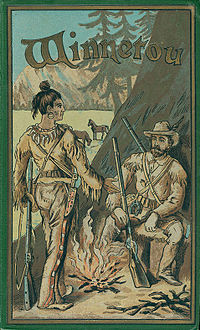
The Winnetou novels are set in the late 1860s, around the time of the building of the first intercontinental railroad. A young German immigrant, Jack (who is later given the moniker of Old Shatterhand due to his strength), is a young "greenhorn" (May overuses this descriptor for a novice frontiersman) who is associated with the railroad. This railroad (ahistorically) passes through the lands of the Apache people, who are not happy with the invasion of their lands. The chief's son, Winnetou, comes into contact with Old Shatterhand and his friend Sam Hawkens. Another white worker, Rattler/Sander, betrays the Apaches, killing their white spiritual guide, Kleki-Petrah. This leads to a series of misunderstandings that include the capture of Old Shatterhand and his company and their eventual rapprochement with Winnetou (now chief) and the Apaches.
The second and third novels relate the crew's adventures across a fanciful version of the South (where a monstrous version of the KKK apparently openly controlled the Reconstruction South), Texas, Mexico (where May claims that no Mexican could engage in a lengthy conversation without first rolling a cigarillo), and back through a vast desert before a final conflict leads to a tragic demise for Winnetou. The fourth novel, written almost twenty years after the others and published the year of May's death (1910), is very different in tone, being more metaphysical and focused on solving the differences between "reds" and "whites" that were outlined in the passage from the first novel that I quoted above.
It would be easy to dismiss these novels as ill-researched and containing references (such as the treatment of the black Bob, often referred to as "nigger Bob," who used the anachronistic "Massa" to the white members of Old Shatterhand's crew) that would be questionable today. The amount of cultural appropriation (to borrow a term often used to discuss how non-native writers take elements of another's civilization to use in a way that is not faithful to how that culture views their culture/history) certainly would leave this century-old series open to some harsh (and well-deserved) attacks. Yet despite being a native American (in a dual sense, at least partially) who could have chosen to dismiss this summarily, there certainly are worthwhile elements to the Winnetou series once the dodgy elements are acknowledged as such. Old Shatterhand's friendship with Winnetou, although there is some literary precedent in James Fennimore Cooper's Leatherstocking novels, is real and genuine and without degrading Winnetou into an "honorary white" status. May, like many Germans of the late 19th century who heard tales of the "Wild West" and who saw the international traveling shows of the time, did have sympathy for the nations that were being subjugated. With the exception of Old Shatterhand and his friends, the American whites were often depicted as being sly and ruthless, if not quite evil and malicious. This stands in marked contrast to most American-penned novels of the West. May's novels contain a spiritual, vaguely Christian element to them. Winnetou and the other Apaches often appear to be analogues for an ideal German nobility, one that is noble in spirit and not necessarily by blood or creed. There are opportunities for the villains to recant of their sins and their failure to abide by the cardinal virtues is juxtaposed to how Winnetou and the Apaches comport themselves. There is a positive message about the need for all humans to act as brothers toward one another, with the final novel serving as the culmination of this theme.
The prose is surprisingly well-written, with the action being fast-paced and yet not being devoid of a deeper meaning. The characters of Old Shatterhand, Winnetou, Sam, Old Death, Old Surehand, and Old Firehand are well-drawn. It is easy to picture youth and adults in Central Europe reading this and dreaming of a West that is not to be tamed but instead to be marveled over. This contrast with the traditional American view is striking and perhaps explains why (as I read in the April 9, 2012 issue of The New Yorker) why so many Germans and other Central Europeans, even today, take such an interest in the native peoples of the United States. Yes, there is much to shake one's head over in these tales, but ultimately, if the reader can be charitable toward May's faults, there are a series of rousing adventures to be found in his writings.


 Posts
Posts


