The OF Blog: Javier Negrete
Showing posts with label Javier Negrete. Show all posts

Friday, December 03, 2010

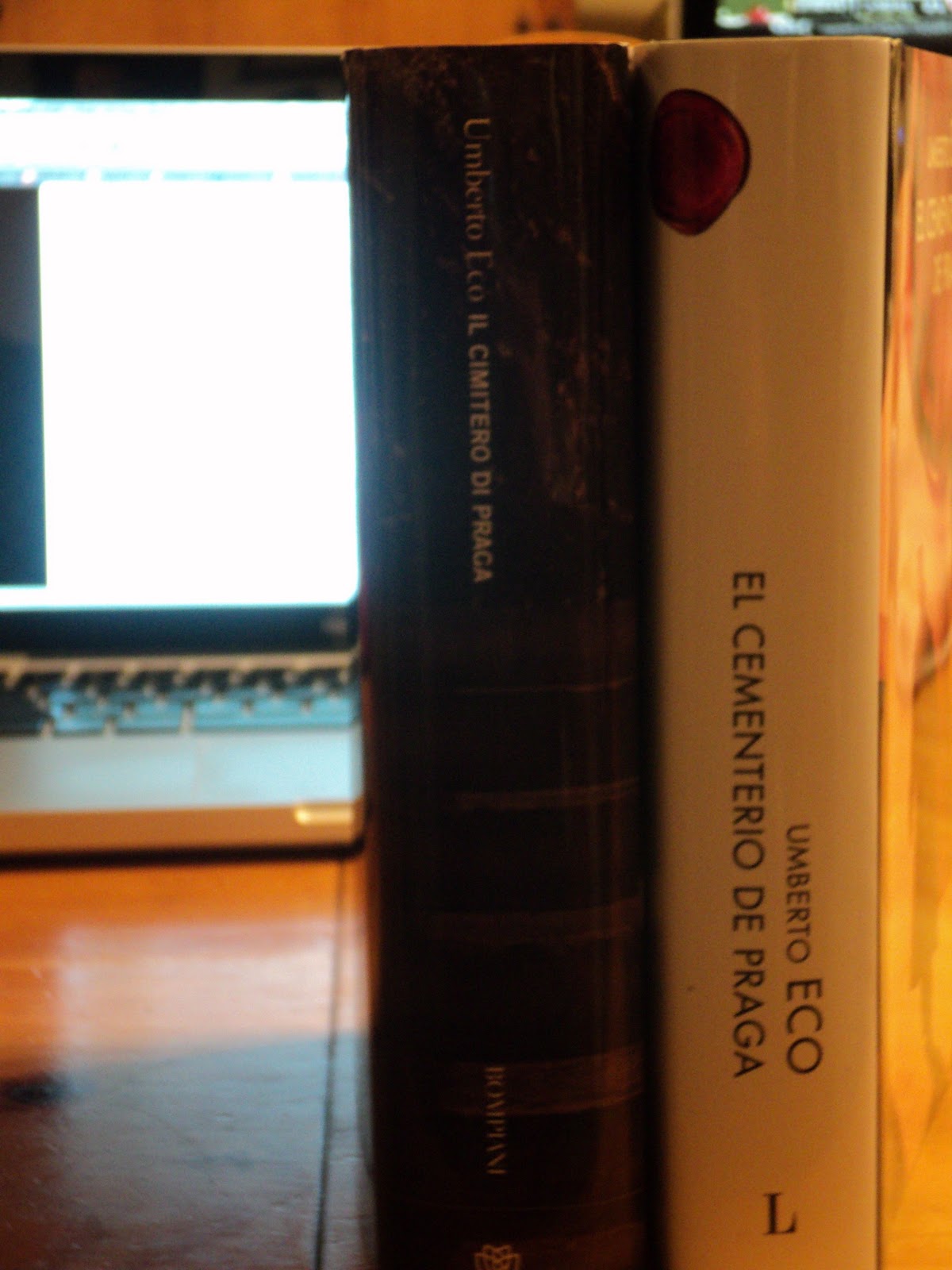
Umberto Eco and Javier Negrete Book Porn


Now that my copy of the Spanish translation of Umberto Eco latest novel has arrived, I thought I'd post three pictures of that and the Italian original side-by-side for readers here to judge which is the better-made (or at least covered) edition.


For those that can read it, the Spanish edition has on its back a description of the book's contents, while the Italian is suitably black (the description there is inside one of the flaps).


Enjoy the MacBook in the background?


In addition to the Eco, I also received my long-awaited copy of Javier Negrete's latest novel, Atlántida, which so far is a fairly good book set in near-future times dealing with a possible landmark discovery of the "real Atlantis."  As with the Eco, I will review it in the near future.

So, besides choosing which Eco edition looks best, what do you make of the Negrete cover?

Wednesday, July 29, 2009

Gotta love reading a popular history that uses a fantasy classic as a reference, no?

I'm currently reading Greek professor/SF/F author Javier Negrete's recently-published popular history on the ancient Greeks, La gran aventura de los griegos, in particular the section about Dionysius and the rise of the Sicilian colony of Syracuse in the fourth century BCE when I came across this line:

Para evitar nuevos asedios, Dionisio hizo fortificar la meseta de las Epípolas, y también reforzó las murallas de la isla de Ortigia, donde se construyó un castillo casi tan inexpugnable como el de Sauron en Mordor. (p. 458)

Certainly makes for an interesting connection, no? If this work were available in translation, I'd recommend this to quite a few, as Negrete does an excellent job relating his interpretations of the information garnered from his years of research in a fashion that is conversational and a pleasure to read. One of the best popular histories I've read in any language in quite some time...even if the author resorts to quoting Tolkien on occasion.

Sunday, October 26, 2008

Javier Negrete, Alejandro Magno y las águilas de Roma


- Ese cabrón tiene que morir.

- No hables así de él. Es Alejandro.

- Es mi esposo. Y tú eres su general y su amigo y te acabas de acostar conmigo. Otra vez.

( "That bastard must die."

"Don't speak so of him. He is Alexander."

"He is my husband. And you are his general and his friend and you just slept with me. Another time.")
So begins Javier Negrete's alt-history, Alejandro Magno y las águilas de Roma (Alexander the Great and the Eagles of Rome). It opens with the mysterious events in Babylon in the year 323 BCE that led to Alexander's death at the age of 32. Negrete posits that instead of contracting a fatal illness, that one of Alexander's wives, Roxana, the daughter of the former Satrap of Bactria, persuaded Perdiccas, cavalry commander of the King's Companions, to help her poison Alexander. But instead of dying, the ill Alexander is saved at the last moment by the near-miraculous appearance of a physician sent by the Delphi oracle, Néstor.

The tricky part about alt-histories is determining just how credible the alt-history (or ucronía in Spanish) is in relation to the events that actually unfolded. In the brief chapter that follows Néstor's intervention, Negrete utilizes a fragment of the official diary of Alexander kept by his secretary, Eumenes of Cardia, to tell briefly what happened in the immediate aftermath of Alexander's recovery from the attempted poisoning. Stretching from 323 BCE to 317 BCE, this journal briefly notes Alexander's division of his army, with one half sent to conquer the Arabian peninsula, while he himself returned to Macedonia in 322 BCE after a twelve year absence to quell an incipient rebellion begun by Antipater:

12 de dío:

«Después de más de once años, el rey ha vuelto a Macedonia. Las noticias de las sospechas de Alejandro han llegado a Antípatro. Él y Casandro han huido a Tesalia con un ejército.»

24 de dío:

«Batalla en Larisa. El ala izquierda de Antípatro se pasa al bando de Alejandro durante el combate. Antípatro se arroja sobre su espada antes de ser capturado. Casandro es apresado.»

25 de dío:

«Casandro es interrogado. Se declara inocente. Muere durante el interrogatorio.»

(October 12:

After more than eleven years, the king has returned to Macedonia. News of Alexander's suspicions [regarding Antipater's ambitions to seize power for himself] have reached Antipater. He and Cassander have fled to Thessaly with an army.

October 24:

Battle in Larisa. Antipater's left wing goes over to Alexander's side during combat. Antipater falls on his sword before being captured. Cassander is seized.

October 25:

Cassander is interrogated. He declares his innocence. He dies during the interrogation.)
Negrete uses this and PoVs from some of Alexander's generals, such as Craterus, as well as completely fictional characters such as Néstor and the Roman tribune Gaius Julius Caesar to tell an intricate story that extrapolates from the real-life Alexander's stated future conquest plans in order to create a vivid and very believable account of what might have transpired had Alexander lived and had turned his armies toward the western Mediterranean. Negrete, himself a former Professor of Greek at the Instituto de Educación Secundaria Gabriel y Galán de Plasencia in Spain, has researched the time period and the social and political conditions very assidiously. He bases his imagined conflict between the Macedonians and the Romans on events that did indeed transpire a generation later in the regions of Calabria and Sicily in southern Italy.

Rome, having just consolidated its power in central, Latin-speaking Italy, has begun to move to assert its dominance over the Greek colonies in Syracuse, Neapolis (Naples), and other parts of southern Italy. These colonies appealed to Alexander for intervention and in 317 BCE, he begins to move his forces into the region. The story the devotes the middle 300 pages of this 526 page novel toward developing the interactions between Alexander and his supporters in the region, as well as between Néstor, Gaius Julius Caesar, and a certain acquaintance Néstor has made. In addition, there is an ominus discovery by the Greek astronomer Euctemon - that the comet Icarus, full of ominous portents, was heading directly towards Earth/Gaea and might strike it.

For the most part, Negrete moves adroitly between these three main subplots. He has a vivid, direct style (of which my translated passages above give only the barest hint) and his characterizations of Alexander, Néstor, Euctemon, and Caesar are well-done, as each is shown in various reflective or emotional states that feel "real," even though some of these characters have no true basis in late fourth century BCE history. Negrete does not rush to the conclusion, but instead develops the scenes set in southern Italy and Rome until they and not the forthcoming, portent-filled battle are the true focus of the novel. In fact, the battle itself comprises only a single chapter and it serves to set the stage for a cliffhanger that ends this novel.

Alejandro Magno y las águilas de Roma won the Premio Ignotus award for Best Novel in September 2008 and based on Negrete's economical use of dialogue and his introspective looks into what would motivate ambitious people such as Alexander and Caesar to strive to attain their dreams, I found myself thinking that this probably was a very worthy winner. If this book were available in English translation, I suspect it would be very popular with ancient history fans, especially those who are interested in more than idle speculation over whether Macedonian phalanxes could overcome the Roman legions. Negrete tells an exciting story, but one that feels "authentic" in its characterizations, its setting, and in how certain events are portrayed and interpreted by the characters. I eagerly await the second half of this story.

Publication Date: May 2007 (Spain). Hardcover.

Publisher: Minotauro.


Wednesday, October 15, 2008

Does this sound like an appealing story blurb to you?


Here is my translation of the back cover of Javier Negrete's 2007 novel, Alejandro Magno y las águilas de Roma:

323 years before Christ. Thirty-three years old, Alexander the Great, the greatest conqueror in history, is destined to die in Babylon. But Nestor, a mysterious doctor who says he has been sent by the Delphi oracle, appears at the precise instant in order to save his life.

Six years after the attempted assassination and after almost two decades of incessant campaigns in Asia and Greece, Alexander has turned his eyes towards the riches of the West. In his path to the dominion of the known world lies only the greatest military power of Italy, a city which like Alexander himself is convinced of the grandness of its destiny: Rome.

It is the moment of deciding who holds supremacy in the Mediterranean, if it is the Macedonian phalanxes or the Roman legions. The augurs and prophets warn of great catastrophes, such as the comet Icarus, which appeared to the same time that Alexander returned to life in Babylon, grows night by night in the firmament. Even worse, the calculations of the extravagant astronomer Euctemon predict that, as in the myth, Icarus will fall to the Earth. And in the meantime, Alexander and Rome are readying themselves to unleash the greatest battle in Antiquity in the vales of Mount Vesuvius.
Let's say this book was available on a local bookshelf and you could read it in your native language. After reading that blurb, as well as others noting the various awards Negrete won in Spain, how disposed would you be in purchasing/reading that book?

Interesting Book Trailer


This is a very cool book trailer I found for Javier Negrete's 2008 novel, Salamina. What I noticed was how the trailer uses Negrete himself (fitting, since he was a Professor of Greek until recently at a university in Spain) to narrate the setting of his novel, which revolves around one of the largest battles in antiquity. The pictoral slides playing in the background add even more power to his words. Very well-done trailer. I guess I'll be plunking down $50+ for this novel in the next month or two...

Sunday, October 05, 2008

2008 Premio Ignotus winners

I've been so busy with the preparations for my brother's wedding (he was married yesterday!) that I forgot to post the results for the 2008 Premio Ignotus Awards, announced the weekend before:

Ganadores de los Premios Ignotus 2007

  • Novela: Alejandro Magno y las Águilas de Roma, de Javier Negrete (Minotauro)

  • Novela Corta: Mundo al revés, de Ángel Padilla (Ediciones Parnaso)

  • Cuento: La apertura Slagar, de Santiago Eximeno y Alfredo Álamo (NGC 3660)

  • Antología: Premio UPC 2006, de VV. AA. (Ediciones B)

  • Libro de Ensayo: Fantástica Televisión, de Alfonso Merelo (Grupo AJEC)

  • Artículo: Hermeneútica relativista, de Gabriella Campbell (Hélice)

  • Ilustración: Cristales de fuego, de Felideus (Ediciones Parnaso)

  • Producción Audiovisual: REC, de Jaume Balagueró y Paco Plaza (film), de

  • Tebeo: La legión del espacio - Alfredo Álamo-Fedde - (Grupo AJEC)

  • Obra Poética: El árbol del dolor, de Gabriella Campbell y Víctor Miguel Gallardo Barragán (Ediciones Efímeras)

  • Revista: Hélice (Asociación Cultural Xatafi)

  • Novela Extranjera: La carretera, de Cormac McCarthy (Mondadori)

  • Cuento Extranjero: El monstruo de las galletas, de Vernor Vinge (Grupo AJEC)

  • Sitio Web: (NGC 3660 ) Pilar Barba

And now, again, this time in English for a couple of these:

Winners of the Ignotus Awards for 2007 works

Best Novel:
Javier Negrete, Alexander the Great and the Eagles of Rome

Foreign Novel: Cormac McCarthy, The Road

Great news on both fronts, as this is a Negrete novel I plan on ordering shortly, not to mention I've read McCarthy's book last year and thought it was stunning in its characterization and prose.

Saturday, August 23, 2008

A few speculations about "scenes"

Still quite busy getting the school year off to a good start (much more relaxed than I was a year ago and the position thus has been much more fun), but I have managed to have a bit more reading time (20-30 minutes a day compared to zero) this week and I finished reading Javier Negrete's UPC-winning novella La luna quieta/The Quiet Moon. Written in 1992, this was his first published fiction I believe and despite the usual little missteps, I found his then-nascent "voice" to be strong, with quite a few twists on dualist concepts regarding madness/sanity, thanatos/eros, and hate/love. Wouldn't be surprised at all if this story is cited in an anthology of the best of Spanish SF twenty or even fifty years from now; it has something of the "feel," without ever stooping into conscious aping of forms and motifs, of some of the more cerebral works of 1960s American SF, especially James Blish.

But the realization that I was comparing Negrete's story to another time and locale made me ponder a bit about the developing SF "scenes" outside the US. I am becoming more aware of some of them through long hours trolling (pronounced more with an "ah" sound in the middle, for those who might think of the other meaning of the word!) various blogs and non-English websites looking for more information about how spec fic is developing outside the Anglo-American (and their immediate satellites) world. This past year, I've become familiar with the Brazilian writers/translators Fábio Fernandes and Jacques Barcia's two Portuguese and English-language blogs and reading in passing their comments on the Brazilian SF scene and their own writing careers has been a true learning experience. Sometime in the next few weeks, I hope to get started on the three anthologies/novella that Fábio sent to me this month, because I am quite curious to see how the themes and story structures will differ and resemble those found in Anglo-American SF anthologies and collections.

Also, there are two Romanian SF writers/translators/publishers whose blogs and e-zines to which I've been introduced this year, Horia-Nicola Ursu and Michael Haulica. Horia has been guest blogging this week at Jeff VanderMeer's blog, with some of the posts dealing with Romanian SF and his roles within it. Very interesting reads, to say the least.

What I noticed from reading both the Brazilian and Romanian blogs is that SF in those countries seems to be more of an "underground" (although growing and developing) movement than it is in either the US or UK, with their more organized means of marketing, distribution, and fan loyalties. Of course, I can't help but to suspect that I'm missing a lot and perhaps those who are more familiar with those two scenes or with other scenes in other countries could enlighten me as to the basics of what's going on, what styles of literature are being favored, hot blogs/e-zines/printing presses, and so on. Consider this an open invitation to cluing me and others here into some interesting "scenes."

Monday, August 18, 2008

No sea disponible in inglés: Javier Negrete, Buscador de sombras


I have heard about Spanish SF/Fantasy/Alt-History writer Javier Negrete for a couple of years now. I have heard about how effortlessly he switches between various subgenres, how well-plotted his stories are, not to mention the depths of his characters and the manner in which his prose flows. However, I resisted importing any of this multiple UPC and Premio Ignotus winner until this month because of the high costs associated with ordering from Spain. If his La luna quieta novella and La espada de fuego novel are at or even above the level of the award-winning 2001 novella Buscador de sombras, then Negrete might have to move toward the head of the line for non-English language authors whose works need to be translated as soon as possible.

I don't have the time/energy for even a quick review, so I'll just provide a book description, first in Spanish and then in English:

Buscador de sombras consolidó a Javier Negrete nueve años después como un autor de referencia en el panorama de la literatura fantástica española.

En esta novela corta, ambientada en un futuro cercano, la humanidad está condenada a no soñar debido al síndrome de Pisan que provoca la muerte lenta de todos aquellos que entran en fase de REM. Un científico español se encuentra en el corredor de la muerte de un cárcel norteamericana por haber subministrado una inyección letal a una mujer.
Hunter of Shadows (or Shadow Hunter might be even more appropriate) strengthened Javier Negrete nine years later (after La luna quieta/The Quiet Moon) as an author of note in the panorama of Spanish literary fantasy.

In this short novel (novella), set in a near future, humanity is condemned not to dream due to Pisan's Syndrome which provokes slow death of all those which enter REM sleep. A Spanish scientist finds himself on Death Row in an American prison for having ministered a lethal injection to his wife.
However, this brief description does not describe the twists in the plot or the thematic elements present in Negrete's story of this apparently deranged Spanish scientist and his search for "dark matter" and the horrific discoveries that follow. Told in both "present" and retrospect PoVs, Buscador de sombras is one of the better-written SF tales that I've read in some time. Clocking in at around 160 large font MMPB pages, it is a story that others would have been tempted to expand into a full novel, but thankfully for the story's cohesion, Negrete resisted the temptation, as the pacing and plot developments are excellent. I cannot help but to think that if translated and published in English that Negrete's SF would find a healthy readership. Perhaps in the near future, as more of his work is translated into other European languages (currently only in Spanish and French, I believe).
 
Add to Technorati Favorites